Power Analysis
TL;DR
Power analysis helps determine sample size for statistical significance.
Transcript
in this lecture we will discuss power analysis which is a very important tool and approach we can use when it comes to inferential statistics but one that's not often employed so we'll start off by talking about what statistical power actually means and then we'll talk about some general purposes for why do we actually do a ... Read More
Key Insights
- Statistical power refers to the probability of detecting a true association or difference in a population, crucial for inferential statistics.
- Power analysis involves four key elements: sample size, effect size, alpha level, and power, with three known elements needed to estimate the fourth.
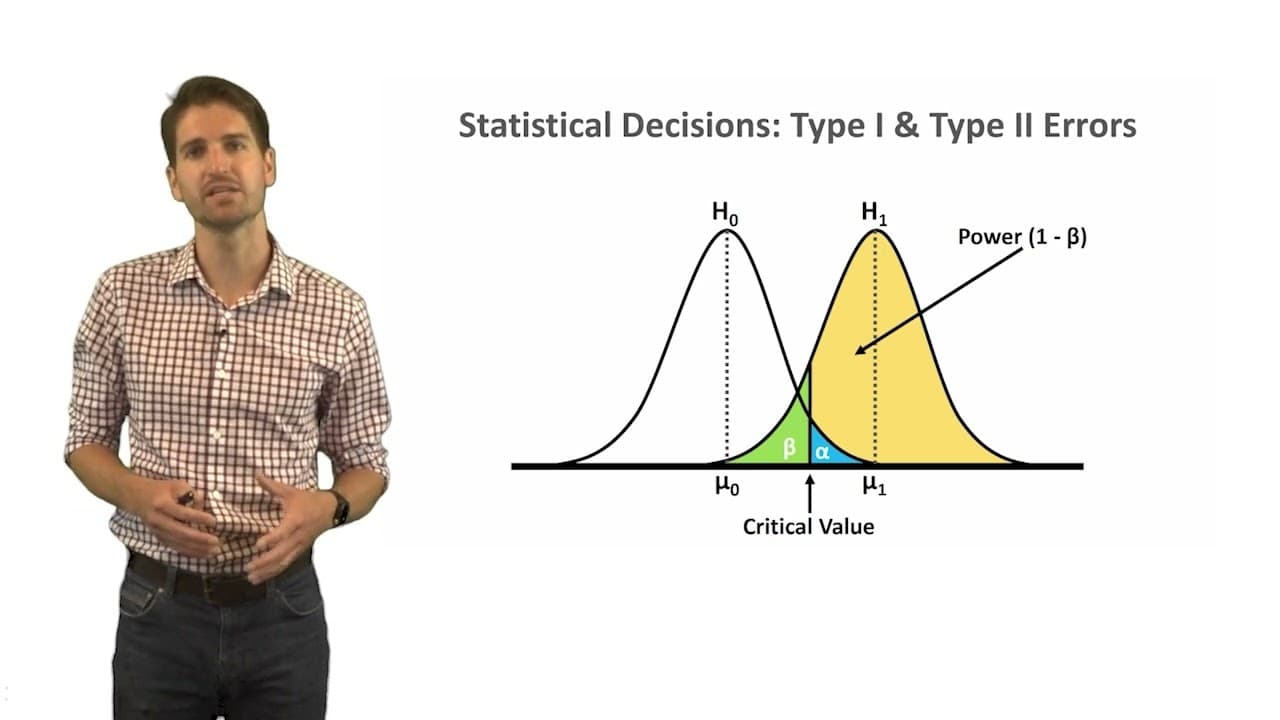
- Type 1 error occurs when a false positive is detected, while Type 2 error occurs when a true effect is missed, both crucial in statistical decision-making.
- Increasing statistical power reduces Type 2 error but may increase Type 1 error, highlighting the trade-off between the two.
- Statistical power is essentially 1 minus Type 2 error, with higher power indicating a greater ability to detect true effects.
- Power analysis can be conducted before data collection to determine necessary sample size or after to assess if the study was adequately powered.
- Tools like G Power, Optimal Design, and R packages such as pwr and Bmem facilitate power analysis for various statistical designs.
- Understanding power analysis helps in designing studies with adequate sample sizes to detect true effects, balancing Type 1 and Type 2 errors.
Install to Summarize YouTube Videos and Get Transcripts
Explore YouTube Video Summarizer or Get YouTube Transcript Extractor
Questions & Answers
Q: What is statistical power?
Statistical power is the probability that a statistical test will correctly reject a false null hypothesis, meaning it will detect a true effect or association in the population. It is a crucial component in inferential statistics, ensuring that researchers can find effects that genuinely exist, thereby reducing the likelihood of Type 2 errors.
Q: What are the key components of a power analysis?
A power analysis involves four key components: sample size (n), effect size, alpha level, and power (1 minus beta). Researchers need to know at least three of these elements to estimate the fourth. These components help determine the study's ability to detect true effects and balance Type 1 and Type 2 errors.
Q: How are Type 1 and Type 2 errors related to power analysis?
Type 1 error occurs when a test incorrectly rejects a true null hypothesis, while Type 2 error happens when a test fails to reject a false null hypothesis. Power analysis aims to minimize these errors by determining the appropriate sample size and effect size, balancing the trade-off between reducing Type 1 and Type 2 errors.
Q: Why is it important to conduct a power analysis before collecting data?
Conducting a power analysis before data collection helps determine the necessary sample size to achieve sufficient statistical power. This ensures that the study is adequately powered to detect true effects, reducing the risk of Type 2 errors and increasing the reliability of the statistical conclusions drawn from the study.
Q: What tools are available for conducting power analysis?
Several tools and platforms are available for conducting power analysis, including G Power, Optimal Design, and R packages such as pwr and Bmem. These tools provide user-friendly interfaces and documentation to help researchers estimate statistical power for various study designs, ensuring accurate and reliable statistical analyses.
Q: What is the controversy surrounding post-hoc power analysis?
Post-hoc power analysis, conducted after data collection, is controversial because it can lead to misleading conclusions about a study's adequacy. Critics argue that it often reflects the observed effect size, which can be biased, rather than providing insight into the study's design or sample size requirements. It's important to interpret post-hoc power analysis results cautiously.
Q: How does effect size influence power analysis?
Effect size is a critical component of power analysis, representing the magnitude of the difference or association being tested. Larger effect sizes generally require smaller sample sizes to achieve the same level of power, while smaller effect sizes necessitate larger samples. Accurately estimating effect size is crucial for determining the appropriate sample size and power for a study.
Q: What is the role of alpha level in power analysis?
The alpha level, often set at 0.05, represents the threshold for statistical significance, influencing the likelihood of a Type 1 error. In power analysis, the alpha level helps determine the sample size needed to achieve adequate power. Lowering the alpha level reduces Type 1 errors but may increase Type 2 errors, highlighting the need for a balanced approach in study design.
Summary & Key Takeaways
-
Power analysis is a critical statistical tool used to determine the likelihood of detecting true associations in a population, focusing on sample size, effect size, alpha, and power. It helps balance Type 1 and Type 2 errors, ensuring accurate statistical conclusions.
-
Type 1 error involves false positives, while Type 2 error involves false negatives. Power analysis aims to minimize these errors by setting appropriate sample sizes and understanding the trade-offs between Type 1 and Type 2 errors.
-
Various tools and methods, such as G Power and Optimal Design, are available to conduct power analysis, aiding researchers in designing studies with sufficient power to detect true effects and make informed statistical decisions.
Read in Other Languages (beta)
Share This Summary 📚
Summarize YouTube Videos and Get Video Transcripts with 1-Click
Try YouTube Summary with ChatGPT & Claude or YouTube Transcript Generator