Using HTML for Language Modeling
TL;DR
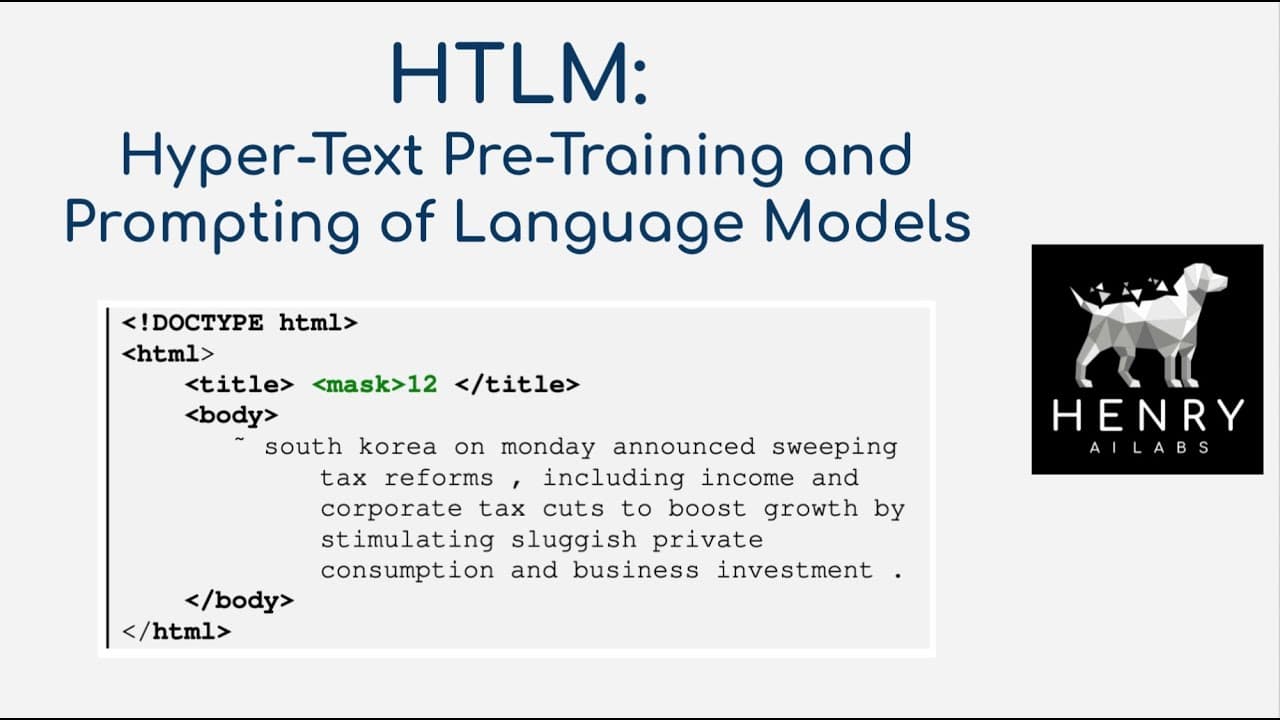
Utilizing HTML data improves the zero-shot summarization capabilities of language models.
Transcript
this video will explain hypertext pre-training and prompting of language models this study is motivated by the textual information contained in the html and also kind of the css and the way that you say decorate a div or a list element of these kind of things with classes and ids and maybe some other kind of javascript source that might be integrat... Read More
Key Insights
- 💁 Maintaining HTML structure during web scraping retains vital information for language model training, enhancing contextual understanding.
- 🥰 State-of-the-art results in zero-shot summarization were achieved by integrating title tags, demonstrating the value of structured prompts.
- 😑 Modifying the pre-training objective to include size hints for masked tokens can significantly improve model performance on various tasks.
- 👻 The concept of auto prompting allows models to generate structured outputs, capitalizing on their familiarity with HTML syntax.
- 🥹 Table-to-text generation demonstrates the benefits of structured data, although competing models still hold the performance edge in certain scenarios.
- 🙇 The research highlights the potential for improved data efficiency in fine-tuning, thanks to effective prompting techniques derived from HTML.
- 💗 The exploration of weak supervision techniques emphasizes the growing trend of utilizing unrefined data sources for training advanced models.
Install to Summarize YouTube Videos and Get Transcripts
Explore YouTube Video Summarizer or Get YouTube Transcript Extractor
Questions & Answers
Q: How does incorporating HTML data enhance language model performance?
Incorporating HTML data retains meaningful structural information from web pages, which traditional data cleaning processes typically discard. This structural information serves as a significant signal during model training, leading to improved performance in tasks like zero-shot summarization by providing context about how content is organized, such as through title and body tags.
Q: What is zero-shot summarization, and how did HTML data play a role?
Zero-shot summarization refers to the model's ability to summarize content without specific training examples. By utilizing HTML title tags during training, the researchers provided contextual prompts that informed the model about essential content, significantly improving summarization accuracy and resulting in state-of-the-art performance compared to previous models like Pegasus.
Q: What modifications to the pre-training objective were tested in this research?
The researchers introduced a new method of signaling the number of masked tokens during training, allowing the model to generate outputs based on a range of potential token counts. This approach modifies the traditional masking techniques to facilitate more nuanced learning during pre-training, enhancing model capabilities for various tasks.
Q: Can you explain the significance of using 'auto prompting' in this research?
Auto prompting involves inserting masked tokens within sequences to encourage the model to generate corresponding HTML code around the text. This method helps to leverage the model's understanding of syntax while delivering structured output, allowing for effective zero-shot transfer in tasks like classification and summarization.
Q: What were the results of using their proposed method for the table-to-text generation task?
While their method showed promise for table-to-text generation, it did not surpass the performance of existing models like GPT-3. However, the integration of HTML table tags as prompts offered improved guidance for generating text from table structures, showcasing the utility of structured data in language processing.
Q: How does the research contribute to the field of natural language processing?
This research pushes forward the understanding of data efficiency in language models by demonstrating that leveraging the intrinsic structural cues available from raw HTML data can lead to more effective model training. Such insights may inform future developments in web scraping and the use of structured web data for machine learning.
Q: What implications does this research have for data efficiency in model fine-tuning?
The findings suggest that using prompt signals derived from HTML can significantly reduce the amount of labeled data required during fine-tuning, ultimately enhancing data efficiency. This means that well-structured prompts derived from noise-laden real-world data can lead to competitive model performance without extensive fine-tuning processes.
Q: How does this work relate to previous studies on weak supervision?
The approach connects to weak supervision paradigms by utilizing web-scraped data, which may not be precisely labeled but still offers valuable training examples. This aligns with the broader trend of leveraging vast, imperfect datasets to train sophisticated machine learning models, emphasizing the potential of using noisy data effectively in NLP tasks.
Summary & Key Takeaways
-
The study demonstrates that incorporating HTML elements during language model pre-training provides substantial advantages over traditional methods, particularly in zero-shot summarization tasks.
-
By maintaining web page structure, including title and body tags, and leveraging them during training, the researchers achieved state-of-the-art results.
-
Innovations in training methods, such as size hints for masked tokens and auto prompting, aided in enhancing the model's performance across various natural language processing benchmarks.
Read in Other Languages (beta)
Share This Summary 📚
Summarize YouTube Videos and Get Video Transcripts with 1-Click
Try YouTube Summary with ChatGPT & Claude or YouTube Transcript Generator
Explore More Summaries from Connor Shorten 📚
Summarize YouTube Videos and Get Video Transcripts with 1-Click
Try YouTube Summary with ChatGPT & Claude or YouTube Transcript Generator