Safety guideline for COVID-19: Vaccination and immunity
TL;DR
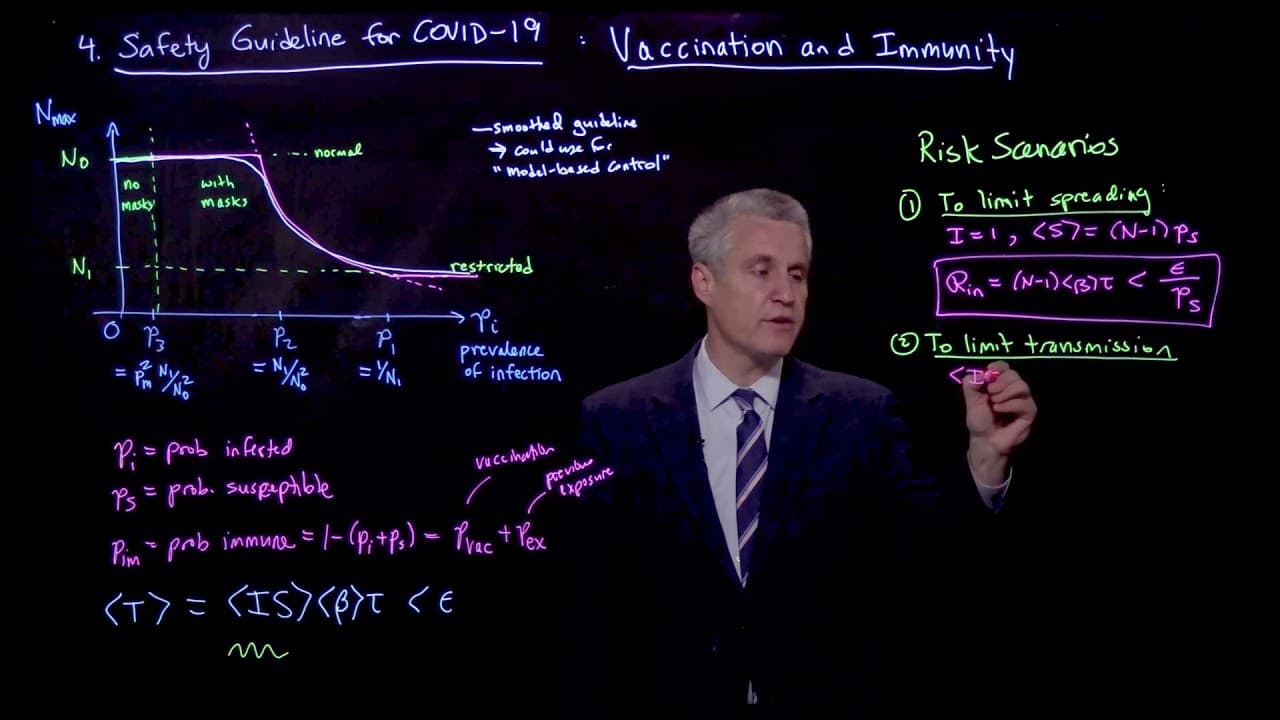
Adjustments to guidelines for reopening schools and businesses should take into account the prevalence of infection and immunity acquired through vaccination or previous exposure.
Transcript
PROFESSOR: So we've just discussed the strategies for reopening schools and businesses based on the indoor safety guideline for the given space and the various physical parameters in that space. And the new concept we added was a prevalence of infection. So we would know, on average, how many infected people we might expect in a room. And as that n... Read More
Key Insights
- ❓ Adjusting guidelines should consider both the prevalence of infection and the probability of susceptibility.
- ☺️ Vaccination and acquired immunity can reduce the number of susceptible individuals in the population, allowing for higher occupancy and relaxed restrictions.
- ✳️ Different risk scenarios, such as limiting spread, transmission, or personal risk, provide guidance for decision-making.
Install to Summarize YouTube Videos and Get Transcripts
Explore YouTube Video Summarizer or Get YouTube Transcript Extractor
Questions & Answers
Q: What factors should be considered when adjusting guidelines for reopening?
When adjusting guidelines, it is important to consider the prevalence of infection, acquired immunity through vaccination or previous exposure, and the number of susceptible individuals in the population.
Q: How does considering immunity affect the guidelines for occupancy and restrictions?
As immunity increases in the population, the number of susceptible individuals decreases, allowing for higher occupancy rates and potentially relaxed restrictions.
Q: What risk scenarios can guide decisions on reopening?
The risk scenarios include limiting the spread of the disease, limiting transmission, and limiting personal risk. Each scenario considers different factors such as the expected number of infected-susceptible pairs in a room.
Q: How does the probability of susceptibility affect decision-making?
The probability of susceptibility, influenced by vaccination and previous exposure, can modify guidelines by decreasing the expected number of infected-susceptible pairs and making it safer to relax restrictions.
Summary & Key Takeaways
-
Adjusting guidelines for reopening involves considering the prevalence of infection and immunity acquired through vaccination or previous exposure.
-
The three categories to consider are: infected individuals, susceptible individuals, and immune individuals.
-
Different risk scenarios can guide decisions on occupancy, ventilation, and other restrictions based on the expected number of infected-susceptible pairs in a room.
Read in Other Languages (beta)
Share This Summary 📚
Summarize YouTube Videos and Get Video Transcripts with 1-Click
Try YouTube Summary with ChatGPT & Claude or YouTube Transcript Generator
Explore More Summaries from MIT OpenCourseWare 📚



Summarize YouTube Videos and Get Video Transcripts with 1-Click
Try YouTube Summary with ChatGPT & Claude or YouTube Transcript Generator