Radar pulses | Coherent & Non-Coherent Integration | Radar Systems | Lec-10
TL;DR
This video explains radar pulse integration, vital for distinguishing multiple targets effectively.
Transcript
hi everyone in this video I am going to explain about integration of radar pulses it is one of the important topics in the radar systems in the Pulsar radar when we are transmitting a signal like this when we are transmitting a signal Source signal is nothing but a main lobe when we are transmitting a main lobe like this targets may be located at d... Read More
Key Insights
- 💗 Integration of radar pulses is crucial for accurately identifying multiple targets and improving radar system performance.
- 💁 Coherent integration retains phase information, which is critical for enhancing echo signal quality and measuring target distance accurately.
- 🥳 Non-coherent integration, while simpler to implement, sacrifices phase data and yields a less efficient signal-to-noise ratio.
- 😁 The video emphasizes the relationship between the number of hits per scan and the radar beam width, explaining how these factors influence target detection capability.
- 🥳 Understanding signal-to-noise ratios and integration efficiency aids in optimizing radar systems to increase detection reliability.
- 🧡 The maximum radar range depends on updated equations that account for different factors including noise and integration efficiency.
- 🕵️ The video illustrates the impact of radar integration on overall performance in detecting targets at various distances and in diverse environments.
Install to Summarize YouTube Videos and Get Transcripts
Explore YouTube Video Summarizer or Get YouTube Transcript Extractor
Questions & Answers
Q: What is the primary purpose of integrating radar pulses in radar systems?
The primary purpose of integrating radar pulses is to enhance the accuracy of target detection by summing multiple echo pulses returned from different targets. This integration helps distinguish which echo belongs to which target, leading to improved surveillance and greater reliability in radar operations.
Q: Can you explain the difference between coherent and non-coherent integration?
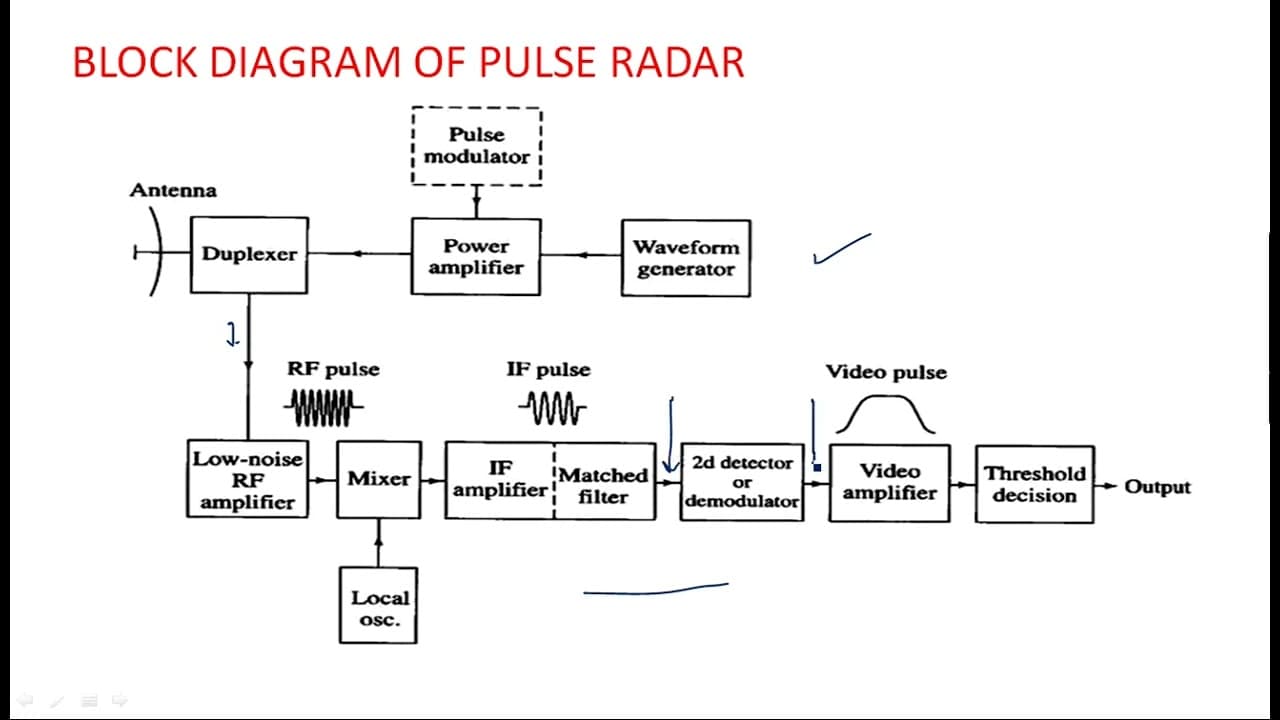
Coherent integration occurs before the second detector, preserving phase information, which makes it more efficient in improving signal-to-noise ratios in radar detection. Non-coherent integration happens after the detection, losing phase information, which results in a less effective integration process and a lower signal-to-noise ratio.
Q: How does the signal-to-noise ratio (SNR) change with the number of pulses integrated?
The overall signal-to-noise ratio improves proportionally with the number of pulses received; specifically, for n pulses, the total SNR becomes n times that of an individual pulse in coherent integration. However, in non-coherent integration, the overall SNR is less efficient than the expected n-fold increase due to the loss of phase information.
Q: What is integration efficiency in the context of radar systems?
Integration efficiency refers to the ratio of the signal-to-noise ratio of an individual pulse to the n times integrated SNR. It quantifies how effectively the radar system captures and integrates multiple pulses and influences the overall performance in terms of noise reduction when multiple targets are evaluated.
Summary & Key Takeaways
-
The video discusses the significance of pulse integration in radar systems, particularly in differentiating between multiple echo pulses from various targets.
-
It covers two types of integration techniques: coherent integration (pre-detection) which preserves phase information and non-coherent integration (post-detection) which does not.
-
The video also details how the signal-to-noise ratio is affected by the number of pulses received, emphasizing the computation of maximum radar range based on integration.
Read in Other Languages (beta)
Share This Summary 📚
Summarize YouTube Videos and Get Video Transcripts with 1-Click
Try YouTube Summary with ChatGPT & Claude or YouTube Transcript Generator