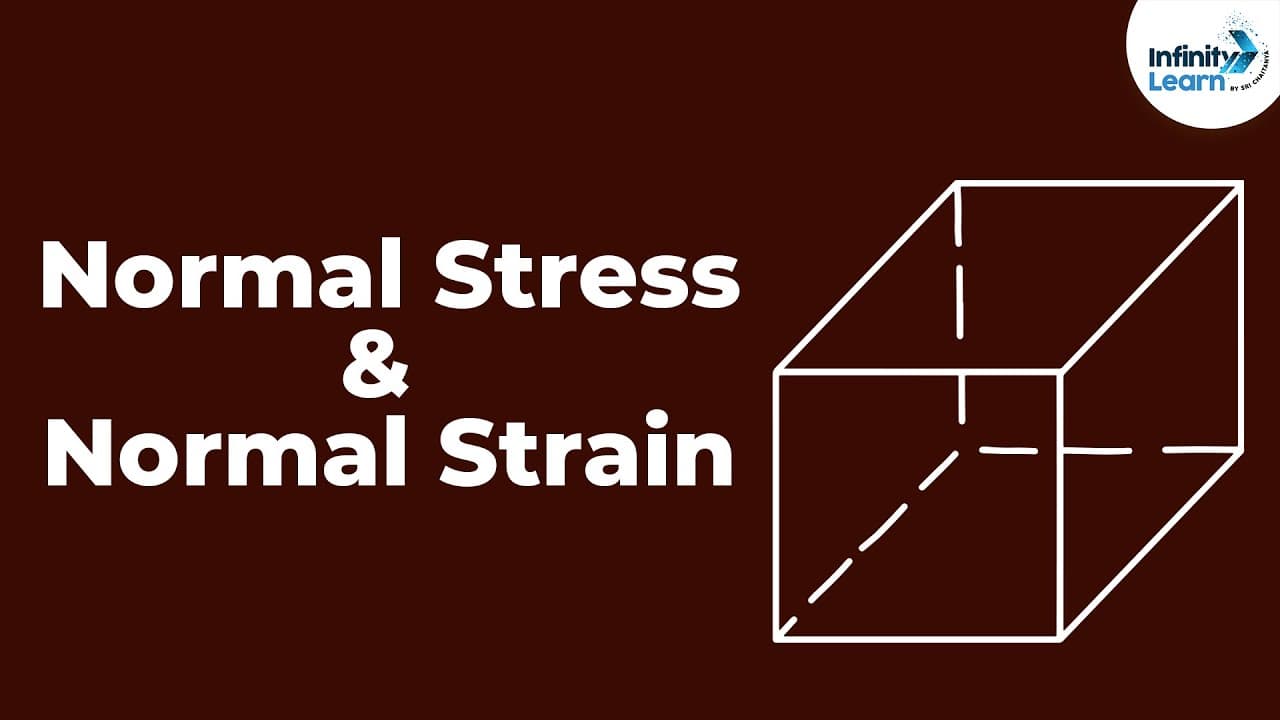
Normal Stress and Normal Strain | Mechanical Properties of Solids | Don't Memorise
TL;DR
This video explains the concepts of normal stress and strain, including their types: tensile and compressive stress, and tensile and compressive strain.
Transcript
in the last video we saw what stress and strain meant in this video let's try understanding their types both stress and strain have two basic types normal and shear so there's normal stress and shear stress and normal strain and shear strain will be discussing the former type in this video that's the normal type let's begin with normal stress when ... Read More
Key Insights
- 😵 Normal stress refers to the force acting perpendicular to a cross-sectional area and has two types: tensile stress (stretching force) and compressive stress (compressing force).
- 🥳 Normal strain is the ratio of change in length to the original length and also has two types: tensile strain (increase in length) and compressive strain (decrease in length).
- ❓ Tensile stress occurs when a force stretches an object, while compressive stress happens when a force compresses an object.
- ❓ Understanding normal stress and strain is crucial in analyzing the behavior and deformation of objects under different forces.
- 🦾 The concepts of normal stress and strain can be applied to various materials and structures to study their mechanical properties.
- 🍰 Compressive stress and strain can cause objects to become shorter, while tensile stress and strain can cause objects to elongate.
- 💁 The restoring force in normal stress is perpendicular to the applied force, aiming to bring the deformed body back to its original form.
Install to Summarize YouTube Videos and Get Transcripts
Explore YouTube Video Summarizer or Get YouTube Transcript Extractor
Questions & Answers
Q: What is normal stress in physics?
Normal stress refers to the force acting perpendicular to a cross-sectional area. It can be further classified into tensile stress (stretching force) and compressive stress (compressing force).
Q: How is normal strain calculated?
Normal strain is calculated by taking the ratio of the change in length (represented by Delta L) to the original length (L). Tensile strain measures the increase in length, while compressive strain measures the decrease in length.
Q: What is the difference between tensile stress and compressive stress?
Tensile stress occurs when a force stretches an object, resulting in an increase in length. Compressive stress, on the other hand, happens when a force compresses an object, causing a decrease in length.
Q: Are normal stress and strain only applicable to beams?
No, normal stress and strain can be observed in various objects and materials. Beams are just one example used to illustrate the concepts in this video.
Summary & Key Takeaways
-
Normal stress is the force acting perpendicular to a cross-sectional area, with two sub-categories: tensile stress (stretching force) and compressive stress (compressing force).
-
Strain is the ratio of change in length to the original length, and normal strain also has two types: tensile strain (increase in length) and compressive strain (decrease in length).
-
The video introduces the basic concepts of normal stress and strain, and hints at the upcoming discussion of shear stress and strain.
Read in Other Languages (beta)
Share This Summary 📚
Summarize YouTube Videos and Get Video Transcripts with 1-Click
Try YouTube Summary with ChatGPT & Claude or YouTube Transcript Generator
Explore More Summaries from Infinity Learn NEET 📚

Summarize YouTube Videos and Get Video Transcripts with 1-Click
Try YouTube Summary with ChatGPT & Claude or YouTube Transcript Generator