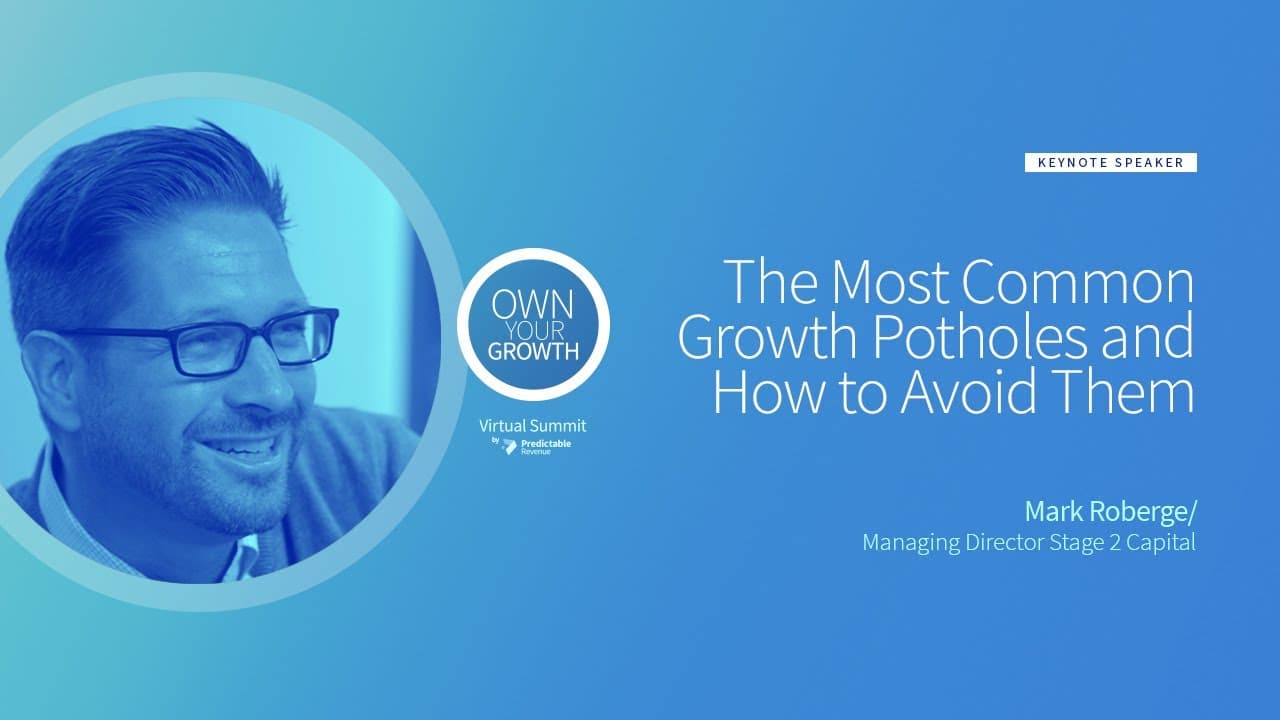
The Most Common Growth Potholes and How to Avoid Them with Mark Roberge
TL;DR
Mark Roberge, managing director at Stage 2 Capital and former SVP of Global Sales and CRO at HubSpot, shares insights on scaling a business, including the importance of product-market fit, sustainable moats, predictable revenue acquisition, salesperson to manager transitions, unit economics, and segment expansion.
Transcript
with uh just a quick intro of mark um okay we've got i don't know paragraphs and paragraphs i think we could your your wikipedia page must be like four feet long i mean i think one of the best books in sales sales sales development in terms of i loved how you broke it down um strategically or not strategically it was almost formulaic like that you ... Read More
Key Insights
- 🚲 Increasing prices without a sustainable moat can lead to longer sales cycles, increased friction with buyers, and vulnerability to disruption by competitors.
- ⚾ Promoting top reps to managers based solely on sales performance does not guarantee success in a managerial role, as skill sets and responsibilities differ.
- 🚄 Prioritizing predictable revenue acquisition without establishing product-market fit can lead to higher failure rates and missed growth opportunities.
- ✈️ Aligning compensation plans with lifetime value encourages salespeople to focus on customer retention and satisfaction rather than short-term bookings.
- ⚖️ Scaling sales teams too quickly can result in inadequate support, training, and onboarding, leading to high turnover and reduced performance.
- 💼 Measuring leading indicators for retention and unit economics provides insights into customer success, financial viability, and long-term business growth.
- ⚖️ Businesses should focus on developing a sustainable moat, such as network effects, brand recognition, and economies of scale, to establish a competitive advantage.
Install to Summarize YouTube Videos and Get Transcripts
Explore YouTube Video Summarizer or Get YouTube Transcript Extractor
Questions & Answers
Q: What are some of the major problems Mark Roberge has observed in growth, and how can businesses overcome them?
Mark Roberge highlights several key problems in growth, including increasing prices without a sustainable moat, promoting top reps to managers, prioritizing predictable revenue acquisition over product-market fit, focusing on bookings rather than lifetime value, and scaling sales teams too quickly. To overcome these challenges, businesses should ensure they have a sustainable moat before increasing prices, promote salespeople to managers based on their potential to develop into effective leaders rather than solely on their sales performance, prioritize product-market fit before pursuing predictable revenue, align compensation with lifetime value to incentivize customer retention, and scale sales teams at a manageable pace while maintaining a focus on onboarding and support.
Q: How can businesses ensure they have a sustainable moat?
According to Mark Roberge, a sustainable moat requires more than just having unique product features. It involves building barriers to entry that competitors cannot easily replicate or overcome. Some examples of sustainable moats are network effects, brand recognition, economies of scale, switching costs, distribution channels, and regulatory requirements. Businesses should focus on developing a moat that sets them apart from competitors and makes it difficult for new entrants to disrupt their market position.
Q: What is the importance of measuring customer retention and unit economics?
Measuring customer retention and unit economics is crucial because they provide insights into the long-term success and profitability of a business. By setting leading indicators for retention, such as specific customer actions that indicate product-market fit, businesses can track their progress in achieving sustainable customer value creation. Monitoring unit economics, such as cost per lead, conversion rates, and average sale price, allows businesses to track the financial viability of their customer acquisition and retention efforts. This data helps optimize sales and marketing strategies to achieve positive unit economics and long-term business growth.
Q: What is the recommended approach for scaling sales teams?
Mark Roberge advises against scaling sales teams too quickly. Instead, businesses should hire salespeople at a manageable pace and focus on onboarding, support, and measurement of success. By gradually increasing the size of the sales team while maintaining a stringent hiring process and clear expectations, businesses can ensure that new hires are aligned with company goals and customer needs. Additionally, providing ongoing training, mentorship, and growth opportunities for salespeople helps create a more sustainable and effective sales force.
Key Insights:
- Increasing prices without a sustainable moat can lead to longer sales cycles, increased friction with buyers, and vulnerability to disruption by competitors.
- Promoting top reps to managers based solely on sales performance does not guarantee success in a managerial role, as skill sets and responsibilities differ.
- Prioritizing predictable revenue acquisition without establishing product-market fit can lead to higher failure rates and missed growth opportunities.
- Aligning compensation plans with lifetime value encourages salespeople to focus on customer retention and satisfaction rather than short-term bookings.
- Scaling sales teams too quickly can result in inadequate support, training, and onboarding, leading to high turnover and reduced performance.
- Measuring leading indicators for retention and unit economics provides insights into customer success, financial viability, and long-term business growth.
- Businesses should focus on developing a sustainable moat, such as network effects, brand recognition, and economies of scale, to establish a competitive advantage.
- Segmenting the business and optimizing growth strategies for each segment allows for successful scaling while maintaining focus on core business and experimentation in new areas.
Summary & Key Takeaways
-
Mark Roberge discusses the major problems he sees in growth, including increasing price without a sustainable moat, promoting top reps to managers, prioritizing predictable revenue acquisition over product-market fit, focusing on bookings instead of lifetime value, and scaling sales teams too quickly.
-
He emphasizes the need for a well-defined strategy and measurement of success, embracing inconsistency in order to explore new growth avenues, and the importance of segmenting the business to optimize growth in different areas.
-
Roberge also highlights the significance of extracting leading indicators for retention and unit economics, as well as the need to balance scaling the core with learning and experimentation in new segments.
Read in Other Languages (beta)
Share This Summary 📚
Summarize YouTube Videos and Get Video Transcripts with 1-Click
Try YouTube Summary with ChatGPT & Claude or YouTube Transcript Generator