How to read a Research Paper ? Made easy for young researchers.
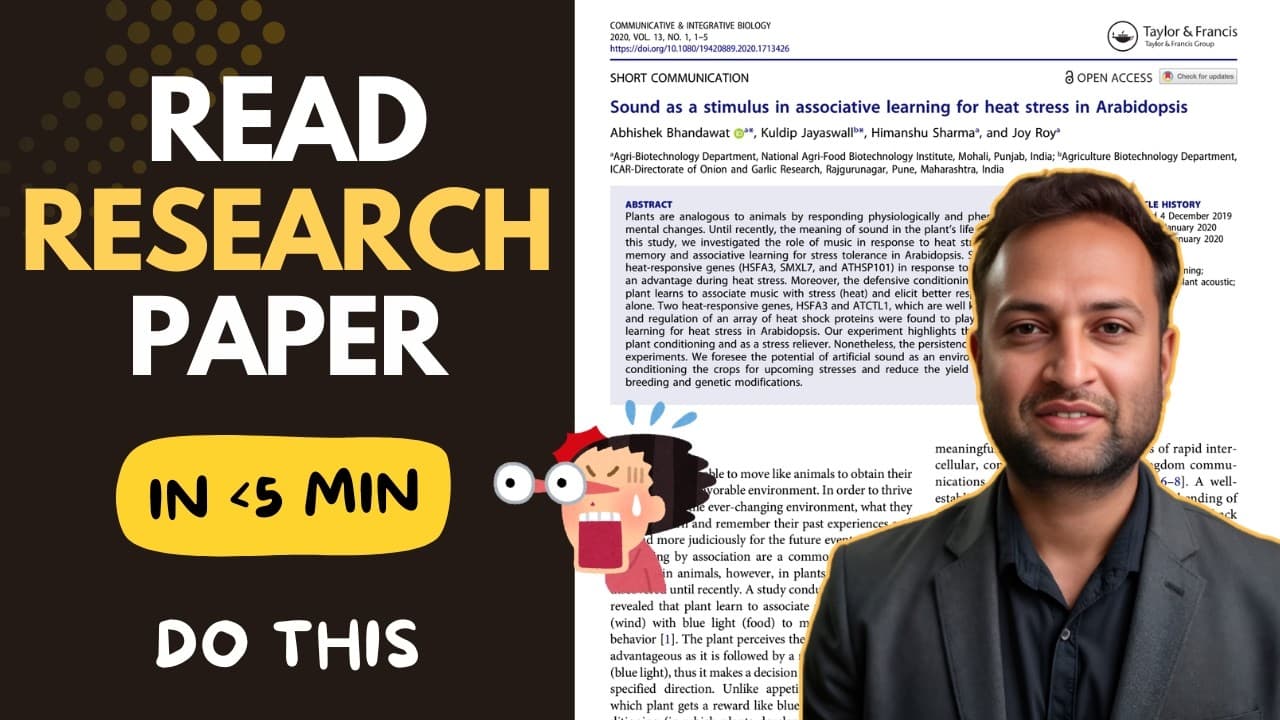
TL;DR
Learn how to effectively read and understand research papers.
Transcript
hello and welcome back to explore bio. if you are a college student who is planning to enter the dimension of research, you must know what research papers are? and how to read them to make best use of them? I myself is a researcher and i too read and write research papers. therefore, i know the importance of reading them and want to help ... Read More
Key Insights
- Research papers are essential for gaining knowledge, writing theses, and staying updated with scientific advancements. They provide authentic information and inspire new research.
- Efficient searching of research papers involves being specific with keywords and using reliable databases like Google Scholar and PubMed.
- A research paper consists of several components including the title, authors, abstract, introduction, methods, results, discussion, conclusion, references, and acknowledgments.
- The abstract and conclusion sections provide a quick overview of the paper's core findings and can determine if the paper is worth reading in detail.
- Reading the introduction helps build background knowledge and identify previous relevant research, often cited within the paper.
- Understanding the results and discussion sections is crucial for interpreting the study's outcomes and comparing them with existing research.
- Using tools like highlighters and taking notes can aid in comprehending complex papers, and seeking help from peers or professors can be beneficial.
- Developing a habit of reading research papers improves scientific vocabulary and research aptitude, enhancing overall academic performance.
Install to Summarize YouTube Videos and Get Transcripts
Explore YouTube Video Summarizer or Get YouTube Transcript Extractor
Questions & Answers
Q: What is the importance of reading research papers?
Reading research papers is crucial for staying informed about the latest scientific advancements, improving scientific vocabulary, and developing research aptitude. They provide authentic information reviewed by experts and serve as a basis for new research, helping students complete assignments and write theses effectively.
Q: How can one efficiently search for research papers?
Efficient searching involves being specific with keywords related to the research topic and using reliable databases like Google Scholar, PubMed, and Science Direct. Narrowing down the search by using filters such as publication year, journal name, or author can yield more relevant results.
Q: What are the key components of a research paper?
A research paper typically includes the journal name, publication date, title, authors, abstract, introduction, methods, results, discussion, conclusion, references, acknowledgments, and author contributions. Each section serves a specific purpose in conveying the research findings and context.
Q: What is the recommended sequence for reading a research paper?
The recommended sequence is to first check the title, then read the abstract and conclusion to get an overview. If the paper seems relevant, proceed to the introduction for background information, followed by the results and discussion sections for detailed insights. Finally, review the methods if necessary.
Q: How can one improve their understanding of complex research papers?
To understand complex papers, slow down the reading pace, take notes, and use highlighters to mark important points. Reading in a quiet environment and seeking help from peers, professors, or scientists can also be beneficial. Over time, practice will improve reading speed and comprehension.
Q: What role do the abstract and conclusion play in a research paper?
The abstract provides a brief overview of the paper, summarizing the research's motive and key outcomes, while the conclusion summarizes the research findings in a few sentences. Together, they help readers quickly determine the paper's relevance and whether it warrants further reading.
Q: Why is it important to use peer-reviewed and indexed journals for research papers?
Peer-reviewed and indexed journals ensure that the research papers published are of high quality and have undergone rigorous review by experts in the field. This guarantees the authenticity and reliability of the information, making them a trustworthy source for academic research.
Q: How can reading research papers benefit students academically?
Reading research papers enhances students' knowledge, keeps them updated with scientific advancements, and improves their scientific vocabulary. It develops critical thinking and research skills, aiding in the completion of assignments and theses, and ultimately contributes to better academic performance.
Summary & Key Takeaways
-
This video provides a comprehensive guide for students entering research on how to read research papers effectively. It covers the structure of research papers, benefits of reading them, and strategies for efficient searching and reading.
-
Research papers are critical for academic growth, offering authentic information and inspiring new research. Efficient searching involves using specific keywords and reliable databases like Google Scholar and PubMed.
-
The video emphasizes the importance of understanding the structure of research papers, including the title, abstract, introduction, methods, results, and discussion, to efficiently extract valuable information.
Read in Other Languages (beta)
Share This Summary 📚
Summarize YouTube Videos and Get Video Transcripts with 1-Click
Try YouTube Summary with ChatGPT & Claude or YouTube Transcript Generator