Demultiplexer | Introduction | 1x4, 1x8 | STLD | Lec-99
TL;DR
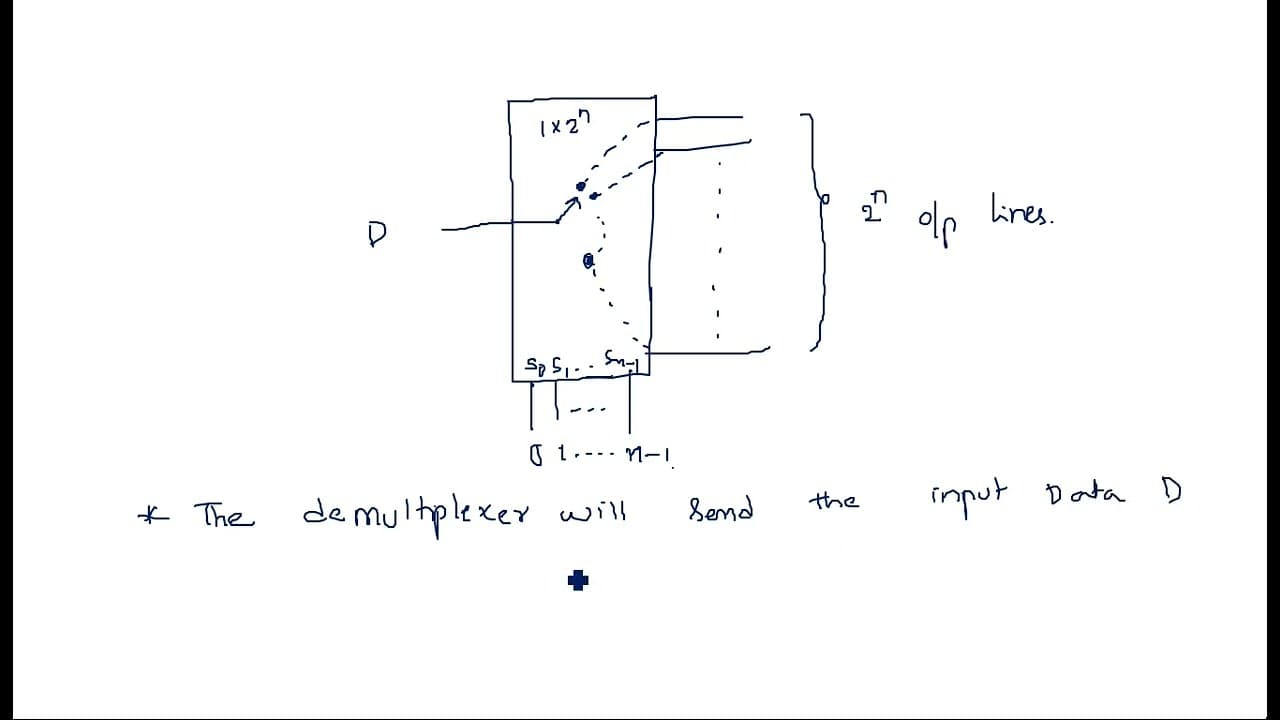
D multiplexers reverse the function of multiplexers, distributing one input to multiple outputs based on selection lines.
Transcript
hi everyone in this video I'm going to tell you about d multiplexor d multiplexor is the opposite action of the multiplexer it is the reverse operation we can say reverse operation of a multiplexor reverse operation of a multiplexor already we have what a multiplexor is multiplexor has 2 power n number of inputs and one output with n number of sele... Read More
Key Insights
- 🈯 A D multiplexer serves as a data distributor, contrasting with the multiplexer’s role as a data selector.
- 🫥 Selection lines in D multiplexers dictate which output line receives the input data, allowing for flexibility in circuits.
- #️⃣ The number of outputs in a D multiplexer follows the equation 2^n, where n represents the number of selection lines.
- 🎨 Proper understanding of D multiplexers is essential for designing efficient digital circuits and systems.
- 👷 The construction of truth tables is a systematic approach to determining output behavior based on input and selection states.
- 🎨 D multiplexers can be categorized by their sizes, which influence their application in various electronic designs.
- 🎨 Understanding the Boolean expressions related to D multiplexers facilitates better circuit design and troubleshooting.
Install to Summarize YouTube Videos and Get Transcripts
Explore YouTube Video Summarizer or Get YouTube Transcript Extractor
Questions & Answers
Q: What is the primary function of a D multiplexer?
The primary function of a D multiplexer is to take a single input and route it to one of several outputs. The chosen output is determined by the selection lines. For example, in a 1x4 D multiplexer, the incoming data can be routed to one of four outputs based on two selection lines that represent different combinations.
Q: How are D multiplexers different from multiplexers?
D multiplexers perform the reverse operation of multiplexers. While multiplexers select one output from multiple inputs, D multiplexers take one input and distribute it to several outputs. Essentially, multiplexers are also known as data selectors, whereas D multiplexers are referred to as data distributors.
Q: Can you explain how selection lines work in a 1x4 D multiplexer?
In a 1x4 D multiplexer, there are two selection lines - S0 and S1. Based on the values of these lines (0 or 1), the single input is routed to one of four outputs. For example, if S0 and S1 are both 0, the input is sent to output W0. If S0 is 1 and S1 is 0, it goes to W1, and so forth, creating a binary selection.
Q: What is a truth table, and how does it apply to a D multiplexer?
A truth table is a mathematical table used to show the output of a system for every possible input combination. In a D multiplexer, the truth table outlines how the input is distributed across outputs based on the selection lines, detailing which output receives the input for each combination of selection line states.
Q: What is the importance of correctly determining the size of a D multiplexer?
Correctly determining the size of a D multiplexer is crucial because it dictates the number of outputs available and the number of selection lines required. As the size increases (e.g., from 1x2 to 1x8), the complexity of the input-output routing increases, impacting circuit design and function in digital systems.
Q: How do you construct a truth table for a 1x8 D multiplexer?
To construct a truth table for a 1x8 D multiplexer, you need three selection lines (S0, S1, S2) and one input data line. For each combination of selection line states (000 to 111), assign the data input to the corresponding output line while setting the other output lines to zero, thus showing which output is activated based on the selection.
Summary & Key Takeaways
-
A D multiplexer (demux) functions by taking one input and distributing it to 2^n outputs, controlled by n selection lines.
-
Unlike multiplexers, which select one output from multiple inputs, D multiplexers are also called data distributors due to their role in directing data.
-
The size of a D multiplexer can vary based on the number of selection lines, resulting in configurations like 1x2, 1x4, or 1x8 demultiplexers.
Read in Other Languages (beta)
Share This Summary 📚
Summarize YouTube Videos and Get Video Transcripts with 1-Click
Try YouTube Summary with ChatGPT & Claude or YouTube Transcript Generator