Translation of Functions (part1): shift the graph in 4 directions
TL;DR
Learn how to shift a function's graph up, down, left, and right, and write equations to represent these shifts.
Transcript
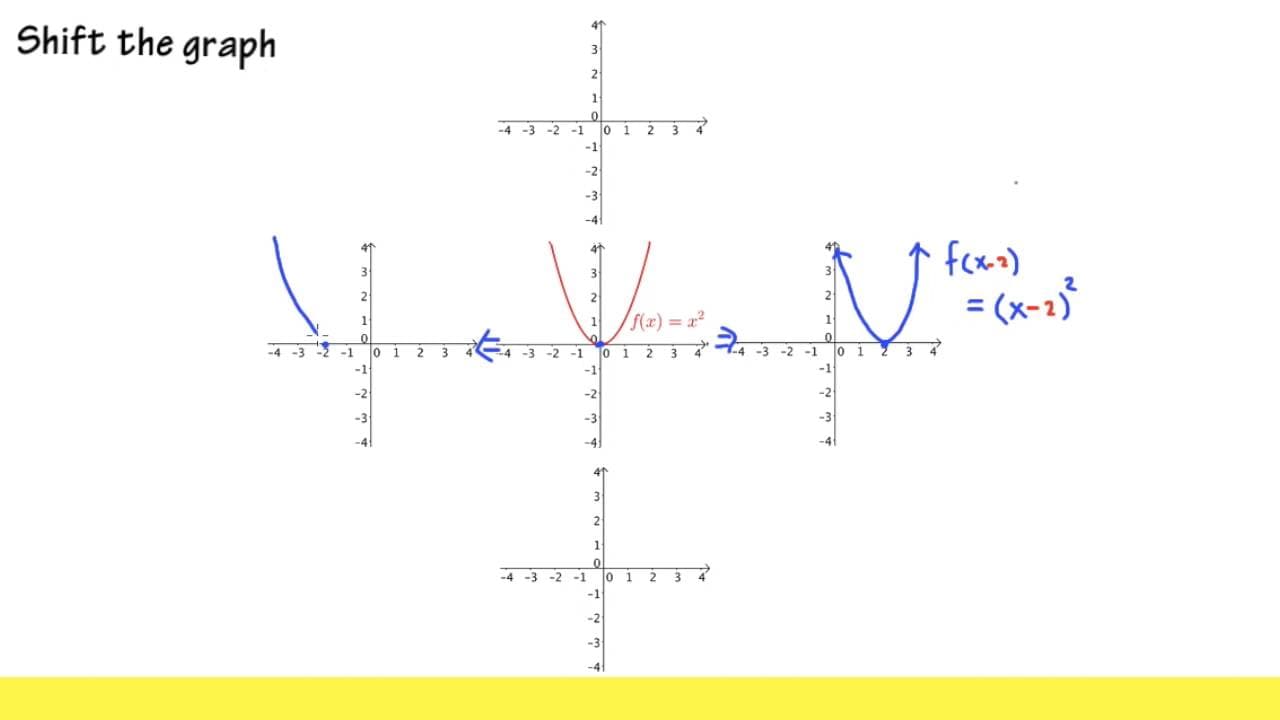
let's talk about how we can shift the graph of a function to the up direction to the right direction and the down Direction and of course the left directions so here we are given this function f ofx equal to x² we are going to see and pay attention to how to write an equation that will associate this shift Ms these four directions okay so notice th... Read More
Key Insights
- ❣️ The x-value in the equation determines the horizontal position of the vertex, while the y-value determines the vertical position.
- 👉 Shifting the graph to the right involves adding a number to the x-value in the equation.
- 👈 The opposite is true for shifting to the left, as this requires subtracting a number from the x-value.
- #️⃣ Adding a number to the y-value in the equation shifts the graph upward, while subtracting a number shifts it downward.
- 🗯️ The equation for shifting right is written as f(x - 2), while shifting left is f(x + 2).
- 📈 Shifting the graph upward is represented by f(x) + 1, and downward by f(x) - 1.
- 😑 Understanding these equations allows for accurately translating graph shifts into mathematical expressions.
Install to Summarize YouTube Videos and Get Transcripts
Explore YouTube Video Summarizer or Get YouTube Transcript Extractor
Questions & Answers
Q: How can the graph of a function be shifted to the right?
To shift the graph of a function to the right, add the desired number directly to the x-value in the equation. For example, if you want to shift the graph two units to the right, make the x-value in the equation x - 2.
Q: What is the equation for shifting a function to the left?
To shift the graph of a function to the left, subtract the desired number from the x-value in the equation. For instance, if you want to shift the graph two units to the left, the equation would be x + 2.
Q: How can the graph of a function be shifted upward?
To shift the graph of a function upward, add the desired number to the y-value in the equation. This means placing the number after the x-value squared. For example, if you want to shift the graph one unit upward, the equation would be x^2 + 1.
Q: What is the equation for shifting a function downward?
To shift the graph of a function downward, subtract the desired number from the y-value in the equation. Similarly to shifting upward, place the number after the x-value squared. For instance, if you want to shift the graph one unit downward, the equation would be x^2 - 1.
Summary & Key Takeaways
-
A function with a vertex at (0,0) can be shifted right by adding a number directly to the x-value in the equation.
-
To shift the graph left, subtract the desired number from the x-value in the equation.
-
Shifting the graph up involves adding a number to the y-value in the equation, while shifting down requires subtracting a number from the y-value.
Read in Other Languages (beta)
Share This Summary 📚
Summarize YouTube Videos and Get Video Transcripts with 1-Click
Try YouTube Summary with ChatGPT & Claude or YouTube Transcript Generator
Explore More Summaries from blackpenredpen 📚
Summarize YouTube Videos and Get Video Transcripts with 1-Click
Try YouTube Summary with ChatGPT & Claude or YouTube Transcript Generator