2.2.3 Using Voltages Digitally
TL;DR
The content explains the concept of digital abstraction and how voltages can be used to represent binary values in digital systems.
Transcript
To solve our engineering problem, we will introduce what we’ll call the “digital abstraction”. The key insight is to use the continuous world of voltages to represent some small, finite set of values, in our case, the two binary values, “0” and “1”. Keep in mind that the world is not inherently digital, we would simply like to engineer it to behave... Read More
Key Insights
- 🌍 The concept of digital abstraction utilizes the continuous world of voltages to represent binary values, "0" and "1", in digital systems.
- 🎨 Naturally digital phenomena exist, but the focus in this course is on using continuous physical phenomenon to create digital designs.
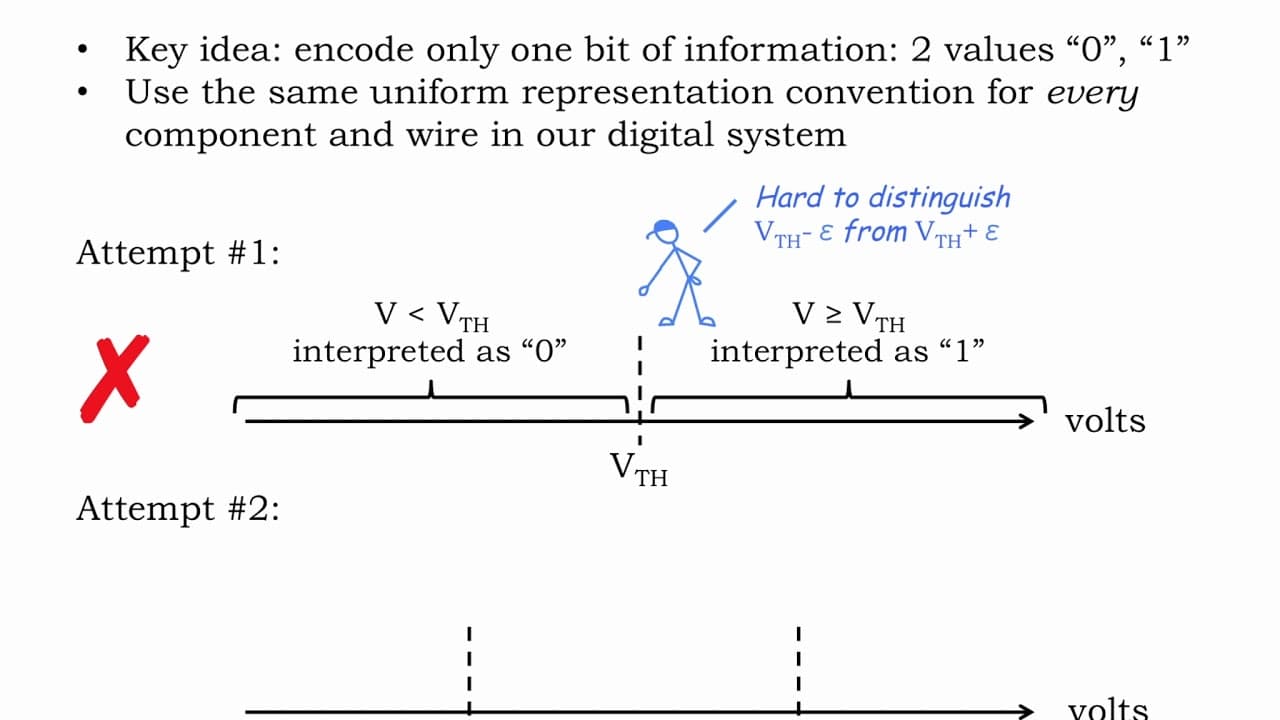
- 🧡 Dividing the range of voltages into two sub-ranges is not practical due to difficulties in accurately interpreting voltages near the threshold.
- ⚡ Introducing two threshold voltages allows the creation of a voltage-to-bit converter, but the forbidden zone exists where interpretation is not required.
Install to Summarize YouTube Videos and Get Transcripts
Explore YouTube Video Summarizer or Get YouTube Transcript Extractor
Questions & Answers
Q: What is the key insight behind using continuous world voltages to represent digital values?
The key insight is to engineer the physical world to behave digitally by using continuous voltages to represent a small set of values, such as binary "0" and "1". This allows us to create digital systems using continuous physical phenomenon.
Q: What are some naturally digital physical phenomena?
Some physical phenomena, such as the spin of an electron, are naturally digital and exhibit quantized values. However, in this course, the focus is on using classical continuous phenomenon, like voltages, to create digital systems.
Q: Why is dividing the range of voltages into two sub-ranges not a practical approach?
While dividing the range of voltages into two sub-ranges to represent "0" and "1" seems mathematically simple, it becomes challenging to interpret voltages near the threshold accurately. Implementing precision components and controlled environments for accurate interpretation is costly and impractical.
Q: How does the introduction of two threshold voltages improve voltage representation?
Introducing two threshold voltages, V_L and V_H, allows the creation of a voltage-to-bit converter. Voltages below V_L are interpreted as "0" and voltages above V_H are interpreted as "1". The range between V_L and V_H is the "forbidden zone" where the digital system's behavior is not defined.
Summary & Key Takeaways
-
The content introduces the concept of "digital abstraction" as a way to engineer physical phenomena to behave digitally.
-
It discusses the use of voltages to represent binary values, "0" and "1", in digital systems.
-
The content explores the challenges and limitations of voltage representation and proposes different approaches to solve them.
Read in Other Languages (beta)
Share This Summary 📚
Summarize YouTube Videos and Get Video Transcripts with 1-Click
Try YouTube Summary with ChatGPT & Claude or YouTube Transcript Generator
Explore More Summaries from MIT OpenCourseWare 📚



Summarize YouTube Videos and Get Video Transcripts with 1-Click
Try YouTube Summary with ChatGPT & Claude or YouTube Transcript Generator