Making a GPU into a Data Access Engine
TL;DR
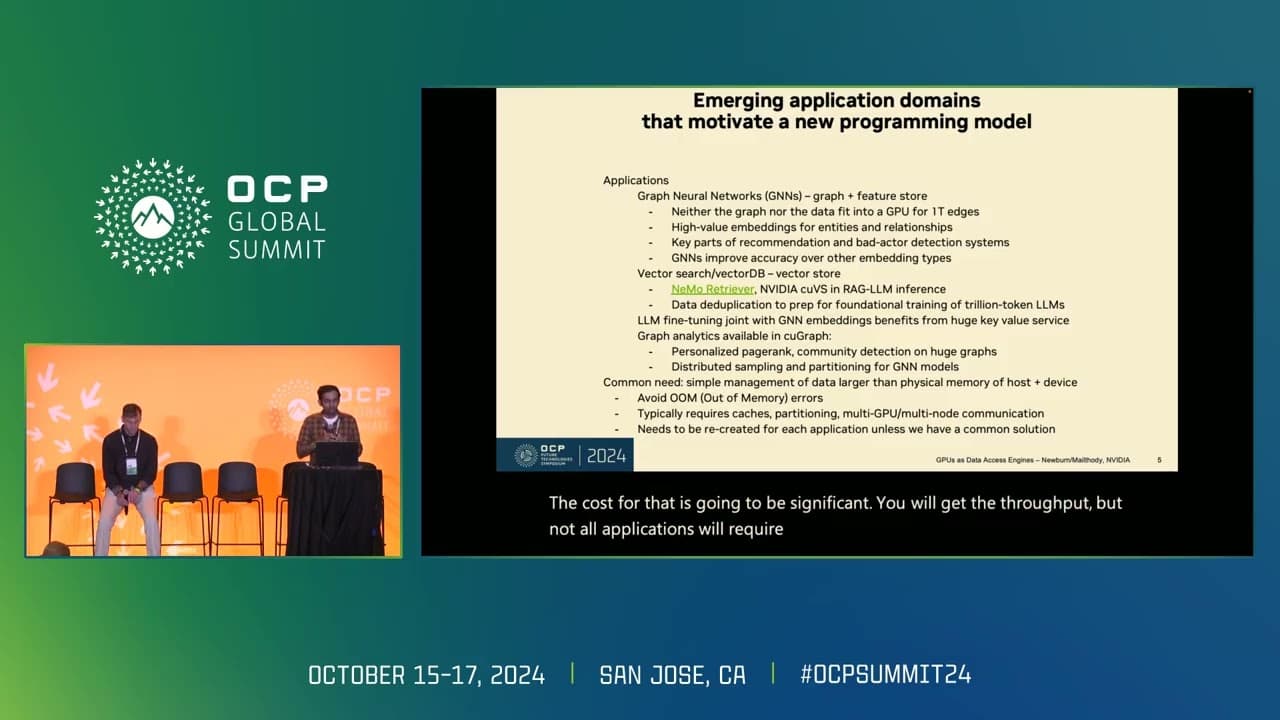
NVIDIA proposes a new model for GPU-initiated storage IO to handle massive data.
Transcript
who needs slides anyway okay great I'd like to introduce my colleague uh Vicor method uh he's a senior researcher in EnV uh research like to uh just Express an excitement uh to be alive at this time how often is it when you get to be engaged with something where things are really changing and you have a chance to help uh sketch out ... Read More
Key Insights
- The rapid evolution of AI workloads necessitates a shift in how GPUs are utilized, transforming them from mere compute engines to data access engines.
- Generative AI workloads require GPUs to manage vast datasets that exceed memory capacity, demanding innovative storage solutions.
- NVIDIA introduces SCADA, a new programming model for GPU-initiated storage IO, aiming to handle large-scale data efficiently.
- The SCADA model focuses on reducing total cost of ownership by leveraging NVMe storage over traditional memory solutions like HBM.
- Applications such as graph analytics and vector search benefit from SCADA by reducing memory management complexity and enhancing data access efficiency.
- The SCADA system proposes a serverless architecture, allowing applications to access data without managing how it is sharded or distributed.
- NVIDIA emphasizes the importance of optimizing IOPS per dollar and tail latency in next-generation storage solutions.
- The initiative seeks community collaboration to develop open-source frameworks and gather requirements for future storage technologies.
Install to Summarize YouTube Videos and Get Transcripts
Explore YouTube Video Summarizer or Get YouTube Transcript Extractor
Questions & Answers
Q: What is the main purpose of redefining GPUs as data access engines?
The main purpose of redefining GPUs as data access engines is to address the evolving needs of modern AI workloads, which require handling vast datasets that exceed traditional memory capacities. By transforming GPUs into data access engines, NVIDIA aims to manage data more efficiently, ensuring that large-scale applications can access and process data without being bottlenecked by memory limitations.
Q: How does the SCADA model benefit applications like graph analytics?
The SCADA model benefits applications like graph analytics by reducing the complexity of memory management and enhancing data access efficiency. It allows these applications to handle large datasets without the need for complex tasks such as graph partitioning or pre-processing. SCADA provides a serverless architecture, enabling applications to focus on computation while the system manages data access seamlessly, improving overall performance and scalability.
Q: Why does NVIDIA emphasize using NVMe storage over traditional memory solutions?
NVIDIA emphasizes using NVMe storage over traditional memory solutions like HBM due to its cost-effectiveness and ability to handle large-scale data efficiently. NVMe offers a better total cost of ownership by providing high-speed data access at a lower cost compared to traditional memory. This approach allows NVIDIA to address the growing data demands of modern AI workloads while optimizing performance and reducing expenses.
Q: What role does the community play in NVIDIA's initiative for next-generation storage?
The community plays a crucial role in NVIDIA's initiative for next-generation storage by collaborating to define requirements and develop open-source frameworks. NVIDIA invites community participation to gather insights on application needs, optimize storage solutions, and innovate new technologies. This collaborative effort aims to create a robust ecosystem that addresses the challenges of AI storage access, ensuring that future solutions meet the demands of evolving workloads.
Q: What challenges do modern AI workloads present that necessitate a new storage model?
Modern AI workloads present challenges such as handling vast datasets that exceed available memory capacities and require fine-grained access from numerous GPU threads. These workloads demand efficient data access and management solutions that traditional storage models cannot provide. As a result, a new storage model, like SCADA, is necessary to address these challenges, ensuring that applications can operate at scale without being constrained by memory limitations.
Q: How does SCADA aim to optimize IOPS per dollar and tail latency?
SCADA aims to optimize IOPS per dollar and tail latency by focusing on efficient data access and management strategies that leverage NVMe storage. By reducing the total cost of ownership and enhancing data throughput, SCADA ensures that applications can access data swiftly and cost-effectively. The model also emphasizes improving power efficiency and reducing latency, allowing applications to perform optimally even when handling large-scale data operations.
Q: What are some potential applications that can benefit from SCADA's capabilities?
Potential applications that can benefit from SCADA's capabilities include graph analytics, vector search, LLM inference, and other data-intensive workloads. These applications require efficient data access and management to handle large datasets and benefit from SCADA's ability to reduce memory management complexity and enhance data throughput. By leveraging SCADA, these applications can operate at scale, achieving improved performance and cost-efficiency.
Q: What is the significance of a serverless architecture in SCADA's design?
The significance of a serverless architecture in SCADA's design lies in its ability to simplify data access for applications. By removing the need for applications to manage data sharding or distribution, SCADA allows them to focus on computation while the system handles data access seamlessly. This architecture enhances scalability and flexibility, enabling applications to operate efficiently without being constrained by traditional data management complexities.
Summary & Key Takeaways
-
NVIDIA is redefining GPUs as data access engines to meet the demands of modern AI workloads, which require handling vast datasets that exceed traditional memory capacities. They propose a new programming model, SCADA, for GPU-initiated storage IO to efficiently manage these large-scale data challenges.
-
SCADA focuses on leveraging NVMe storage to reduce total cost of ownership, offering a more efficient alternative to traditional memory solutions. This model simplifies data management for applications like graph analytics, enabling them to operate at scale without complex memory management tasks.
-
NVIDIA calls for community collaboration to define the future of AI storage access, emphasizing the need for optimizing IOPS per dollar and tail latency. They aim to create an ecosystem of vendors to establish requirements for next-generation storage solutions, inviting participation in this transformative initiative.
Read in Other Languages (beta)
Share This Summary 📚
Summarize YouTube Videos and Get Video Transcripts with 1-Click
Try YouTube Summary with ChatGPT & Claude or YouTube Transcript Generator
Explore More Summaries from Open Compute Project 📚
Summarize YouTube Videos and Get Video Transcripts with 1-Click
Try YouTube Summary with ChatGPT & Claude or YouTube Transcript Generator