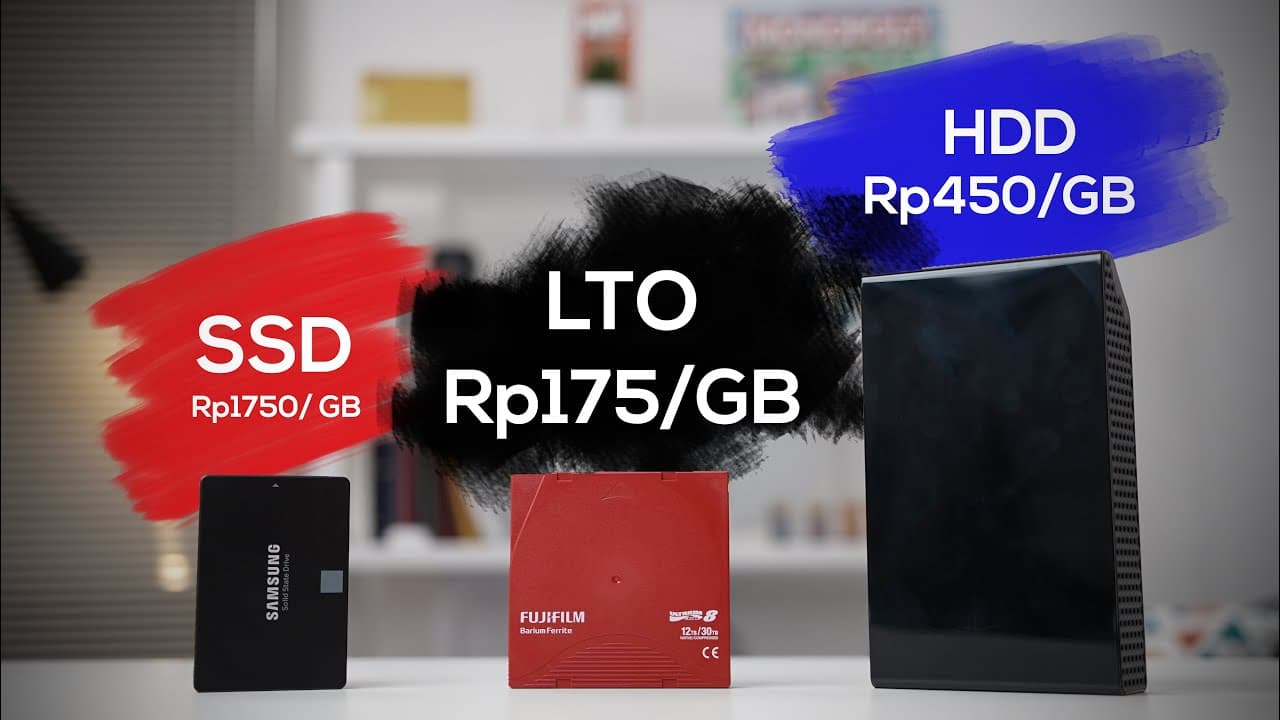
LTO - Storage data yang JAUH LEBIH MURAH dari harddisk.
TL;DR
Fujifilm LTO offers cheaper and durable data storage than HDDs.
Transcript
Hello everyone, I am David. And this is Fujifilm LTO. The media for storing digital data which is cheaper than hard disk, and of course also SSD. Perhaps 90% of you may have heard about LTO for the first time. It is reasonable. Typically the most commonly hardware device heard of, or seen or used to store the data, is hard disk. I store all the old... Read More
Key Insights
- Fujifilm LTO provides a cost-effective data storage solution, being cheaper per gigabyte than both HDDs and SSDs.
- LTO uses Barium Ferrite tape for data storage, offering a more advanced material compared to older tape technologies.
- The technology is primarily beneficial for large institutions with significant data storage needs, such as banks and cloud companies.
- LTO offers long-term durability, with a lifespan exceeding 50 years, compared to HDDs which last around 10 years.
- Despite its advantages, LTO's high initial cost for a special reader makes it less accessible for individual consumers.
- LTO's linear data access system makes it slower than HDDs for frequent data retrieval but suitable for large-scale backups.
- The technology's compact form factor saves storage space compared to traditional hard disks.
- Future LTO generations promise even larger capacities, with LTO 12 expected to store up to 192TB of data.
Install to Summarize YouTube Videos and Get Transcripts
Explore YouTube Video Summarizer or Get YouTube Transcript Extractor
Questions & Answers
Q: What makes Fujifilm LTO a cost-effective data storage solution?
Fujifilm LTO is cost-effective because it offers a lower price per gigabyte compared to traditional hard disks and SSDs. With a price of IDR 175 per GB for LTO 8, it is significantly cheaper than HDDs, which cost around IDR 450 per GB. This makes LTO an attractive option for organizations with large data storage needs.
Q: Why is LTO not widely used by individual consumers?
LTO is not widely used by individual consumers primarily due to the high initial cost of the specialized reader required to access the data stored on the tapes. The reader, such as the Unitex LT80H, costs at least $6,000, which is prohibitive for most individuals who do not have extensive data storage needs.
Q: What are the benefits of using LTO for large institutions?
Large institutions benefit from using LTO due to its cost savings, durability, and space efficiency. LTO can store data for over 50 years, reducing the need for frequent replacements. Its compact form factor saves physical storage space, and its lower cost per gigabyte significantly reduces operational expenses for organizations with vast data storage requirements.
Q: How does LTO's data access system differ from HDDs?
LTO's data access system is linear, meaning it reads and writes data sequentially along the tape. This differs from HDDs, which allow random access to data. As a result, LTO is slower for frequent data retrieval but is suitable for large-scale backups where data is not accessed frequently.
Q: What advancements does LTO technology offer over traditional tape storage?
LTO technology uses Barium Ferrite tape, which is more advanced than the materials used in traditional tape storage. This modern tape technology provides greater durability and data integrity, making it suitable for long-term data storage. Additionally, LTO offers compression capabilities, further increasing its storage efficiency.
Q: Why is LTO considered suitable for long-term data storage?
LTO is suitable for long-term data storage due to its durability, with a lifespan exceeding 50 years. This longevity ensures that data remains intact and accessible over extended periods, reducing the need for frequent data migration or replacement, which can be costly and time-consuming.
Q: What are the future prospects for LTO technology?
Future prospects for LTO technology are promising, with upcoming generations like LTO 12 expected to offer significantly larger storage capacities, up to 192TB. This expansion in capacity will further enhance LTO's appeal for organizations with massive data storage needs, providing a scalable and cost-effective solution for future data archiving.
Q: How does LTO compare to HDDs in terms of data transfer speed?
While LTO is slower than HDDs for frequent data retrieval due to its linear access system, it offers competitive data transfer speeds for large-scale backups. Although LTO takes longer to locate data, its maximum transfer speed can surpass that of HDDs, making it efficient for copying large volumes of data once the data location is reached.
Summary & Key Takeaways
-
Fujifilm LTO is a cost-effective data storage medium that is cheaper per gigabyte than traditional hard disks and SSDs. It uses advanced Barium Ferrite tape technology, making it suitable for large institutions with extensive data storage needs, offering long-term durability and space-saving benefits.
-
While LTO provides significant cost savings and durability, its high initial cost for specialized readers makes it less accessible for individual consumers. The technology is ideal for large-scale backups rather than frequent data retrieval due to its linear access system, which is slower than HDDs.
-
Future iterations of LTO promise even greater storage capacities, with LTO 12 expected to hold up to 192TB. This makes LTO an attractive option for companies needing to archive large amounts of data securely and cost-effectively over the long term.
Read in Other Languages (beta)
Share This Summary 📚
Summarize YouTube Videos and Get Video Transcripts with 1-Click
Try YouTube Summary with ChatGPT & Claude or YouTube Transcript Generator
Explore More Summaries from GadgetIn 📚




Summarize YouTube Videos and Get Video Transcripts with 1-Click
Try YouTube Summary with ChatGPT & Claude or YouTube Transcript Generator