BERT Explained!
TL;DR
This video explains BERT’s bi-directional language modeling and pre-training methods for improved natural language processing.
Transcript
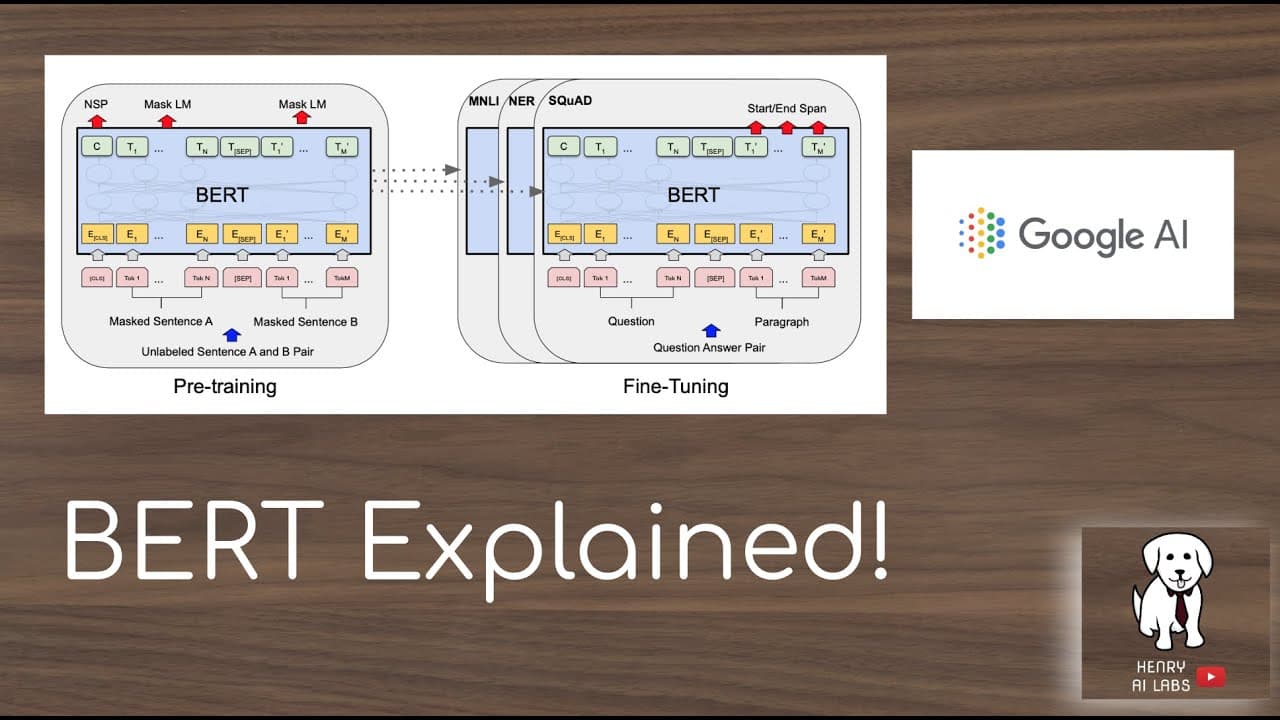
this video will explain the burr transformer model natural language processing has seen huge improvements by pre-training these models on massive unlabeled text datasets like Wikipedia and then fine-tuning them for tasks like question answering this form of pre-training by constructing a supervised learning task on unlabeled data is described as se... Read More
Key Insights
- 😃 BERT's innovation lies in its bi-directional context creation, vastly improving understanding over previous models that processed text in a unidirectional manner.
- 🤳 Self-supervised learning enables cost-effective training by using massive unlabeled datasets, mitigating the need for extensive manual labeling.
- 🔠 The input structure for BERT fine-tuning is specifically crafted to facilitate tasks like answer extraction from context or predicting the relationship between sentences.
- 👻 BERT's architecture allows for dynamic handling of varying input lengths through efficient tensor dimension management in self-attention layers.
- 😷 The unique masking strategy in BERT, where 80% of the time a token is masked, plays an essential role in its superior language understanding capabilities.
- 😑 During fine-tuning, BERT’s adaptability helps it extend its pre-trained knowledge to specific tasks such as the Stanford Question Answering Dataset (SQuAD).
- 🤕 BERT's attention heads enable the model to learn multiple perspectives on language simultaneously, making it robust for diverse linguistic challenges.
Install to Summarize YouTube Videos and Get Transcripts
Explore YouTube Video Summarizer or Get YouTube Transcript Extractor
Questions & Answers
Q: What is the primary innovation of the BERT model in natural language processing?
The primary innovation of the BERT model is its bi-directional language modeling approach, enabling the model to predict masked tokens based on context from both directions. Unlike traditional left-to-right models, BERT captures a broader context for each word, significantly enhancing its understanding in various NLP tasks.
Q: How does BERT use self-supervised learning for pre-training?
BERT employs self-supervised learning by masking a portion of the input tokens and training the model to predict these masked tokens. This approach leverages large unlabeled text corpora, allowing BERT to learn contextual representations without needing labeled data, which is essential for fine-tuning on tasks like question answering.
Q: Can BERT effectively handle variable-length input sequences?
Yes, BERT can manage variable-length input sequences due to its design that utilizes dot product attention. Unlike models with fixed input dimensions, BERT's architecture allows it to accept different sequence lengths and adjust the attention mechanism accordingly, providing flexibility when processing diverse textual inputs.
Q: What role does the masked language modeling task play in BERT's training?
The masked language modeling task is crucial for BERT's training as it trains the model to predict masked words in a sentence. This process helps BERT learn the relationships and context among words effectively, improving its capability to understand sentences more holistically, which is vital for downstream tasks like sentiment analysis and named entity recognition.
Summary & Key Takeaways
-
The BERT transformer model utilizes a self-supervised learning approach by masking intermediate tokens to predict context, enabling bi-directional comprehension of text.
-
Pre-training on vast datasets like Wikipedia and fine-tuning on specific tasks such as question answering and natural language inference leads to improved performance in NLP applications.
-
The unique architecture of BERT allows for flexible input shapes and efficient attention mechanisms, enhancing its applicability for various sentence-level tasks.
Read in Other Languages (beta)
Share This Summary 📚
Summarize YouTube Videos and Get Video Transcripts with 1-Click
Try YouTube Summary with ChatGPT & Claude or YouTube Transcript Generator
Explore More Summaries from Connor Shorten 📚
Summarize YouTube Videos and Get Video Transcripts with 1-Click
Try YouTube Summary with ChatGPT & Claude or YouTube Transcript Generator