Lecture 7: Sigma Algebras
TL;DR
The lecture discusses the concept of outer measure and introduces the definition of Lebesgue measurable sets as a way to approximate the measure of subsets of real numbers.
Transcript
[SQUEAKING] [RUSTLING] [CLICKING] CASEY RODRIGUEZ: So let's get started. Last time, at the end of the last lecture, we introduced outer measure. So we first discussed what we wanted to measure, the properties of kind of a notion measure of subsets of to satisfy. We wanted it to, first off, be defined for all subsets. We then wanted the measure of a... Read More
Key Insights
- #️⃣ Outer measure can be used to approximate the measure of subsets of real numbers.
- 😫 Lebesgue measurable sets are subsets of real numbers that satisfy specific conditions related to outer measure.
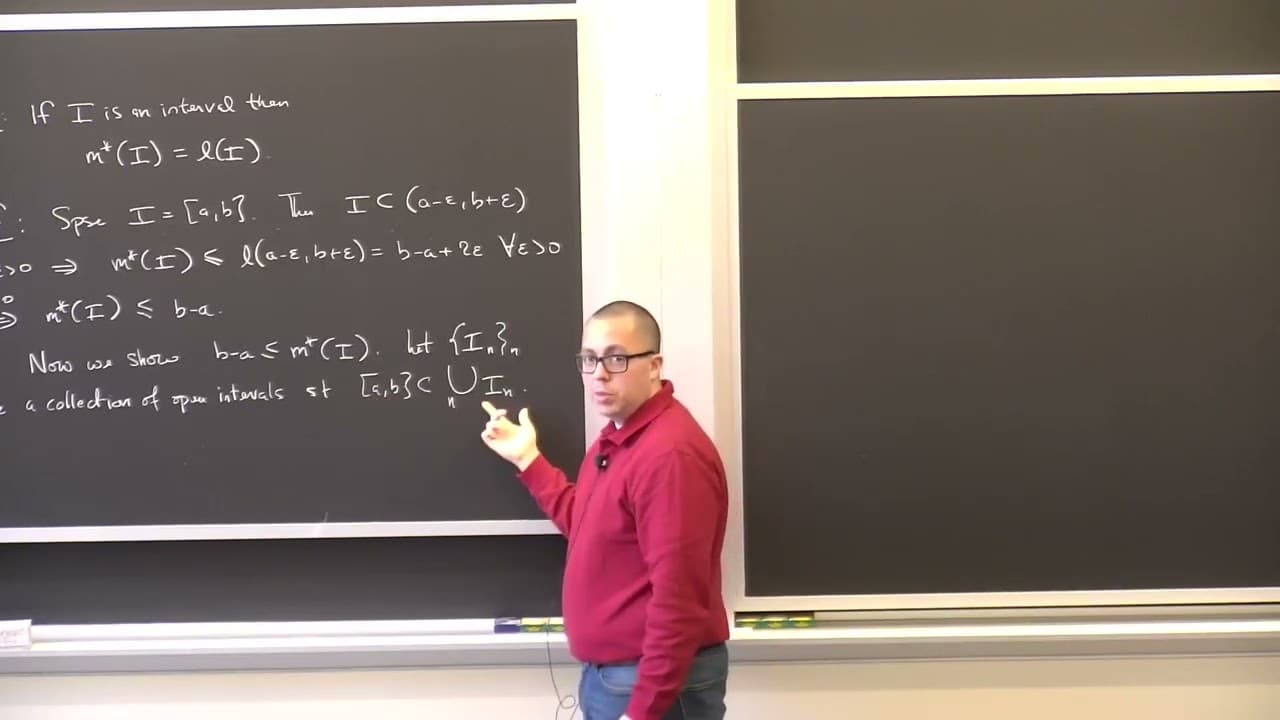
- 🟰 The measure of an interval is equal to its length.
- 😫 Finite unions and intersections of measurable sets are also measurable.
Install to Summarize YouTube Videos and Get Transcripts
Explore YouTube Video Summarizer or Get YouTube Transcript Extractor
Questions & Answers
Q: What is the difference between outer measure and Lebesgue measure?
Outer measure is a concept introduced to approximate the measure of subsets of real numbers, but it does not satisfy all the desired properties of a measure. Lebesgue measure, on the other hand, is a measure defined on a collection of subsets of real numbers that are well-behaved with respect to measure.
Q: How can we approximate the measure of a subset using outer measure?
Outer measure can be approximated by considering the outer measure of open sets that contain the subset. By taking the infimum of the sum of the lengths of intervals covering the subset, we can approximate its outer measure.
Q: What are the main properties that a measure of subsets of real numbers should satisfy?
The main properties are that the measure of an interval should be its length, the measure of a countable disjoint union of sets should be the sum of the measures, and the measure should be translation invariant.
Q: Are all subsets of real numbers Lebesgue measurable?
No, not all subsets of real numbers are Lebesgue measurable. The lecture introduced the concept of measurable sets, which are subsets of real numbers that satisfy a specific property called the Lebesgue measurability condition.
Summary & Key Takeaways
-
The lecture introduces outer measure as a way to measure the properties of subsets of real numbers.
-
Outer measure is defined and satisfies most of the desired properties of a measure, but not all.
-
The lecture explains how to define a measurable set by restricting outer measure to a certain class of well-behaved subsets of real numbers.
-
The lecture proves the theorem that the measure of an interval is equal to its length.
-
The lecture shows that finite unions and intersections of measurable sets are also measurable.
Read in Other Languages (beta)
Share This Summary 📚
Summarize YouTube Videos and Get Video Transcripts with 1-Click
Try YouTube Summary with ChatGPT & Claude or YouTube Transcript Generator
Explore More Summaries from MIT OpenCourseWare 📚



Summarize YouTube Videos and Get Video Transcripts with 1-Click
Try YouTube Summary with ChatGPT & Claude or YouTube Transcript Generator