Numerical Based On Dopplers Effect 3 - Ultrasonic Waves - Physics 2
TL;DR
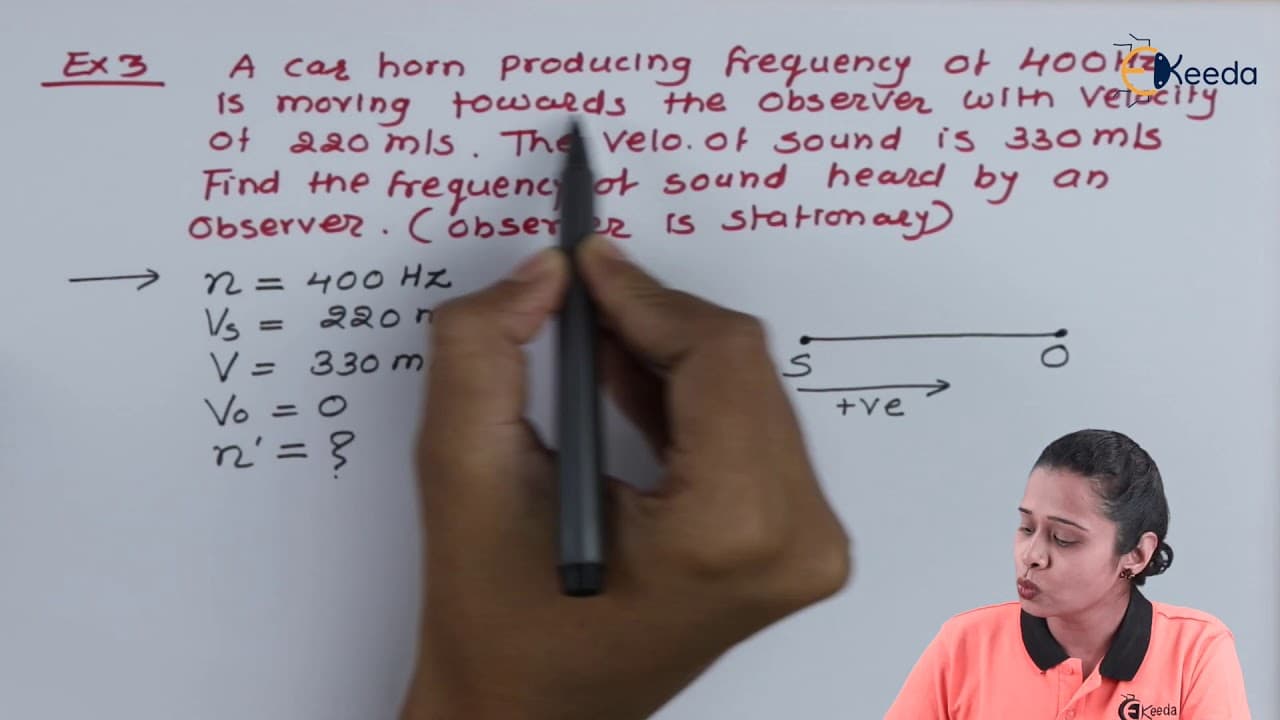
The video explains how to determine the frequency of sound heard by a stationary observer when a moving source is approaching, using the Doppler effect.
Transcript
click the bell icon to get latest videos from equator hello friends today we will see numerical based on Doppler effect so let us start with numerical number 3 now in numerical number 3 we have a path horn producing frequency of 400 Hertz is moving towards the observer with velocity - 20 meter per second the velocity of sound is 330 meter per secon... Read More
Key Insights
- 👋 Doppler effect is the change in frequency and wavelength of a wave due to relative motion between the source and the observer.
- ✋ When a source is moving towards the observer, the apparent frequency is higher than the actual frequency.
- 👂 The formula for calculating the apparent frequency is [(velocity of sound - velocity of observer) / (velocity of sound - velocity of source)] * actual frequency.
Install to Summarize YouTube Videos and Get Transcripts
Explore YouTube Video Summarizer or Get YouTube Transcript Extractor
Questions & Answers
Q: What is the Doppler effect?
The Doppler effect is the change in frequency and wavelength of a wave when there is relative motion between the source of the wave and the observer.
Q: What factors affect the Doppler effect?
The frequency of the source, the velocity of the source, the velocity of the observer, and the velocity of the wave are the factors that affect the Doppler effect.
Q: How does the apparent frequency change when the source is moving towards the observer?
When the source is moving towards the observer, the apparent frequency is higher than the actual frequency. This is because the sound waves are compressed due to the motion of the source.
Q: Why is the apparent frequency greater than the actual frequency in the given example?
In the given example, the observer is stationary while the source (car horn) is moving towards the observer. This causes the sound waves to be compressed, resulting in a higher apparent frequency.
Summary & Key Takeaways
-
The video discusses the concept of Doppler effect and how it applies to sound waves.
-
It provides a numerical example where a car horn with a frequency of 400 Hz is moving towards a stationary observer.
-
By applying the formula for apparent frequency, the video calculates that the observer will hear a sound with an apparent frequency of 1015 Hz.
Read in Other Languages (beta)
Share This Summary 📚
Summarize YouTube Videos and Get Video Transcripts with 1-Click
Try YouTube Summary with ChatGPT & Claude or YouTube Transcript Generator
Explore More Summaries from Ekeeda 📚






Summarize YouTube Videos and Get Video Transcripts with 1-Click
Try YouTube Summary with ChatGPT & Claude or YouTube Transcript Generator