How Can Case-Based Reasoning Enhance Marathon Training?
TL;DR
A case-based reasoning system predicts marathon performance and suggests tailored training plans using data from over 21,000 runners. This innovative approach improves prediction accuracy and offers explainable recommendations, aiding both novice and experienced marathon runners in their training journey.
Transcript
hi everyone today's video is going to be based on two papers that i have written in collaboration with ucd professors brian caulfield angus lawler and barry smith so the first of which was entitled using case-based reasoning to predict marathon performance and recommend tailored training plans and this was presented in the long paper proceedings at... Read More
Key Insights
- 🏃 Marathon running has experienced a significant increase in participation, particularly among recreational and novice runners.
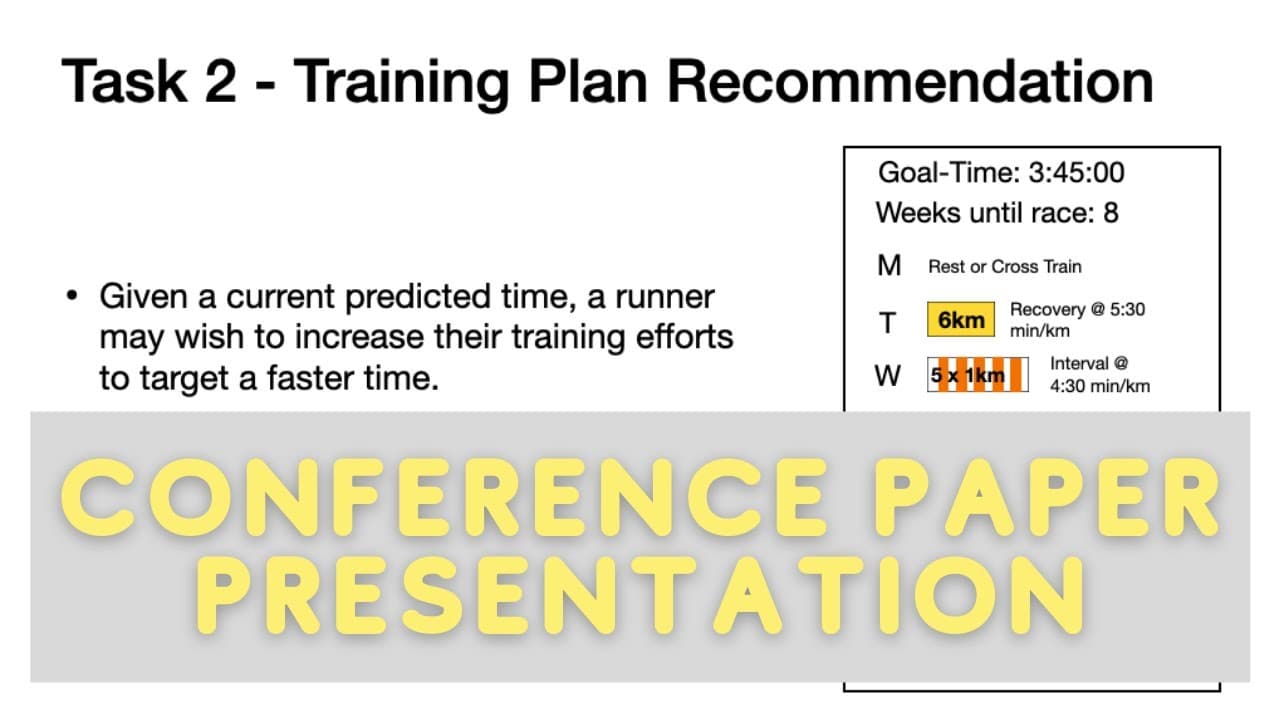
- 😒 The case-based reasoning system uses training session data to predict race times and recommend training plans.
- 💁 The single-week model of the system outperforms the ensemble model, providing more explainability and concrete training information.
- 🥳 The system's prediction accuracy improves as the race day approaches.
- 👤 The evaluation of the training plan recommendations demonstrates promising results, but a live user study is needed for further validation.
- 👨🔬 The research can be extended to other endurance sports by adapting the system to similar training session data.
- 🥰 Potential future improvements include incorporating heart rate data and using advanced analysis techniques for better classification and representation.
Install to Summarize YouTube Videos and Get Transcripts
Explore YouTube Video Summarizer or Get YouTube Transcript Extractor
Questions & Answers
Q: How does the case-based reasoning system work for predicting marathon performance?
The system uses past training and race time data as cases to find solutions for new cases. It retrieves similar cases, reuses their solutions, and revises them if necessary to predict race times for new runners.
Q: What are the main contributions of this research?
The research aims to provide support and advice for marathon runners by predicting race times and recommending tailored training plans. It addresses the limitations of one-size-fits-all resources available to recreational and novice runners.
Q: How is the case-based reasoning system evaluated?
The system's prediction accuracy is evaluated using cross-validation and compared to actual marathon times. The training plan recommendations are evaluated by comparing the recommended training load with the actual training completed by runners.
Q: What are the potential future improvements of this research?
The researchers suggest including heart rate data and using time series analysis techniques for automatic training session classification to improve the representation. They also plan to conduct a live user study of the training recommendations.
Summary & Key Takeaways
-
Researchers collaborated with UCD professors to develop a case-based reasoning system for marathon runners.
-
The system uses training session data from over 21,000 runners to predict marathon performance and recommend training plans.
-
The system provides both race time predictions and training plan recommendations based on weekly training features.
Read in Other Languages (beta)
Share This Summary 📚
Summarize YouTube Videos and Get Video Transcripts with 1-Click
Try YouTube Summary with ChatGPT & Claude or YouTube Transcript Generator
Explore More Summaries from PhD and Productivity 📚






Summarize YouTube Videos and Get Video Transcripts with 1-Click
Try YouTube Summary with ChatGPT & Claude or YouTube Transcript Generator