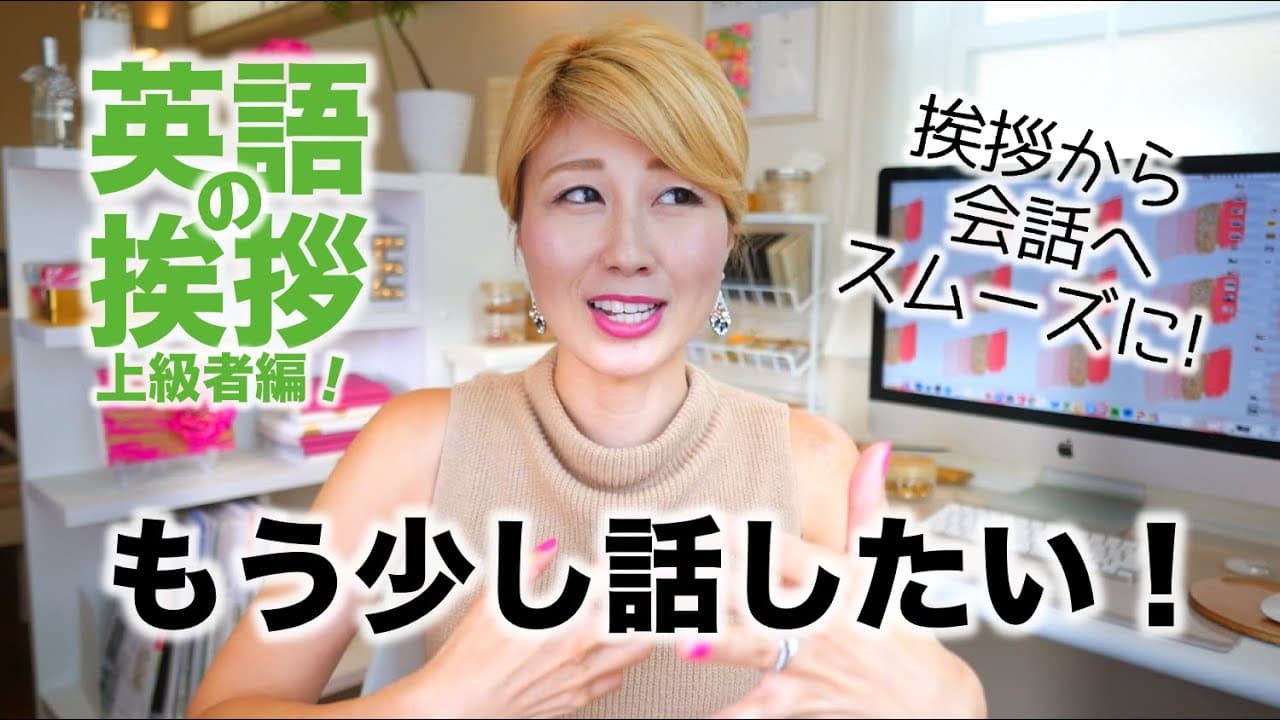
挨拶から会話へスムーズに!英語の挨拶 上級者編☆〔#457〕
TL;DR
Learn advanced English greetings for smoother conversations.
Transcript
Busy, but good. 忙しいけど順調だよ。 How are you? 調子はどう? Good. Busy, but good. いいよ。忙しいけど順調だよ。 How are you? 調子はどう? Not so good. あまりよくない。 What's wrong? What happened? どうしたの?何が起きたの? I got in a fight with my husband this morning and ... 今朝主人と喧嘩してね... That's not true! 嘘ですよ! I didn't get in a fight with my husband this morning lol おサルさんと喧嘩していないですよ。 But just an e... Read More
Key Insights
- The video provides examples of advanced English greetings beyond the basic 'How are you?' to help learners enhance their conversational skills.
- Different responses to greetings are demonstrated, such as 'Busy, but good' and 'Could be better,' showing the variety of expressions available.
- The importance of context in choosing the right greeting or response is emphasized, as it can vary based on the situation and relationship.
- The video uses real-life scenarios, like discussing work or personal life changes, to illustrate how to apply these greetings in conversations.
- The speaker provides examples of how to inquire about others, like 'What have you been up to?' and 'How have you been?' to foster engaging dialogues.
- Humor and light-hearted examples are used to make the learning process enjoyable and relatable for viewers.
- The video encourages viewers to adapt the greetings to their own style and context, rather than memorizing fixed phrases.
- The aim is to equip learners with the tools to have meaningful and effective conversations with friends, family, and colleagues.
Install to Summarize YouTube Videos and Get Transcripts
Explore YouTube Video Summarizer or Get YouTube Transcript Extractor
Questions & Answers
Q: What is the main focus of the video?
The main focus of the video is to teach viewers advanced English greetings that go beyond the basic 'How are you?' This aims to help learners engage in more natural and effective conversations by providing a variety of expressions and responses suitable for different contexts and relationships.
Q: Why does the video use real-life scenarios?
Real-life scenarios are used in the video to illustrate how the advanced greetings can be applied in everyday conversations. This approach helps viewers understand the practical application of the phrases and encourages them to use the greetings in similar situations, making the learning experience more relatable and effective.
Q: How does the video make learning enjoyable?
The video incorporates humor and light-hearted examples to make the learning process enjoyable. By using relatable and funny scenarios, the video keeps viewers engaged and entertained, which can enhance their retention of the material and make them more likely to practice the greetings in real conversations.
Q: What is emphasized about choosing the right greeting?
The video emphasizes the importance of context when choosing the right greeting or response. It highlights that the choice can vary based on the situation and the relationship with the person being addressed, encouraging viewers to consider these factors to ensure their interactions are appropriate and effective.
Q: How are viewers encouraged to use the greetings?
Viewers are encouraged to adapt the greetings to their own style and context, rather than memorizing fixed phrases. The video aims to equip learners with the tools to personalize their interactions, making them more natural and meaningful, and helping them build confidence in their conversational skills.
Q: What kinds of expressions are taught in the video?
The video teaches a variety of expressions, such as 'Busy, but good,' 'Could be better,' and questions like 'What have you been up to?' These expressions are intended to help learners convey their feelings more accurately and engage others in more meaningful conversations.
Q: Why is humor used in the examples?
Humor is used in the examples to make the learning process more engaging and enjoyable. By incorporating funny and relatable scenarios, the video captures viewers' attention and helps them remember the material better, making it more likely they will practice and use the greetings in their own conversations.
Q: What is the ultimate goal of the video?
The ultimate goal of the video is to provide viewers with the knowledge and confidence to have meaningful and effective conversations with friends, family, and colleagues. By learning advanced greetings and responses, viewers can enhance their communication skills and build stronger, more engaging relationships.
Summary & Key Takeaways
-
This video teaches advanced English greetings to help learners engage in smoother conversations. It provides various examples and emphasizes the importance of context.
-
Viewers learn how to respond to greetings in different ways, such as saying 'Busy, but good' or 'Could be better,' to convey their true feelings.
-
The video uses real-life scenarios to demonstrate the application of these greetings, encouraging viewers to personalize their use for more natural interactions.
Read in Other Languages (beta)
Share This Summary 📚
Summarize YouTube Videos and Get Video Transcripts with 1-Click
Try YouTube Summary with ChatGPT & Claude or YouTube Transcript Generator
Explore More Summaries from バイリンガール英会話 | Bilingirl Chika 📚





Summarize YouTube Videos and Get Video Transcripts with 1-Click
Try YouTube Summary with ChatGPT & Claude or YouTube Transcript Generator