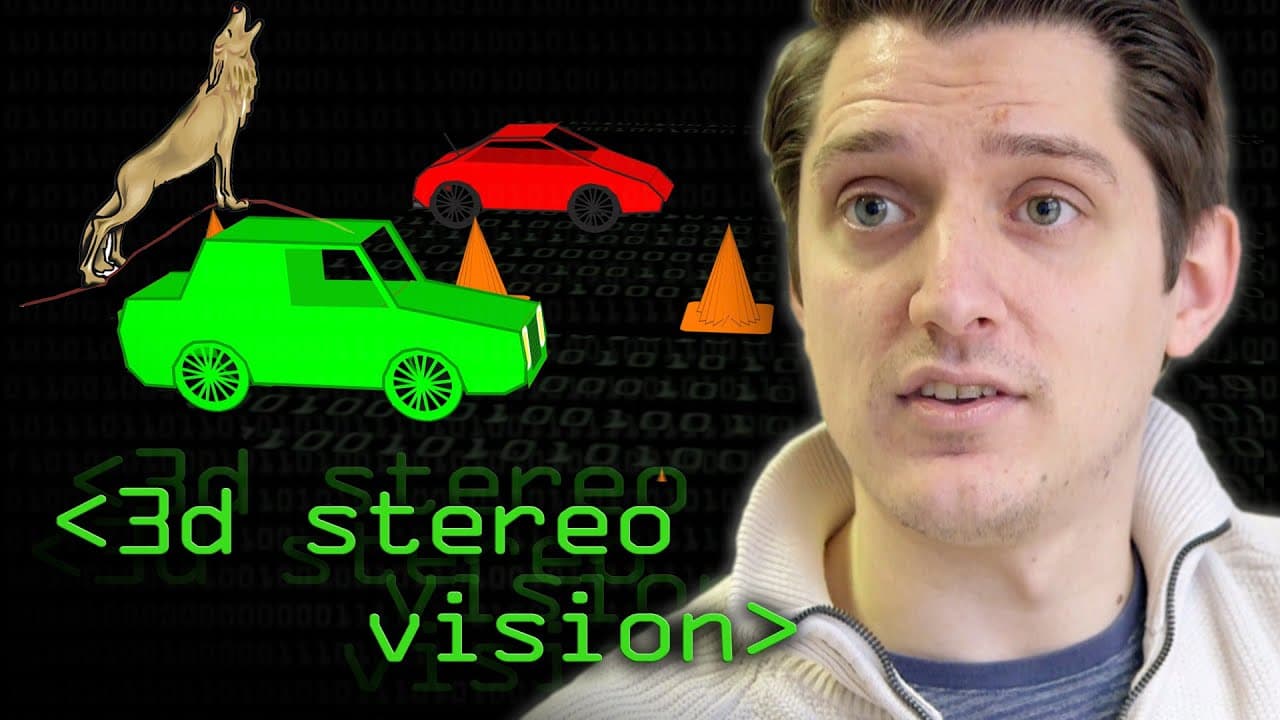
Stereo 3D Vision (How to avoid being dinner for Wolves) - Computerphile
TL;DR
The video discusses how using a pair of stereo cameras can provide more accurate 3D depth perception compared to laser scanners.
Transcript
you can get results from this where you can't get results from lasers lasers get bleached out in sunlight i had a colleague that i was speaking to who went to mexico to do crop scanning and he had a handheld laser scanner and he had to do it at night in a tent because the sun wrecked the laser scanner and there were walls about and it was a big pro... Read More
Key Insights
- 🎥 Laser scanners can be ineffective in sunlight, while stereo cameras provide reliable results even in challenging lighting conditions.
- ⛑️ Monocular cues can provide some depth perception, but true 3D perception relies on using a pair of stereo cameras.
- 🎥 Camera calibration is crucial for accurate depth estimation, as it helps determine the positions of the cameras.
- 🫥 Epipolar geometry simplifies the depth estimation process by limiting the search space to specific lines in the images.
- 🤩 The correspondence problem, finding matching points in the stereo images, is a key challenge in depth estimation.
- 😥 Triangulation is a commonly used technique in stereo vision to calculate the depth of objects based on their corresponding points.
- 🧑🏭 Advanced algorithms can enhance depth estimation by considering factors like smoothness and object shapes in the images.
Install to Summarize YouTube Videos and Get Transcripts
Explore YouTube Video Summarizer or Get YouTube Transcript Extractor
Questions & Answers
Q: How does using stereo cameras improve depth perception compared to laser scanners?
Stereo cameras can handle challenging lighting conditions that can cause laser scanners to fail. Additionally, they provide more accurate depth information by utilizing corresponding points in the images.
Q: What are monocular cues and how do they contribute to depth perception?
Monocular cues are visual clues that help estimate depth with one eye. They include size changes of objects, parallax, and occlusion. However, true 3D perception is only achieved with two eyes.
Q: Why is camera calibration important in depth estimation?
Camera calibration helps determine the positions of the cameras, which is crucial for accurate depth estimation. Without calibration, the search space for finding corresponding points increases, leading to confusion and errors in depth estimation.
Q: How does triangulation help in calculating depth using stereo cameras?
Triangulation involves projecting rays from corresponding points in the stereo images and finding the intersection point. This technique allows us to determine the distance of an object from the cameras and obtain accurate depth information.
Summary & Key Takeaways
-
Laser scanners can get bleached out in sunlight, making it difficult to obtain results, whereas stereo cameras can provide accurate depth perception even in challenging conditions.
-
Monocular cues can provide some depth estimation with one eye, but true 3D perception comes from using two eyes and corresponding points in the images.
-
Camera calibration is essential to determine the positions of the cameras and enables accurate depth estimation using triangulation.
Read in Other Languages (beta)
Share This Summary 📚
Summarize YouTube Videos and Get Video Transcripts with 1-Click
Try YouTube Summary with ChatGPT & Claude or YouTube Transcript Generator
Explore More Summaries from Computerphile 📚



Summarize YouTube Videos and Get Video Transcripts with 1-Click
Try YouTube Summary with ChatGPT & Claude or YouTube Transcript Generator