3.3.1 The Framingham Heart Study - Video 1: Evaluating Risk Factors to Save Lives
TL;DR
The Framingham Heart Study is a significant epidemiological study that has shaped our understanding of cardiovascular disease, showcasing the importance of tracking patient health over their lifetimes.
Transcript
In this lecture, we'll describe the Framingham Heart Study, one of the most important epidemiological studies ever conducted, and the underlying analytics that led to our current understanding of cardiovascular disease. To motivate how the study affected our understanding of blood pressure today, we describe the case of Franklin Delano Roosevelt, F... Read More
Key Insights
- 🧑⚕️ The Framingham Heart Study revolutionized our understanding of cardiovascular disease by tracking patient health over their lifetimes.
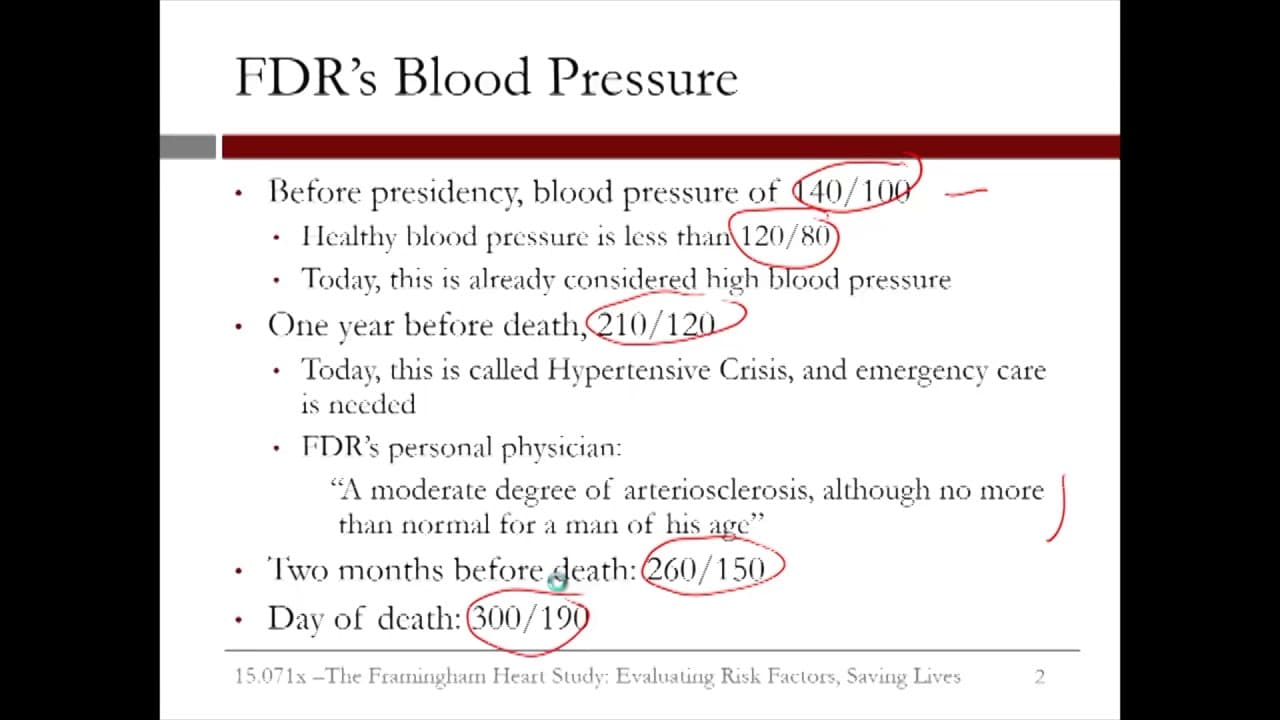
- ✋ Roosevelt's case exemplifies the progression and severity of high blood pressure and its impact on health.
- 👨🔬 Early misconceptions about blood pressure were corrected through research, including the Framingham study.
- 📌 Framingham was chosen as an ideal location for the study due to its population stability and collaborative healthcare professionals.
- 🧑⚕️ The study involved regular examinations and questionnaires to gather comprehensive data on participants' health characteristics.
- 🥰 The study's data enables the development of models for predicting and preventing heart disease.
- 🩸 Monitoring blood pressure is vital for identifying potential cardiovascular risks.
Install to Summarize YouTube Videos and Get Transcripts
Explore YouTube Video Summarizer or Get YouTube Transcript Extractor
Questions & Answers
Q: How did Franklin Delano Roosevelt's case contribute to our understanding of blood pressure?
Roosevelt's case highlighted the significance of high blood pressure and its effects on health. His blood pressure readings throughout his life demonstrated the progression and severity of the condition, ultimately leading to his hypertensive crisis and death.
Q: What were the early misconceptions about blood pressure?
In the early 20th century, high blood pressure was seen as essential to force blood flow and lowering it was believed to be harmful. However, this misconception changed over time as more research, including the Framingham Heart Study, revealed the risks associated with high blood pressure.
Q: Why was Framingham chosen as the site for the study?
Framingham, Massachusetts, was chosen due to its suitable size, stable population, and cooperative doctors and residents. These factors allowed for effective long-term tracking of the patients' health and behaviors.
Q: How did the Framingham Heart Study collect data from participants?
Participants in the study underwent regular examinations and completed questionnaires every two years. These assessments recorded their physical and behavioral characteristics and test results, providing valuable data for studying their health trajectory.
Summary & Key Takeaways
-
The Framingham Heart Study is an influential study that has contributed to our understanding of cardiovascular disease.
-
Franklin Delano Roosevelt's case demonstrates the impact of the study, showcasing the progression of his high blood pressure over time.
-
The study began in 1948 and involved tracking the health trajectory of 5,209 patients in Framingham, Massachusetts.
Read in Other Languages (beta)
Share This Summary 📚
Summarize YouTube Videos and Get Video Transcripts with 1-Click
Try YouTube Summary with ChatGPT & Claude or YouTube Transcript Generator
Explore More Summaries from MIT OpenCourseWare 📚



Summarize YouTube Videos and Get Video Transcripts with 1-Click
Try YouTube Summary with ChatGPT & Claude or YouTube Transcript Generator