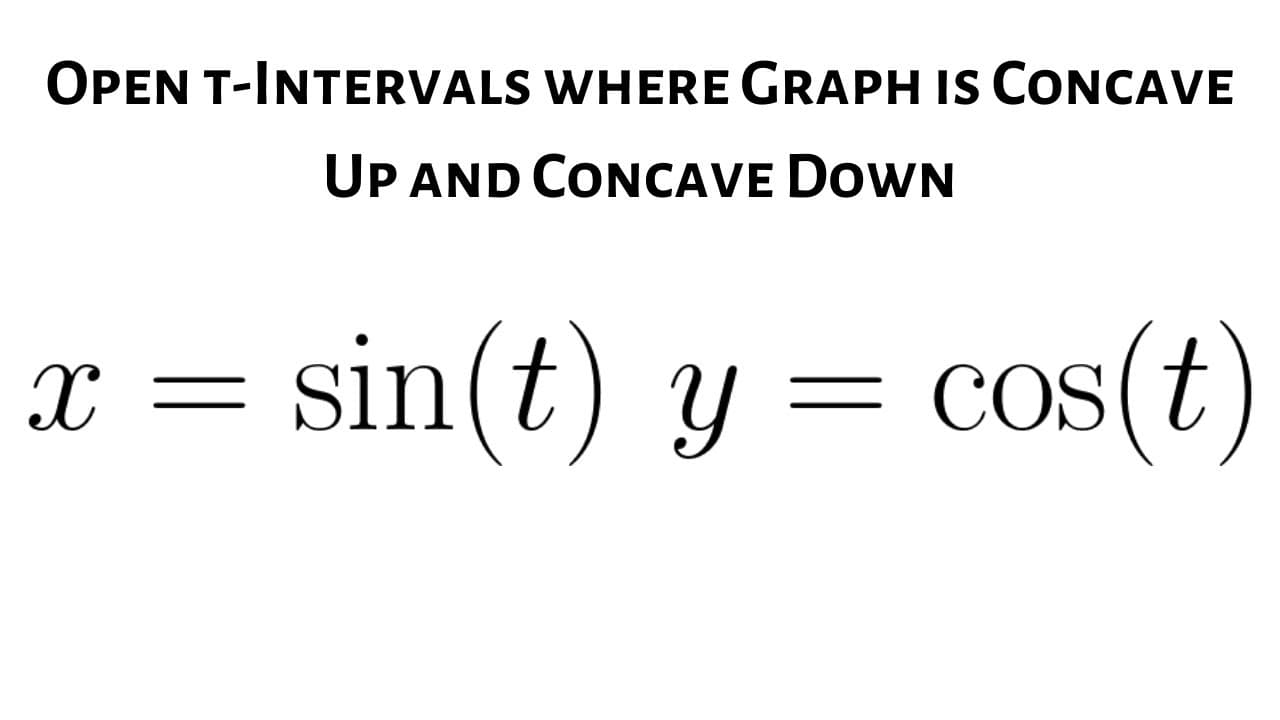
Determine the Open t-intervals where the Graph is Concave up or Down: x = sin(t), y = cos(t)
TL;DR
Analyzing concavity using parametric equations and derivatives.
Transcript
in this problem we have to find the open T intervals where the graph of these parametric equations is concave up and concave down so in order to do that we have to find the second derivative and figure out where it's positive which will tell us where it's concave up and negative which will tell us where it's concave down so the first derivative is ... Read More
Key Insights
- 🤘 Finding concavity in parametric equations involves determining the sign of the second derivative.
- ❓ Differentiating parametric formulas yields the first and second derivatives for concavity analysis.
- 📈 Understanding concavity intervals helps in interpreting the curvature of parametric graphs.
- 🦻 Utilizing the graph of cosine or the unit circle can aid in visualizing concavity behavior.
- ❎ Positive second derivatives indicate concave up sections, while negative values correspond to concave down intervals.
- 📈 Analyzing concavity in parametric equations enhances the understanding of graph curvature.
- 📈 Utilizing multiple reasoning methods, like graph characteristics and the unit circle, can provide comprehensive insights.
Install to Summarize YouTube Videos and Get Transcripts
Explore YouTube Video Summarizer or Get YouTube Transcript Extractor
Questions & Answers
Q: How are concavity and parametric equations related?
Concavity in parametric equations is determined by finding the second derivative through differentiation to see intervals of concave up or down behavior.
Q: What role does the first derivative play in analyzing concavity?
The first derivative helps in calculating the second derivative, which then indicates concavity behavior by its sign – positive for concave up and negative for concave down.
Q: Why is it important to consider the sign of the second derivative in concavity analysis?
The sign of the second derivative reveals whether the graph is concave up or down at specific intervals, crucial for understanding the curvature of the parametric equations.
Q: How can one use both the graph of cosine and the unit circle to analyze concavity?
Both methods provide insights into concavity behavior; the graph of cosine helps visualize sign changes, while the unit circle relates the cosine values to concavity characteristics.
Summary & Key Takeaways
-
Finding concavity using parametric equations involves finding the second derivative to determine if the graph is concave up or down.
-
The first derivative is calculated using parametric formulas for dy/dx, leading to the second derivative through further differentiation.
-
Understanding the sign of the second derivative helps in identifying concave up intervals using graph characteristics or the unit circle.
Read in Other Languages (beta)
Share This Summary 📚
Summarize YouTube Videos and Get Video Transcripts with 1-Click
Try YouTube Summary with ChatGPT & Claude or YouTube Transcript Generator
Explore More Summaries from The Math Sorcerer 📚


Summarize YouTube Videos and Get Video Transcripts with 1-Click
Try YouTube Summary with ChatGPT & Claude or YouTube Transcript Generator