trigonometry: the ratio of the 45-45-90 special right triangle
TL;DR
Learn how to create and analyze a 45-45-90 special right triangle by dividing a square, and understand the ratio of its sides.
Transcript
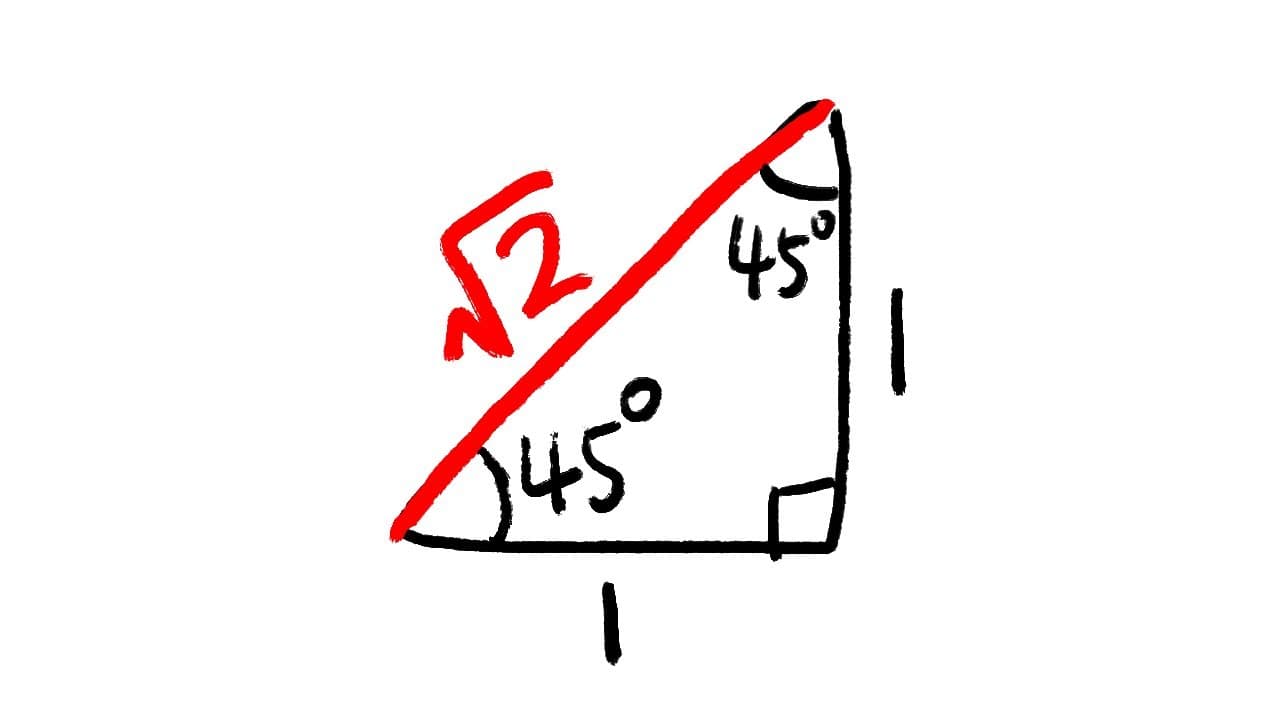
okay I'm gonna show you guys how to get the 45-45-90 special right triangle so to begin we are going to start off with a square and this right here is my square okay and because this is a square we know all the sites are going to be the same length so I'm just going to say this right here has one unit likewise this is also going to be one... Read More
Key Insights
- 🙃 Dividing a square diagonally creates a 45-45-90 special right triangle where all sides are equal.
- 🔺 The angles in a 45-45-90 special right triangle are 90 degrees, 45 degrees, and 45 degrees.
- 🙃 The ratio of the sides in a 45-45-90 special right triangle is 1:1:sqrt(2).
- 🗯️ The Pythagorean theorem can be applied to find the length of the hypotenuse in a 45-45-90 special right triangle.
- ❎ The Pythagorean theorem states that in a right triangle, the sum of the squares of the lengths of the shorter sides is equal to the square of the length of the hypotenuse.
- 🙃 The lengths of the shorter sides in a 45-45-90 special right triangle are equal.
- 🗯️ The hypotenuse of a 45-45-90 special right triangle is the square root of 2 times the length of either shorter side.
Install to Summarize YouTube Videos and Get Transcripts
Explore YouTube Video Summarizer or Get YouTube Transcript Extractor
Questions & Answers
Q: How is a 45-45-90 special right triangle created?
By dividing a square diagonally into two equal halves, a 45-45-90 special right triangle can be created. This triangle has two 45-degree angles and one 90-degree angle.
Q: How are the sides of a 45-45-90 special right triangle related?
In a 45-45-90 special right triangle, all sides have a ratio of 1:1:sqrt(2). The two shorter sides have equal length, while the hypotenuse is the square root of 2 times the length of either shorter side.
Q: How is the length of the hypotenuse calculated in a 45-45-90 special right triangle?
The Pythagorean theorem is used to calculate the length of the hypotenuse. By substituting the lengths of the shorter sides into the equation a^2 + b^2 = c^2, where a and b are the same length and c is the hypotenuse, the value of the hypotenuse can be found.
Q: Why is the Pythagorean theorem used only with the positive square root in finding the length of the hypotenuse?
The Pythagorean theorem is used with the positive square root because we are dealing with the lengths of sides in a right triangle. Negative lengths are not meaningful in this context.
Summary & Key Takeaways
-
A square is divided diagonally to create a 45-45-90 special right triangle where all sides are equal.
-
The angles in the triangle are 90 degrees, 45 degrees, and 45 degrees, respectively.
-
To find the length of the longest side (hypotenuse), the Pythagorean theorem is used.
Read in Other Languages (beta)
Share This Summary 📚
Summarize YouTube Videos and Get Video Transcripts with 1-Click
Try YouTube Summary with ChatGPT & Claude or YouTube Transcript Generator
Explore More Summaries from blackpenredpen 📚




Summarize YouTube Videos and Get Video Transcripts with 1-Click
Try YouTube Summary with ChatGPT & Claude or YouTube Transcript Generator