L09.7 Joint PDFs
TL;DR
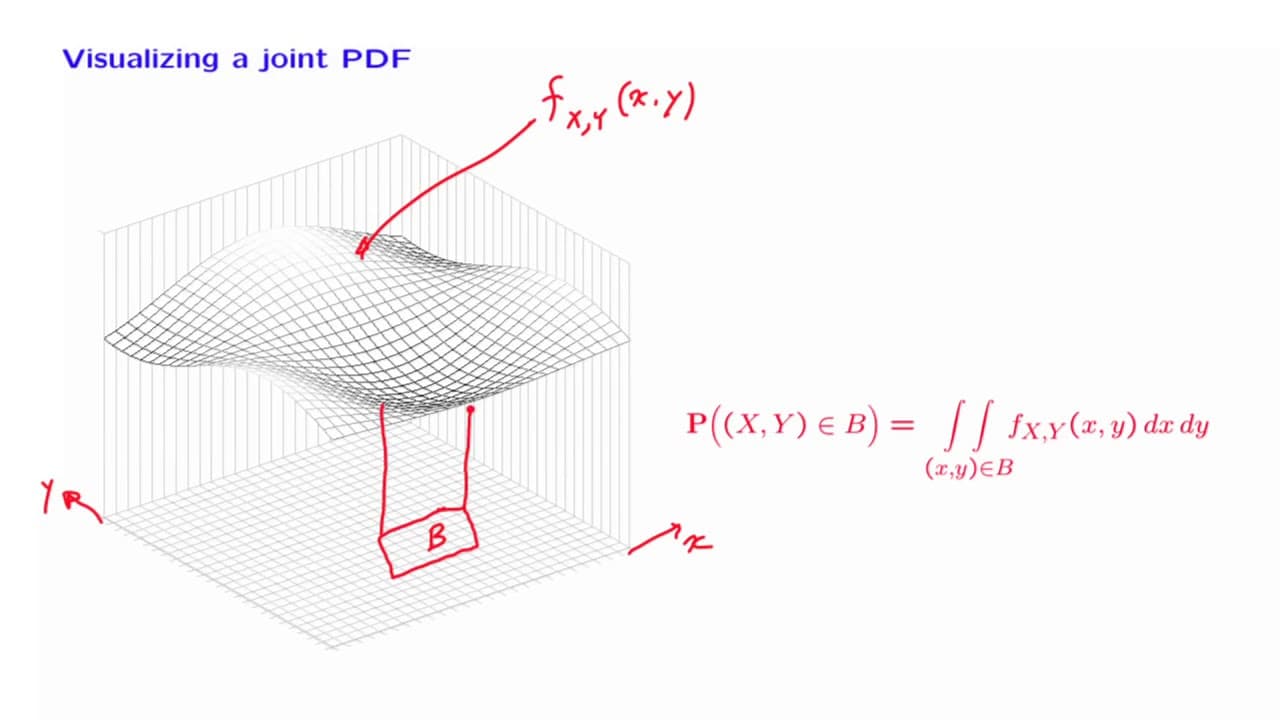
Joint Probability Density Functions (PDFs) are the continuous analog of joint Probability Mass Functions (PMFs) and are used to calculate the probability of a set by finding the volume under the joint PDF that lies on top of that set.
Transcript
In this segment, we start a discussion of multiple continuous random variables. Here are some objects that we're already familiar with. But exactly as in the discrete case, if we are dealing with two random variables, it is not enough to know their individual PDFs. We also need to model the relation between the two random variables, and this is don... Read More
Key Insights
- ❓ Joint PDFs are used to model the relation between two continuous random variables.
- 🚱 The joint PDF must be non-negative and integrate to 1.
- 😫 Probability is calculated by integrating the joint PDF over a set.
- 😫 Joint continuity is important for ensuring the probability is spread over two dimensions rather than concentrated on a one-dimensional set.
Install to Summarize YouTube Videos and Get Transcripts
Explore YouTube Video Summarizer or Get YouTube Transcript Extractor
Questions & Answers
Q: What is the difference between a joint PDF and a joint PMF?
The joint PDF is the continuous analog of the joint PMF and is used to model the relation between two continuous random variables. While the joint PMF gives the probability of specific values, the joint PDF gives the probability density per unit area.
Q: How do we calculate probabilities using joint PDFs?
To calculate the probability of a set, we integrate the joint PDF over that set. The integral gives us the volume under the joint PDF that lies on top of the set, which represents the probability.
Q: Can joint PDFs have negative values?
No, joint PDFs must be non-negative. A legitimate joint PDF is any function of two variables that is non-negative and integrates to 1.
Q: What is the importance of joint continuity?
Joint continuity means that the probability is spread over two dimensions and not concentrated on a one-dimensional set. If the probability is concentrated on a set with zero area, it contradicts the concept of joint continuity.
Summary & Key Takeaways
-
Joint PDFs model the relation between two continuous random variables.
-
The joint PDF must be non-negative and integrate to 1.
-
Probability is calculated by integrating the joint PDF over a set, similar to how it is done with a joint PMF in the discrete setting.
Read in Other Languages (beta)
Share This Summary 📚
Summarize YouTube Videos and Get Video Transcripts with 1-Click
Try YouTube Summary with ChatGPT & Claude or YouTube Transcript Generator
Explore More Summaries from MIT OpenCourseWare 📚


Summarize YouTube Videos and Get Video Transcripts with 1-Click
Try YouTube Summary with ChatGPT & Claude or YouTube Transcript Generator