Products
Features
YouTube Video Summarizer
Summarize YouTube videos
Web & PDF Highlighter
Highlight web pages & PDFs
Chat with PDF
Ask any PDF questions with AI
Ask AI Clone
Chat with your highlights & memories
Audio Transcriber
Transcribe audio files to text
Glasp Reader
Read and highlight articles
Kindle Highlight Export
Export your Kindle highlights
Idea Hatch
Hatch ideas from your highlights
Integrations
Obsidian Plugin
Notion Integration
Pocket Integration
Instapaper Integration
Medium Integration
Readwise Integration
Snipd Integration
Hypothesis Integration
Apps & Extensions
Chrome Extension
Safari Extension
Edge Add-ons
Firefox Add-ons
iOS App
Android App
Discover
Discover
Ideas
Discover new ideas and insights
Articles
Curated articles and insights
Books
Book recommendations by great minds
Posts
Essays and notes from readers
Quotes
Inspiring quotes collection
Videos
Curated videos and summaries
Explore Glasp
Glasp Newsletter
Weekly insights and updates
Glasp Talk
Interview series with great minds
Glasp Blog
Latest news and articles
Glasp Use Cases
Learn how others use Glasp
Build & Support
Glasp API
Access Glasp's API for developers
MCP Connector
Connect Glasp to Claude & ChatGPT
Community
Glasp Reddit Community
Students
Student discount and benefits
FAQs
Frequently Asked Questions
AboutPricing
DashboardLog inSign up

Intro to Sequences

19.6K views
•
February 12, 2019
by
Dr. Trefor Bazett
YouTube video player
Intro to Sequences

TL;DR

Sequences are ordered lists of elements, which can follow a pattern or be completely random.

Transcript

consider this list of numbers 1 1/2 1/3 1/4 1/5 and so on this is the idea of a sequence a sequence is just a list there's a first element a second element a third element and you have this ordered list that goes on for forever another example might be this one 1/2 2/3 3/4 4/5 and so on you can sort of see what the pattern is indeed there's a third... Read More

Key Insights

  • 🚴 Sequences are ordered lists that can have patterns or be random.
  • 📇 Notation like a sub-index and explicit formulas are used to represent sequences.
  • 🪻 Formulas can help find the nth term in a sequence.
  • 🚴 Some sequences do not follow a predictable pattern and can only be listed explicitly.

Install to Summarize YouTube Videos and Get Transcripts

Explore YouTube Video Summarizer or Get YouTube Transcript Extractor

Questions & Answers

Q: What is a sequence?

A sequence is an ordered list of elements that can follow a pattern or have no predictable pattern.

Q: How can sequences be represented?

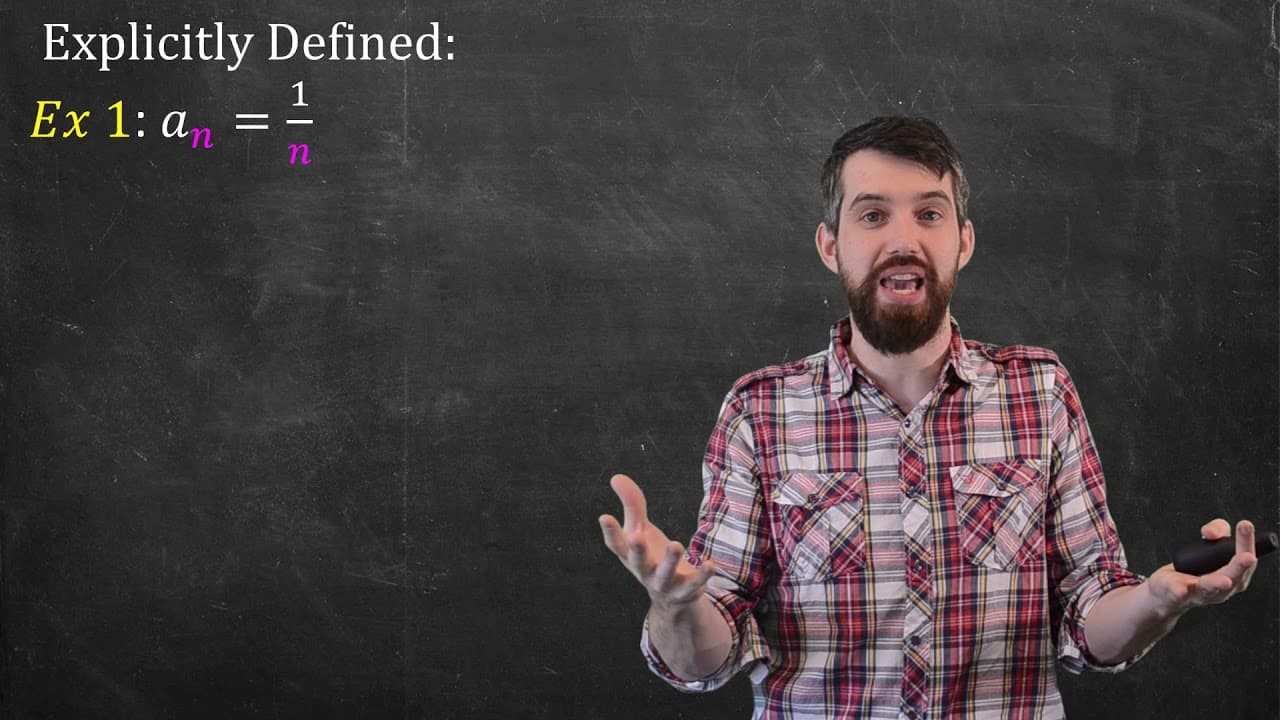
Sequences can be represented using a sub-index notation, such as a_1, a_2, a_3, or through explicit formulas like a_n = 1/n.

Q: What is an explicit formula?

An explicit formula represents a sequence by providing an expression for each term. For example, a_n = n/(n+1) represents a sequence where the numerator increases by 1 while the denominator increases by 1.

Q: Can all sequences be represented by an explicit formula?

Not all sequences can be represented by an explicit formula. Some sequences may have no discernible pattern and can only be listed explicitly.

Key Insights:

  • Sequences are ordered lists that can have patterns or be random.
  • Notation like a sub-index and explicit formulas are used to represent sequences.
  • Formulas can help find the nth term in a sequence.
  • Some sequences do not follow a predictable pattern and can only be listed explicitly.
  • Understanding sequences is crucial for further concepts in mathematics.

Summary & Key Takeaways

  • Sequences are lists of elements that can follow a pattern or have no predictable pattern.

  • They can be represented using a sub-index notation or explicitly defined using formulas.

  • Formulas can be used to find the nth term in a sequence.


Read in Other Languages (beta)

English

Share This Summary 📚

Summarize YouTube Videos and Get Video Transcripts with 1-Click

Download browser extensions on:

Try YouTube Summary with ChatGPT & Claude or YouTube Transcript Generator

Explore More Summaries from Dr. Trefor Bazett 📚
The Multi-Variable Chain Rule: Derivatives of Compositions thumbnail
The Multi-Variable Chain Rule: Derivatives of Compositions
Dr. Trefor Bazett
Intro to LaTeX : Learn to write beautiful math equations || Part 1 thumbnail
Intro to LaTeX : Learn to write beautiful math equations || Part 1
Dr. Trefor Bazett
3 Applications of Taylor Series: Integrals, Limits, & Series thumbnail
3 Applications of Taylor Series: Integrals, Limits, & Series
Dr. Trefor Bazett
Separation of Variables //  Differential Equations thumbnail
Separation of Variables // Differential Equations
Dr. Trefor Bazett
Using Elementary Row Operations to Solve Systems of Linear Equations thumbnail
Using Elementary Row Operations to Solve Systems of Linear Equations
Dr. Trefor Bazett
Example: Is this relation a function? thumbnail
Example: Is this relation a function?
Dr. Trefor Bazett

Summarize YouTube Videos and Get Video Transcripts with 1-Click

Download browser extensions on:

Try YouTube Summary with ChatGPT & Claude or YouTube Transcript Generator

Apps & Extensions

  • Chrome Extension
  • Safari Extension
  • Edge Add-ons
  • Firefox Add-ons
  • iOS App
  • Android App

Key Features

  • YouTube Video Summarizer
  • Web & PDF Summarizer
  • Web & PDF Highlighter
  • Chat with PDF
  • Ask AI Clone
  • Audio Transcriber
  • Glasp Reader
  • Kindle Highlight Export
  • Idea Hatch

Integrations

  • Obsidian Plugin
  • Notion Integration
  • Pocket Integration
  • Instapaper Integration
  • Medium Integration
  • Readwise Integration
  • Snipd Integration
  • Hypothesis Integration

More Features

  • APIs
  • MCP Connector
  • Blog & Post
  • Embed Links
  • Image Highlight
  • Personality Test
  • Quote Shots

Company

  • About us
  • Blog
  • Community
  • FAQs
  • Job Board
  • Newsletter
  • Pricing
Terms

•

Privacy

•

Guidelines

© 2026 Glasp Inc. All rights reserved.