ICT Mentorship Core Content - Month 05 - Ideal Seasonal Tendencies
TL;DR
Explores ideal seasonal tendencies in FX trading for high probability trades.
Transcript
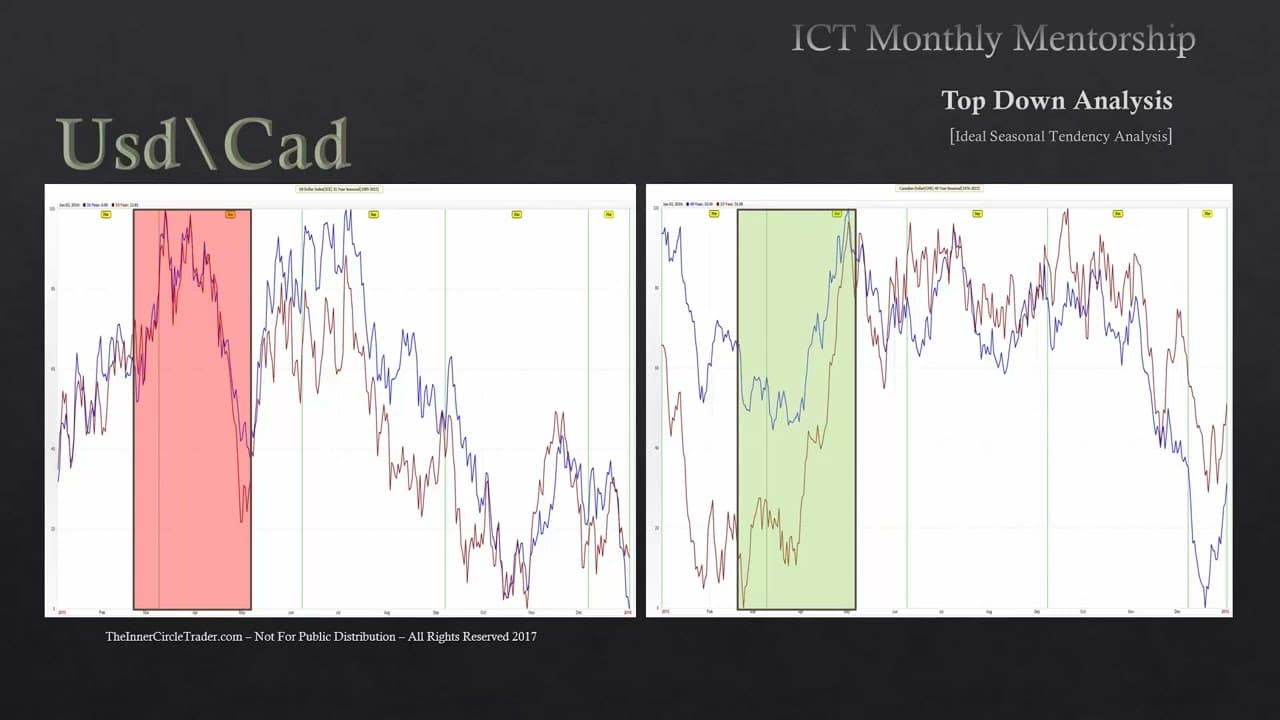
welcome back folks this is lesson 4.3 of the January 2017 ICT mentorship continuing our discussion on seasonal Tendencies we're going to be highlighting ideal seasonal Tendencies and higher time frame analysis this is going to be specifically dealing with foreign exchange or FX payers okay before we begin uh just a reminder that seasonal Te... Read More
Key Insights
- Seasonal tendencies in Forex are not guarantees but provide historical insights into potential price movements.
- Comparative analysis of currency pairs like the Australian dollar and US dollar index helps identify ideal trade scenarios.
- The strongest seasonal tendency for the Australian dollar is a rally from March to May, contrasting with a dollar index sell-off.
- New Zealand dollar also shows a seasonal rally from March to May, with a corresponding dollar index decline.
- The Euro typically experiences a seasonal low in June-July, while the dollar index forms a high during the same period.
- British pound shows a tendency to make a low in March and high in May, aligning with a dollar index sell-off.
- Swiss franc tends to form a low in June-July, opposite to the dollar index high, marking a turning point for trading.
- Utilizing seasonal tendencies involves blending historical data with current market trends for effective trading strategies.
Install to Summarize YouTube Videos and Get Transcripts
Explore YouTube Video Summarizer or Get YouTube Transcript Extractor
Questions & Answers
Q: What are seasonal tendencies in Forex trading?
Seasonal tendencies in Forex trading refer to historical patterns where certain currency pairs exhibit predictable price movements during specific times of the year. These tendencies are not absolute but provide traders with a roadmap of potential market behavior, helping them identify high-probability trade setups based on past data.
Q: How do seasonal tendencies influence trading decisions?
Seasonal tendencies influence trading decisions by offering insights into potential market movements. Traders use these patterns to anticipate price changes and align their strategies accordingly. By understanding when a currency pair typically rallies or declines, traders can make informed decisions on entry and exit points, enhancing their overall trading effectiveness.
Q: What is the significance of comparing currency pairs in seasonal analysis?
Comparing currency pairs in seasonal analysis is crucial as it helps identify contrasting movements between currencies. For instance, analyzing the Australian dollar against the US dollar index can reveal ideal trade scenarios where one currency is expected to rally while the other declines. This comparative approach enhances the accuracy of predicting market trends based on historical data.
Q: Why is the Australian dollar's seasonal tendency significant?
The Australian dollar's seasonal tendency is significant because it consistently shows a pattern of rallying from March to May. This pattern is contrasted with a decline in the US dollar index, providing traders with a high-probability scenario for entering long positions. Understanding such tendencies allows traders to capitalize on predictable market movements.
Q: How can traders utilize seasonal tendencies in their strategies?
Traders can utilize seasonal tendencies by integrating them into their broader trading strategies. By identifying high-probability periods for currency movements, traders can plan their trades around these times, potentially increasing their chances of success. Seasonal tendencies should be used in conjunction with current market analysis to validate and enhance trading decisions.
Q: What role do historical data play in seasonal tendency analysis?
Historical data plays a critical role in seasonal tendency analysis as it provides the foundation for identifying patterns in currency movements. By analyzing years of past performance, traders can detect recurring trends and use this information to predict future market behavior. This data-driven approach helps traders make more informed and strategic decisions.
Q: What are the limitations of relying solely on seasonal tendencies?
Relying solely on seasonal tendencies has limitations, as these patterns are not guarantees of future performance. Market conditions can change, and unforeseen factors can disrupt historical trends. Traders must consider other elements, such as current economic indicators and geopolitical events, to ensure a comprehensive and adaptable trading strategy.
Q: How does the video suggest traders incorporate seasonal tendencies into their routine?
The video suggests traders incorporate seasonal tendencies into their routine by maintaining a macro perspective and planning trades around high-probability periods. Traders should document these tendencies in their calendars, regularly review them, and align them with current market conditions. This disciplined approach ensures traders remain aware of potential opportunities and risks throughout the trading year.
Summary & Key Takeaways
-
The video discusses the concept of seasonal tendencies in Forex trading, emphasizing that these are historical patterns and not certainties. By analyzing currency pairs like the Australian dollar and US dollar index, traders can identify high-probability trade setups based on past seasonal movements.
-
The analysis highlights specific patterns, such as the Australian dollar's tendency to rally from March to May, contrasting with a dollar index decline. Similar patterns are observed with the New Zealand dollar, Euro, British pound, Swiss franc, and Japanese Yen, each showing unique seasonal tendencies.
-
Traders are encouraged to blend these seasonal insights with current market trends to enhance their trading strategies. By focusing on the highest probability scenarios, traders can potentially capitalize on long-term moves, especially when supported by underlying market conditions.
Read in Other Languages (beta)
Share This Summary 📚
Summarize YouTube Videos and Get Video Transcripts with 1-Click
Try YouTube Summary with ChatGPT & Claude or YouTube Transcript Generator
Explore More Summaries from The Inner Circle Trader 📚



Summarize YouTube Videos and Get Video Transcripts with 1-Click
Try YouTube Summary with ChatGPT & Claude or YouTube Transcript Generator