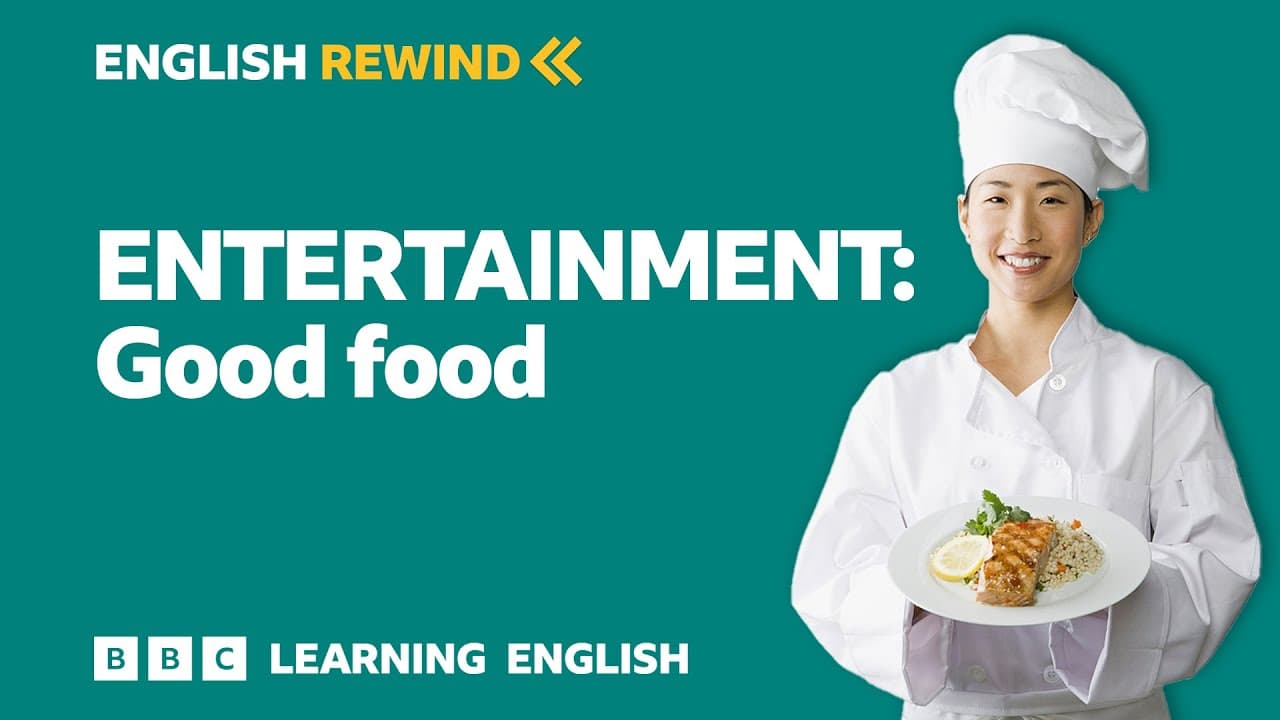
English Rewind - Entertainment: Good food 🍝
TL;DR
Learn English food vocabulary at London's Good Food Show.
Transcript
Hello! Andrew here from BBC Learning English. Just so you know, this programme is from the BBC Learning English archive and was first broadcast in December 2006 on our website. And now, on with the show! BBC Learning English dot com. Hello, I'm Jackie Dalton. Welcome to the programme. Today we're going to take a look at food and the language you mi... Read More
Key Insights
- The program focuses on teaching English vocabulary related to food, using real-life examples from London's Good Food Show.
- Diane, a visitor to the show, describes a duck dish by Gordon Ramsay as 'very tasty' and 'moreish', indicating high enjoyment.
- The word 'moreish' is used to describe food that is so good you want to keep eating more of it.
- Texture-related vocabulary includes 'tough', 'chewy', 'tender', and 'melt in the mouth', each describing different food textures.
- Describing food as 'tough' or 'chewy' is generally not complimentary, while 'tender' and 'melt in the mouth' are positive descriptors.
- The program encourages viewers to use these vocabulary terms to describe their own food experiences.
- The episode is part of the BBC Learning English archive, originally broadcast in December 2006.
- The show aims to improve English language skills by providing practical vocabulary that can be used in everyday situations.
Install to Summarize YouTube Videos and Get Transcripts
Explore YouTube Video Summarizer or Get YouTube Transcript Extractor
Questions & Answers
Q: What is the main focus of this episode?
The main focus of this episode is to teach English vocabulary related to food, particularly how to describe the taste and texture of food. The program uses examples from London's Good Food Show, where visitors describe dishes they have tried, to illustrate these vocabulary terms in a real-world context.
Q: How does Diane describe the duck dish by Gordon Ramsay?
Diane describes the duck dish by Gordon Ramsay as 'very tasty' and 'moreish', indicating that she found the dish enjoyable and difficult to stop eating. She also mentions that it has a 'melt in the mouth' texture, suggesting that the duck was extremely tender and easy to eat.
Q: What does the term 'moreish' mean?
The term 'moreish' is used to describe food that is so delicious that you want to keep eating more of it. It is a positive descriptor that indicates a high level of enjoyment and satisfaction with the food. Diane uses this term to describe the duck dish she tried at the show.
Q: What vocabulary is used to describe food textures?
The program introduces vocabulary to describe food textures, including 'tough', 'chewy', 'tender', and 'melt in the mouth'. 'Tough' and 'chewy' are generally negative descriptors, indicating that the food is difficult to bite or chew, while 'tender' and 'melt in the mouth' are positive, suggesting that the food is soft and easy to eat.
Q: Why are 'tough' and 'chewy' generally not compliments?
Describing food as 'tough' or 'chewy' is generally not complimentary because these terms indicate that the food is difficult to bite or chew, which can make it less enjoyable to eat. 'Tough' suggests that the food requires a lot of effort to break down, while 'chewy' implies that it takes a long time to chew before swallowing.
Q: What does 'melt in the mouth' mean?
The expression 'melt in the mouth' is used to describe food that is extremely tender and soft, requiring little to no effort to chew. It is a highly positive descriptor, indicating that the food breaks down easily and smoothly when eaten, providing a pleasurable eating experience.
Q: What is the purpose of using real-life examples in the program?
The use of real-life examples, such as those from London's Good Food Show, helps to contextualize the vocabulary being taught and makes it more relatable and easier to understand for viewers. By hearing how these terms are used in actual conversations, learners can better grasp their meanings and how to apply them in their own experiences.
Q: How does the program encourage viewer participation?
The program encourages viewer participation by inviting them to use the vocabulary terms discussed to describe their own food experiences. This interactive approach not only reinforces learning but also allows viewers to practice and apply the new vocabulary in real-world situations, enhancing their language skills.
Summary & Key Takeaways
-
This episode of BBC Learning English explores food-related vocabulary, using the setting of London's Good Food Show to provide real-world examples. Diane, a visitor, describes a dish by Gordon Ramsay as 'very tasty' and 'moreish', illustrating positive food descriptors.
-
The program highlights the use of words like 'tough', 'chewy', 'tender', and 'melt in the mouth' to describe food textures. 'Tough' and 'chewy' are generally negative, while 'tender' and 'melt in the mouth' are positive.
-
Viewers are encouraged to apply this vocabulary in their own food experiences. The episode, originally aired in 2006, aims to enhance English language skills by teaching practical vocabulary useful in everyday conversations.
Read in Other Languages (beta)
Share This Summary 📚
Summarize YouTube Videos and Get Video Transcripts with 1-Click
Try YouTube Summary with ChatGPT & Claude or YouTube Transcript Generator
Explore More Summaries from BBC Learning English 📚
Summarize YouTube Videos and Get Video Transcripts with 1-Click
Try YouTube Summary with ChatGPT & Claude or YouTube Transcript Generator