What Is Web3 Governance and How Have DAOs Evolved?
TL;DR
Web3 governance has advanced from decentralized autonomous organizations (DAOs) to legal autonomous organizations (LAOs) that provide a structured legal framework, limiting participant liability and facilitating real-world asset integration. The evolution emphasizes regulatory compliance and specialized investment opportunities, as showcased by examples like the LAO and Flamingo DAO, which enable collaborative decision-making within the Web3 ecosystem.
Transcript
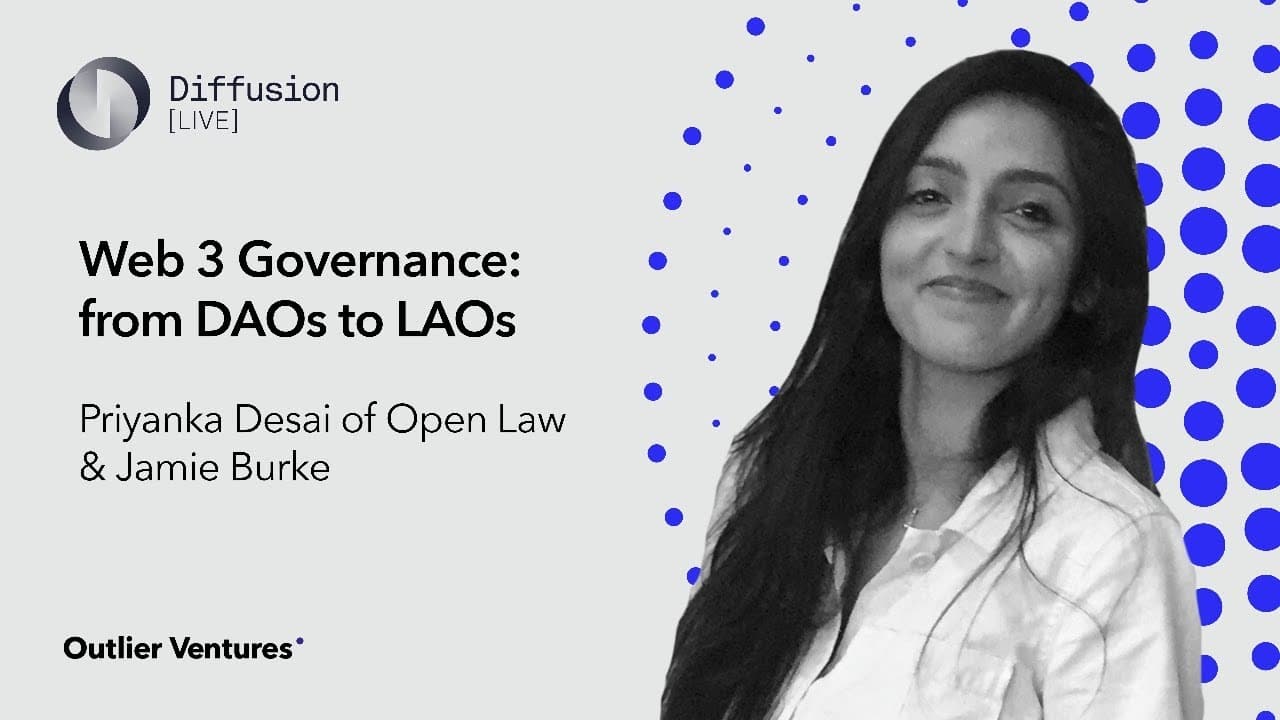
so welcome to another session of diffusion live this time we've got priyanka desai who is the vp of operations at open law and lead ops for the lao and flamingo dao um so the reason why we're going into the topic of dows today the title is web3 governance from daos to laos from decentralized autonomous organizations to legal autonomous organization... Read More
Key Insights
- ❓ DAOs have evolved significantly since the DAO hack, with frameworks like Moloch DAO simplifying the creation and operation of DAOs.
- 🌍 The LAO provides a legal framework for DAOs, limiting liability for participants and enabling the integration of real-world assets.
- 👾 Flamingo DAO focuses on investments and projects in the NFT space, showcasing the diversity and specialization of DAOs.
- 📱 Web3 governance involves not only decentralized decision-making but also legal and regulatory considerations, such as jurisdictional selection and documentation of smart contracts.
- ✊ The LAO and Flamingo DAO both leverage the power of community networks to discover, evaluate, and support projects in the Web3 ecosystem.
- 👻 The flexibility and fluidity of DAOs allow members to participate, invest, and exit according to their interests and preferences.
Install to Summarize YouTube Videos and Get Transcripts
Explore YouTube Video Summarizer or Get YouTube Transcript Extractor
Questions & Answers
Q: What is a DAO?
A DAO, or decentralized autonomous organization, is a web3 organization that utilizes blockchain technology, smart contracts, and decentralized governance to pool capital and make collective decisions on project funding.
Q: How has the concept of DAOs evolved since the DAO hack?
Since the DAO hack, there has been a cooling period followed by a resurgence of interest in DAOs. Frameworks like Moloch DAO have simplified the creation and operation of DAOs, leading to the emergence of projects like the LAO and Flamingo DAO.
Q: What is the difference between a DAO and a LAO?
While a DAO focuses on decentralized governance and decision-making, a LAO adds a legal framework to protect participants and limit their liability. The LAO operates as an LLC and uses familiar partnership structures to ensure compliance and protect members.
Q: How do LAOs like the LAO and Flamingo DAO function in terms of decision-making and investments?
LAOs like the LAO and Flamingo DAO rely on a network of members who discover, discuss, and vote on potential investments. A proposal undergoes a voting process, and if approved, the capital is locked in and the project receives funding. Members have the option to leave during a grace period.
Summary & Key Takeaways
-
DAOs have evolved significantly, both in terms of infrastructure and thinking, since the infamous DAO hack in 2016.
-
The LAO (Legal Autonomous Organization) limits liability for participants and provides a legal framework for DAOs, allowing for real-world asset integration and jurisdictional selection.
-
The LAO and Flamingo DAO, as case studies, demonstrate the ability of DAOs to support investments and projects in various niche areas of the Web3 ecosystem.
Read in Other Languages (beta)
Share This Summary 📚
Summarize YouTube Videos and Get Video Transcripts with 1-Click
Try YouTube Summary with ChatGPT & Claude or YouTube Transcript Generator
Explore More Summaries from Outlier Ventures 📚



Summarize YouTube Videos and Get Video Transcripts with 1-Click
Try YouTube Summary with ChatGPT & Claude or YouTube Transcript Generator