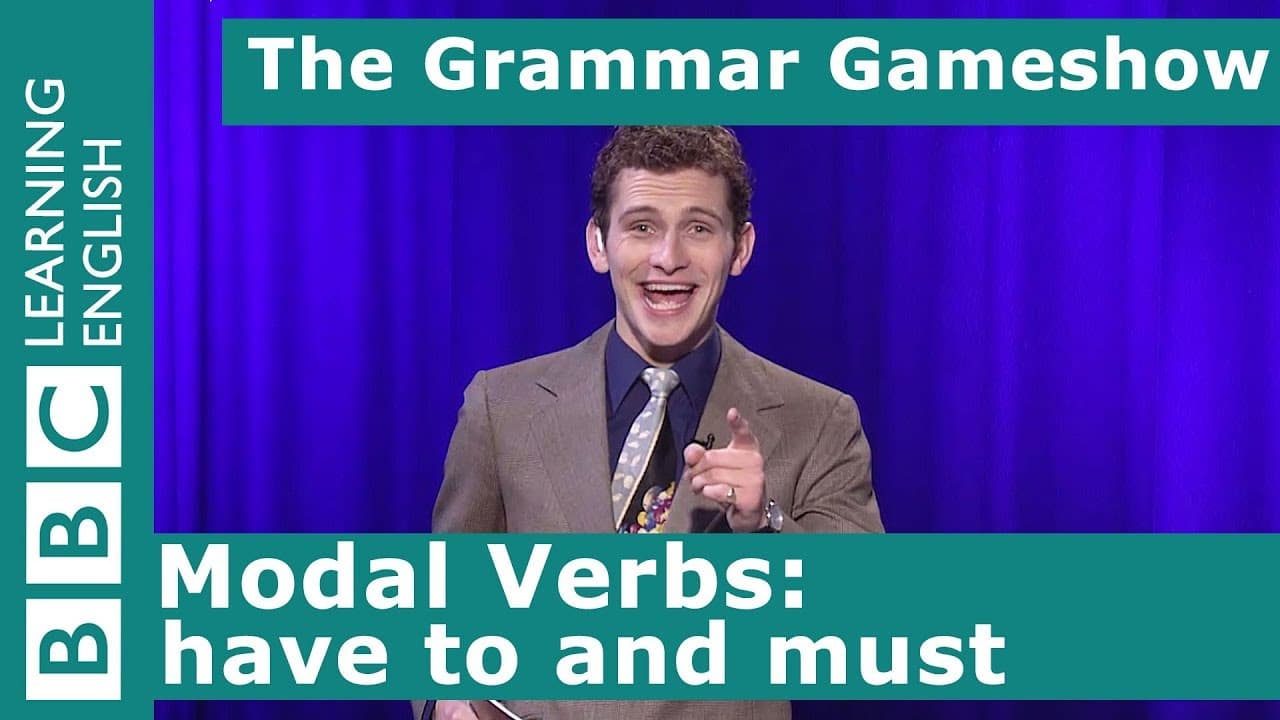
Modal Verbs: Have to and Must: The Grammar Gameshow Episode 5
TL;DR
Explores differences between 'must' and 'have to' in obligations.
Transcript
Hello, and welcome to today’s Grammar Gameshow! I’m your host, Will, but I’m no has been! And of course, let’s not forget Leslie, our all-knowing voice in the sky. Hello, everyone! Tonight we’re going to ask you three questions about… Have to and must. Those two little expressions that are to do with obligation and make all the rules! OK! Now, let’... Read More
Key Insights
- The show focuses on the differences between 'must' and 'have to', two expressions related to obligations in English grammar.
- 'Must' is used for internal obligations, while 'have to' is used for external obligations, highlighting their distinct uses.
- Unlike other modal verbs, 'have to' changes form to reflect person and time, making it unique among modals.
- Contestants engage in a series of questions to demonstrate their understanding of 'must' and 'have to'.
- 'Must' and 'have to' are followed by a bare infinitive verb, a common trait among modal verbs.
- The Grammar Gameshow uses a lighthearted, humorous approach to teach English grammar in an engaging way.
- Points awarded during the show seem arbitrary, adding an element of unpredictability and entertainment.
- The episode concludes with Mya winning the game, emphasizing learning through competition.
Install to Summarize YouTube Videos and Get Transcripts
Explore YouTube Video Summarizer or Get YouTube Transcript Extractor
Questions & Answers
Q: What is the main focus of the Grammar Gameshow episode?
The main focus of this episode is to explore the differences between the modal verbs 'must' and 'have to', particularly in terms of their use in expressing obligations. The show aims to clarify when to use each expression, emphasizing that 'must' is for internal obligations and 'have to' is for external ones.
Q: How does 'have to' differ from other modal verbs?
'Have to' differs from other modal verbs because it changes form to reflect person and time. For example, it can appear as 'have to', 'has to', 'had to', or 'didn't have to'. This is unlike other modal verbs, which do not change form in this way, even though they all follow a bare infinitive verb.
Q: What educational approach does the Grammar Gameshow use?
The Grammar Gameshow uses a lighthearted and humorous approach to teaching English grammar. By incorporating elements of a game show, it engages viewers in learning through competition and entertainment. The whimsical distribution of points and humorous commentary contribute to an enjoyable and educational experience.
Q: What key grammar rules are highlighted in the episode?
The episode highlights several key grammar rules, including the use of 'must' for internal obligations and 'have to' for external obligations. It also emphasizes that both expressions are followed by a bare infinitive verb. The unique feature of 'have to' changing form to indicate person and time is also discussed.
Q: Who were the contestants and what was the outcome?
The contestants were Simone and Mya. Throughout the episode, they answered questions to demonstrate their understanding of 'must' and 'have to'. Mya emerged as the winner with 37 and a half points, while Simone lost points due to incorrect answers, highlighting the competitive aspect of the show.
Q: How does the show make learning grammar entertaining?
The show makes learning grammar entertaining by using a game show format that includes humor, whimsical point distribution, and a playful host. The unpredictability of the game, coupled with engaging questions and a lighthearted tone, keeps viewers entertained while effectively teaching grammar concepts.
Q: What is the significance of the quick-fire question segment?
The quick-fire question segment is significant as it tests the contestants' ability to quickly and accurately apply their understanding of 'must' and 'have to' in different contexts. This segment reinforces the distinctions between internal and external obligations and challenges contestants to think on their feet, enhancing their learning experience.
Q: What prize did the winner receive, and what does it signify?
The winner, Mya, received a cuddly toy as a prize. This humorous and modest prize signifies the show's playful and lighthearted nature, emphasizing that the real reward is the knowledge gained rather than the material prize. It adds to the show's charm and reinforces its educational focus.
Summary & Key Takeaways
-
The Grammar Gameshow episode explores the differences between 'must' and 'have to', focusing on their use in expressing obligations. Contestants Simone and Mya answer questions to test their understanding, with Mya emerging as the winner. The show uses humor and unpredictability to make grammar learning engaging.
-
Contestants learn that 'must' is used for internal obligations, while 'have to' is for external ones. The show highlights that 'have to' changes form, unlike other modal verbs. Points are awarded in a whimsical manner, adding to the entertainment value of the educational content.
-
The episode is part of a series aimed at helping viewers learn English grammar through fun quizzes. The Grammar Gameshow combines education with entertainment, using a game format to teach language rules, with a focus on the nuances of 'must' and 'have to'.
Read in Other Languages (beta)
Share This Summary 📚
Summarize YouTube Videos and Get Video Transcripts with 1-Click
Try YouTube Summary with ChatGPT & Claude or YouTube Transcript Generator
Explore More Summaries from BBC Learning English 📚
Summarize YouTube Videos and Get Video Transcripts with 1-Click
Try YouTube Summary with ChatGPT & Claude or YouTube Transcript Generator