Physics Vs Math - How to Pick the Right Major
TL;DR
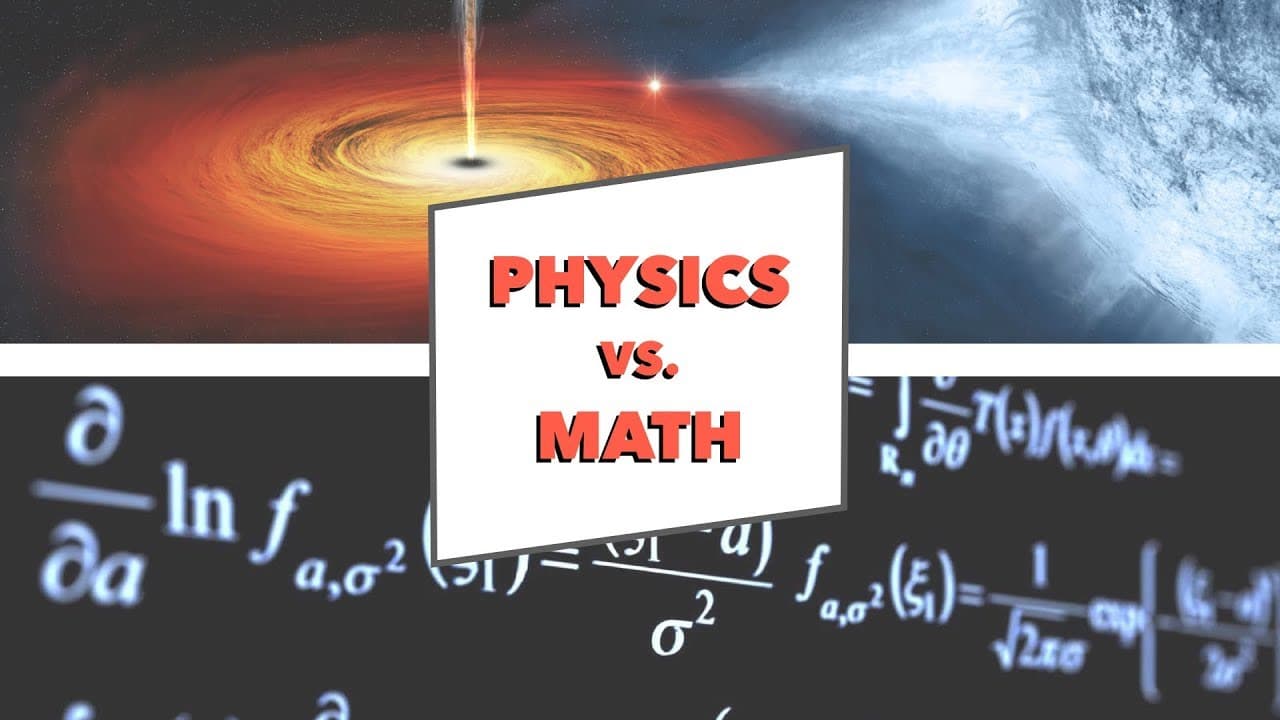
Physics and math majors have some overlapping coursework in undergraduate education, but the focus and content differ significantly. Math majors focus on proofs and abstract concepts, while physics majors study applied math and specialized physics topics.
Transcript
physics and math are two subjects we are exposed to before we even enter college and if you like both then logically you may want to major in one but can't decide which one to pick let's go through some of the similarities and differences so you can make a more educated decision first I want to say that all physics majors take a lot of the same cla... Read More
Key Insights
- ❓ Physics and math majors share foundational coursework but diverge as they progress.
- ❓ Physics majors focus on applied math and specialized physics topics, while math majors delve into proofs and abstract concepts.
- 🤙 Physics majors have more hands-on laboratory experiences, while math majors focus more on theoretical and mathematical concepts.
- 💻 Math majors often pursue careers in academia, mathematics research, computer science, or finance.
- 🏑 Physics majors have a wider range of career options, including research in particle physics, energy, engineering, or technology fields.
- 🎓 The job market for both majors requires further education and specialization beyond a bachelor's degree.
- ❓ Math and physics skills can be applicable to a variety of industries, and job opportunities can be found outside of strictly defined disciplines.
Install to Summarize YouTube Videos and Get Transcripts
Explore YouTube Video Summarizer or Get YouTube Transcript Extractor
Questions & Answers
Q: What are the main differences between physics and math majors in undergraduate education?
Physics majors focus on applied math and specialized physics topics, while math majors learn proofs, abstract algebra, and real analysis. Physics majors also have more hands-on laboratory experiences.
Q: Do physics and math majors share any coursework in undergraduate education?
Yes, both majors typically take foundational courses, such as calculus, linear algebra, and differential equations. However, as they progress, the content becomes more distinct to each discipline.
Q: Can math majors minor in physics or take physics electives?
Yes, math majors may have the option to choose physics electives or even minor in physics. However, the level of physics knowledge gained in math programs is limited compared to that of physics majors.
Q: What kind of jobs do math majors typically pursue?
Math majors often choose careers in academia, mathematical research, computer science, finance, or data analysis. They may also work on developing encryption algorithms or improving search algorithms.
Q: What are some specialized topics that physics majors study in undergraduate education?
Physics majors delve into areas such as vector analysis, partial differential equations, quantum mechanics, classical mechanics, and electromagnetism. They also gain hands-on experience in the laboratory.
Key Insights:
- Physics and math majors share foundational coursework but diverge as they progress.
- Physics majors focus on applied math and specialized physics topics, while math majors delve into proofs and abstract concepts.
- Physics majors have more hands-on laboratory experiences, while math majors focus more on theoretical and mathematical concepts.
- Math majors often pursue careers in academia, mathematics research, computer science, or finance.
- Physics majors have a wider range of career options, including research in particle physics, energy, engineering, or technology fields.
- The job market for both majors requires further education and specialization beyond a bachelor's degree.
- Math and physics skills can be applicable to a variety of industries, and job opportunities can be found outside of strictly defined disciplines.
- Having a clear plan and understanding of career opportunities is important when choosing between physics and math majors in undergraduate education.
Summary & Key Takeaways
-
Physics and math majors in undergraduate education share some foundational courses, such as calculus, linear algebra, and differential equations.
-
Physics majors diverge into specialized coursework, including vector analysis, partial differential equations, quantum mechanics, and classical mechanics.
-
Math majors take courses in proofs, abstract algebra, real analysis, and may have the option to study topology, complex analysis, or number theory.
-
While math majors may minor in physics or take some electives in physics, the level of physics knowledge in math programs is limited.
-
Math majors tend to pursue careers in academia, mathematical research, computer science, or finance, while physics majors have a wider range of options, including research in particle physics, energy, or engineering.
Read in Other Languages (beta)
Share This Summary 📚
Summarize YouTube Videos and Get Video Transcripts with 1-Click
Try YouTube Summary with ChatGPT & Claude or YouTube Transcript Generator
Explore More Summaries from Zach Star 📚
Summarize YouTube Videos and Get Video Transcripts with 1-Click
Try YouTube Summary with ChatGPT & Claude or YouTube Transcript Generator