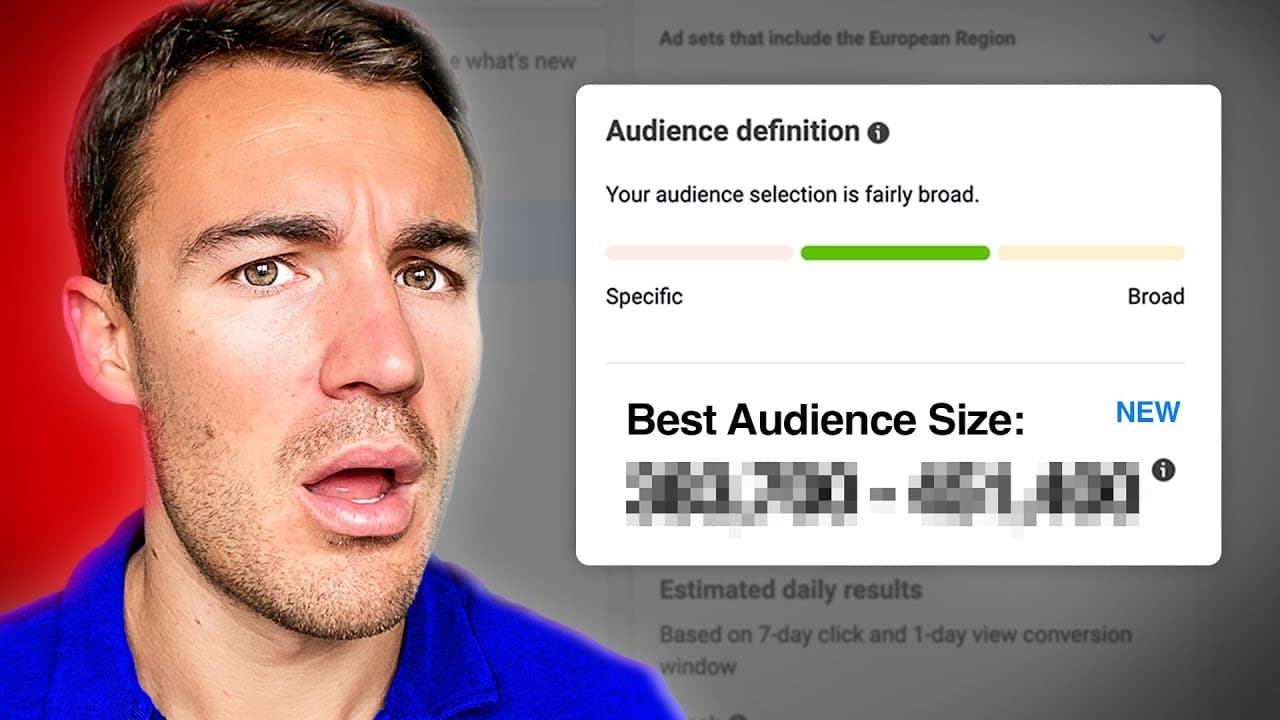
Facebook just told us the BEST Audience Size!
TL;DR
Meta recommends broad targeting with 2 million+ audience size.
Transcript
meta has come out with a new recommendation when it comes to the ideal Facebook ads audience s now meta isn't usually anywhere near as clear with their recommendations as this and I think this represents a big Facebook ads targeting change and we're going to need to adjust our approach as advertisers to accommodate this So Meta released documentati... Read More
Key Insights
- Meta now recommends using a broad targeting strategy, encouraging advertisers to set audience sizes to over 2 million people for optimal performance.
- Broad targeting can reduce the cost per action by an average of 12%, as it allows Meta's delivery system more flexibility in choosing ad recipients.
- The recommendation to target audiences larger than 2 million is a significant change from previous advice, which suggested not going below 500,000.
- Advertisers should still tailor their targeting to make sense for their business, rather than blindly following the 2 million+ guideline.
- Meta's new approach filters audience size estimates to include only active accounts served ads in the past 30 days, excluding inactive users.
- Broad targeting benefits Meta by filling more ad inventory, but it can also benefit advertisers by leveraging Meta's AI to find optimal ad recipients.
- Testing different targeting options, including broad, lookalikes, and detailed targeting, remains crucial as results can vary across businesses.
- Meta's recommendation aligns with a trend towards larger audiences performing better, as seen in testing over the past few years.
Install to Summarize YouTube Videos and Get Transcripts
Explore YouTube Video Summarizer or Get YouTube Transcript Extractor
Questions & Answers
Q: Why has Meta recommended a 2 million+ audience size?
Meta recommends a 2 million+ audience size to enhance the flexibility of its ad delivery system. Larger audiences allow Meta's algorithms to better identify optimal ad recipients, potentially reducing costs and improving performance. This recommendation aligns with trends showing that broader targeting often yields better results for advertisers.
Q: What is broad targeting, and why is it beneficial?
Broad targeting involves not using detailed targeting options or lookalikes, instead allowing Meta to determine the best ad recipients within a large audience. This method is beneficial because it can reduce costs, increase flexibility, and leverage Meta's AI capabilities to optimize ad delivery and performance.
Q: How does Meta's new audience size estimation work?
Meta's new audience size estimation includes only active accounts that have been served ads in the past 30 days. This change excludes inactive users, providing advertisers with a more accurate assessment of their potential reach and allowing for better campaign planning and targeting adjustments.
Q: Is it always best to follow Meta's 2 million+ audience recommendation?
While Meta's 2 million+ recommendation can be beneficial, it's not always the best choice for every advertiser. Businesses should tailor their targeting strategies to their specific needs, testing various options like detailed targeting or lookalikes, as results can vary depending on the business and target audience.
Q: What should advertisers do if their audience is below 2 million?
Advertisers with audiences below 2 million shouldn't worry if it makes sense for their business. Testing smaller, targeted audiences can still yield effective results, especially if they align with specific business objectives or target demographics. It's crucial to experiment and find what works best for your particular situation.
Q: How does broad targeting benefit Meta as a platform?
Broad targeting benefits Meta by allowing it to fill more ad inventory across its vast user base. By encouraging advertisers to target larger audiences, Meta can serve ads to a broader range of users, optimizing its platform's ad slots and potentially increasing revenue from advertisers seeking better ad performance.
Q: What impact does filtering inactive accounts have on audience size estimates?
Filtering inactive accounts from audience size estimates provides advertisers with a more accurate representation of their potential reach. This adjustment helps advertisers plan and execute campaigns more effectively, ensuring that their ads are shown to active users who are more likely to engage with the content.
Q: Why is it important to test different targeting options?
Testing different targeting options is essential because ad performance can vary significantly based on the business, audience, and market conditions. By experimenting with broad, lookalike, and detailed targeting, advertisers can identify the strategies that deliver the best results for their specific objectives and optimize their campaigns accordingly.
Summary & Key Takeaways
-
Meta has issued new guidance for Facebook ads, urging advertisers to use broad targeting with audience sizes exceeding 2 million. This shift aims to enhance the flexibility and effectiveness of Meta's ad delivery system.
-
The recommendation for broader audience sizes represents a significant change from previous practices, where advertisers were advised to maintain audiences above 500,000. Broad targeting can potentially lower costs and improve ad performance.
-
Meta's updated approach excludes inactive accounts from audience size estimates, focusing only on active users served ads recently. This change aids advertisers in accurately assessing their potential reach and planning campaigns.
Read in Other Languages (beta)
Share This Summary 📚
Summarize YouTube Videos and Get Video Transcripts with 1-Click
Try YouTube Summary with ChatGPT & Claude or YouTube Transcript Generator
Explore More Summaries from Ben Heath 📚
Summarize YouTube Videos and Get Video Transcripts with 1-Click
Try YouTube Summary with ChatGPT & Claude or YouTube Transcript Generator