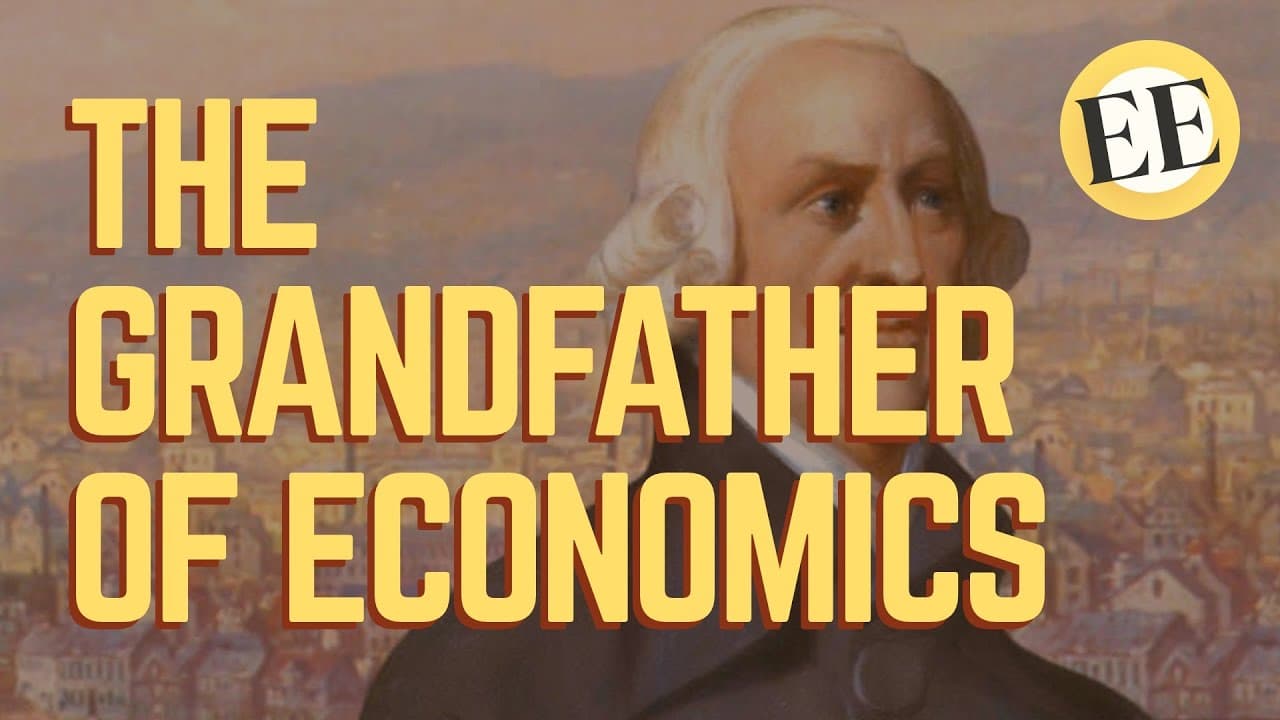
Adam Smith: The Grandfather Of Economics
TL;DR
Adam Smith revolutionized economics with his book 'The Wealth of Nations'.
Transcript
this is Adam Smith Adam Smith was a Scottish philosopher and author who is probably best known for writing a book titled an inquiry into the nature and causes of the wealth of nations this book effectively marked the beginnings of economics as a separate academic discipline as Adam Smith now heralded as the father of economics lay the foundation fo... Read More
Key Insights
- Adam Smith is considered the father of economics, laying the foundation for modern economic principles with 'The Wealth of Nations'.
- Smith's work marked a shift from mercantilism, emphasizing that wealth could be created through industry, not just agriculture.
- He introduced the concept of value-adding production, where manufacturing processes increase the value of raw materials.
- Smith identified land, labor, and capital as essential factors of production, highlighting the importance of capital in wealth creation.
- His ideas promoted the transition from agrarian economies to industrial ones, encouraging nations to develop industries for economic growth.
- Smith emphasized the role of trade and specialization, suggesting that nations should focus on producing goods they are best at and trade with others.
- He argued for minimal government intervention in markets, advocating for a free market economy driven by individual choices.
- Smith's theories contributed to the rise of capitalism and influenced democratic movements by promoting individual choice in the economy.
Install to Summarize YouTube Videos and Get Transcripts
Explore YouTube Video Summarizer or Get YouTube Transcript Extractor
Questions & Answers
Q: What was Adam Smith's main contribution to economics?
Adam Smith's main contribution to economics was his book 'The Wealth of Nations', which laid the foundation for modern economic principles. He challenged the mercantilist view that wealth was a zero-sum game and introduced the idea that wealth could be created through industrialization and trade, emphasizing the importance of production and specialization.
Q: How did Adam Smith's ideas differ from mercantilism?
Adam Smith's ideas differed from mercantilism by rejecting the notion that wealth was a zero-sum game. Instead, he argued that wealth could be created through industrialization and trade. Smith emphasized the importance of production, specialization, and free markets, contrasting with mercantilism's focus on hoarding wealth and limiting imports to increase national wealth.
Q: What are the factors of production according to Adam Smith?
According to Adam Smith, the factors of production are land, labor, and capital. He highlighted the importance of capital, which includes anything that contributes to production, such as machinery and tools. Smith's identification of these factors laid the groundwork for understanding how resources are used to create goods and services in an economy.
Q: Why did Adam Smith advocate for minimal government intervention in markets?
Adam Smith advocated for minimal government intervention in markets because he believed that individuals acting in their self-interest would naturally lead to efficient resource allocation and wealth creation. He argued that government should focus on maintaining market integrity by enforcing contracts and ensuring safety, allowing the free market to drive economic growth and innovation.
Q: How did Adam Smith's theories influence the transition from agrarian to industrial economies?
Adam Smith's theories influenced the transition from agrarian to industrial economies by highlighting the potential for wealth creation through industrialization. He argued that manufacturing could add value to raw materials, similar to agriculture, and encouraged nations to develop industries, improve technologies, and educate their populations to foster economic growth beyond traditional farming.
Q: What role did trade and specialization play in Adam Smith's economic theories?
Trade and specialization played a crucial role in Adam Smith's economic theories. He suggested that individuals and nations should focus on producing goods they are best at and trade with others to increase overall wealth. This specialization leads to increased efficiency and productivity, as individuals and nations can take advantage of their unique strengths and resources.
Q: How did Adam Smith's ideas contribute to the rise of capitalism?
Adam Smith's ideas contributed to the rise of capitalism by promoting the concept of a free market economy driven by individual choices. His emphasis on minimal government intervention, specialization, and trade laid the foundation for capitalist systems, where competition and self-interest drive innovation and economic growth. Smith's work supported the idea of economic freedom and personal responsibility in wealth creation.
Q: In what ways did Adam Smith's theories align with democratic movements of his time?
Adam Smith's theories aligned with democratic movements of his time by emphasizing individual choice and freedom in economic activities. Just as democratic movements advocated for political freedom and the right to choose leaders, Smith's economic theories supported the idea that individuals should have the freedom to choose their work and products, contributing to the broader ethos of personal liberty and self-determination.
Summary & Key Takeaways
-
Adam Smith, the Scottish philosopher, revolutionized economics with his seminal work 'The Wealth of Nations', which laid the groundwork for modern economic principles. He challenged the mercantilist view by suggesting that wealth could be generated through industrialization, not just agriculture, and highlighted the importance of trade and specialization.
-
Smith introduced key economic concepts such as the factors of production—land, labor, and capital—and emphasized the role of capital in creating value. His theories encouraged nations to transition from agrarian to industrial economies, fostering economic growth through improved technologies and education.
-
Smith's advocacy for a free market economy with minimal government intervention reshaped economic thought, promoting individual choice and specialization. His ideas not only influenced economic policies but also contributed to the rise of capitalism and democratic movements by emphasizing personal freedom in both economic and political spheres.
Read in Other Languages (beta)
Share This Summary 📚
Summarize YouTube Videos and Get Video Transcripts with 1-Click
Try YouTube Summary with ChatGPT & Claude or YouTube Transcript Generator
Explore More Summaries from Economics Explained 📚






Summarize YouTube Videos and Get Video Transcripts with 1-Click
Try YouTube Summary with ChatGPT & Claude or YouTube Transcript Generator