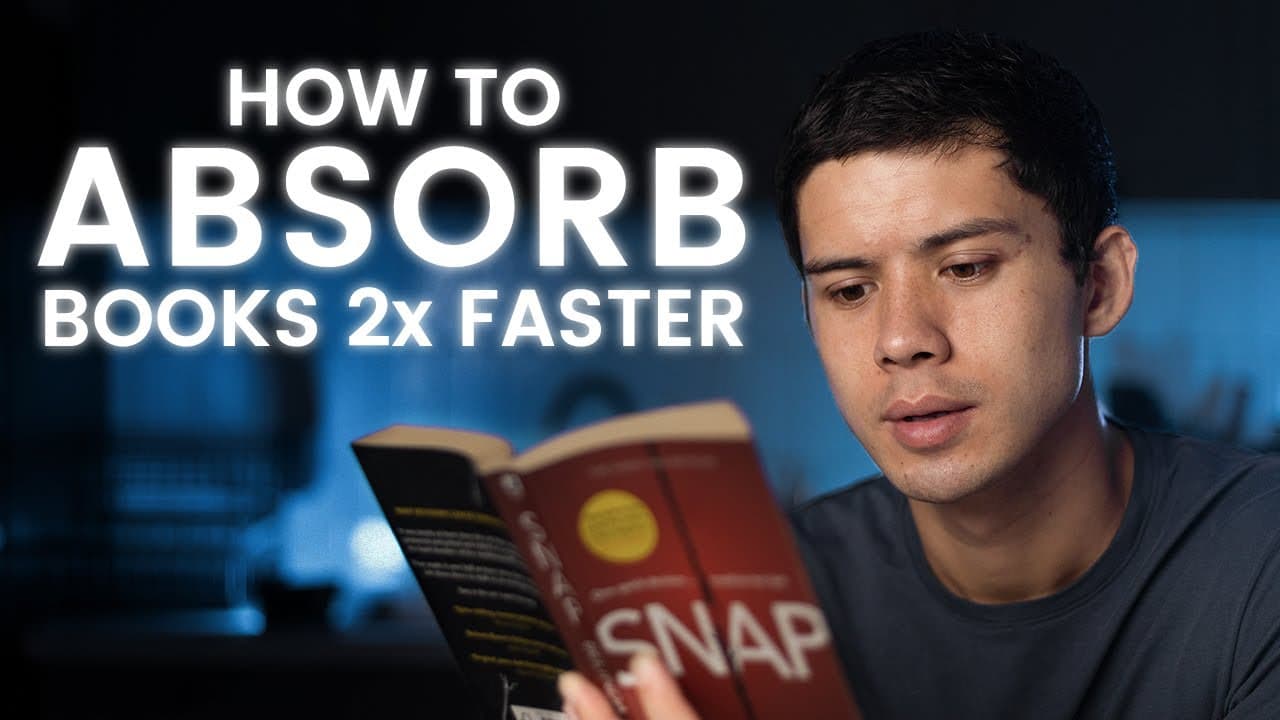
How to Absorb Books 2x Faster (Speed Learning)
TL;DR
Learn to absorb books faster using speed learning techniques.
Transcript
being able to utilize speed learning strategies into your daily life is an absolute superpower whether you need to memorize vast amounts of information for your exams or you're just like me and you're constantly reading books and watching documentaries and listening to podcasts and you want to kind of remember long term everything you learn then th... Read More
Key Insights
- The Law of Least Effort suggests utilizing minimal effort for maximum productivity, allowing natural curiosity to guide learning and avoiding mental fatigue.
- Distributed practice involves repetition to transfer concepts from short-term to long-term memory, with tools like book summary apps aiding in this process.
- Attacking learning from multiple angles by exploring various sources can deepen understanding and satisfy curiosity about a subject.
- Reading consciously and deliberately ensures better retention by actively engaging with the material rather than passively consuming it.
- Reflection boosting involves pausing to meditate on what was read, linking new information to existing knowledge, enhancing memory retention.
- Creating searchable notes in a knowledge bank helps retain and revisit key insights, ensuring important information remains accessible and fresh.
- Shortform book summaries offer a time-efficient way to revisit and reinforce knowledge from previously read books, aiding in long-term retention.
- Self-education, through strategic learning and resource utilization, can significantly enhance personal and professional growth.
Install to Summarize YouTube Videos and Get Transcripts
Explore YouTube Video Summarizer or Get YouTube Transcript Extractor
Questions & Answers
Q: What is the Law of Least Effort?
The Law of Least Effort is a principle suggesting that humans naturally seek the path of least resistance to achieve tasks. This approach can enhance productivity by focusing on tasks that are easy and enjoyable, reducing mental fatigue, and allowing for more efficient learning and retention of information.
Q: How does distributed practice aid in learning?
Distributed practice involves repeated exposure to information over time, which helps transfer knowledge from short-term to long-term memory. Techniques such as using flashcards or revisiting book summaries periodically can reinforce learning, making it more likely that the information will be retained and recalled when needed.
Q: How can attacking learning from multiple angles benefit understanding?
Attacking learning from multiple angles involves exploring various sources and perspectives on a topic. This approach can deepen understanding, satisfy curiosity, and provide a more comprehensive view of the subject, making it easier to connect new information with existing knowledge and enhancing overall retention.
Q: Why is reading consciously and deliberately important?
Reading consciously and deliberately ensures active engagement with the material, which is crucial for understanding and retaining information. By focusing on the content, rather than passively consuming it, readers are more likely to make meaningful connections and remember what they have read, improving overall learning efficiency.
Q: What is reflection boosting and how does it work?
Reflection boosting is a technique where after reading a page, one takes a moment to meditate on the content, recalling what was learned and linking it to existing knowledge. This process helps embed new information into long-term memory, making it more likely to be retained and recalled in the future.
Q: How can creating searchable notes aid in learning?
Creating searchable notes allows for easy retrieval and review of important information. By organizing key insights in a knowledge bank, learners can revisit and reinforce their understanding, keeping critical concepts fresh in their minds and enhancing the likelihood of long-term retention and application.
Q: What role do Shortform book summaries play in learning?
Shortform book summaries provide concise overviews of key concepts from non-fiction books, allowing readers to quickly revisit and reinforce their understanding without rereading entire books. This efficient method supports distributed practice and helps maintain long-term retention of important information and insights.
Q: How does self-education contribute to personal growth?
Self-education empowers individuals to take control of their learning, utilizing strategies and resources that enhance understanding and retention. By actively engaging in self-directed learning, individuals can acquire new skills and knowledge, leading to significant personal and professional growth and development.
Summary & Key Takeaways
-
Speed learning involves using techniques like the Law of Least Effort to maximize productivity by focusing on easy and enjoyable tasks, thus avoiding mental fatigue and enhancing learning retention.
-
Distributed practice and tools like Shortform summaries enable efficient learning by incorporating repetition and revisiting key concepts, facilitating the transfer of information to long-term memory.
-
Engaging with content from multiple sources and maintaining a knowledge bank of searchable notes encourages deeper understanding and supports long-term memory retention through active learning.
Read in Other Languages (beta)
Share This Summary 📚
Summarize YouTube Videos and Get Video Transcripts with 1-Click
Try YouTube Summary with ChatGPT & Claude or YouTube Transcript Generator
Explore More Summaries from Mike Dee 📚


Summarize YouTube Videos and Get Video Transcripts with 1-Click
Try YouTube Summary with ChatGPT & Claude or YouTube Transcript Generator