What Are the Exponential and Logarithmic Integral Functions?
TL;DR
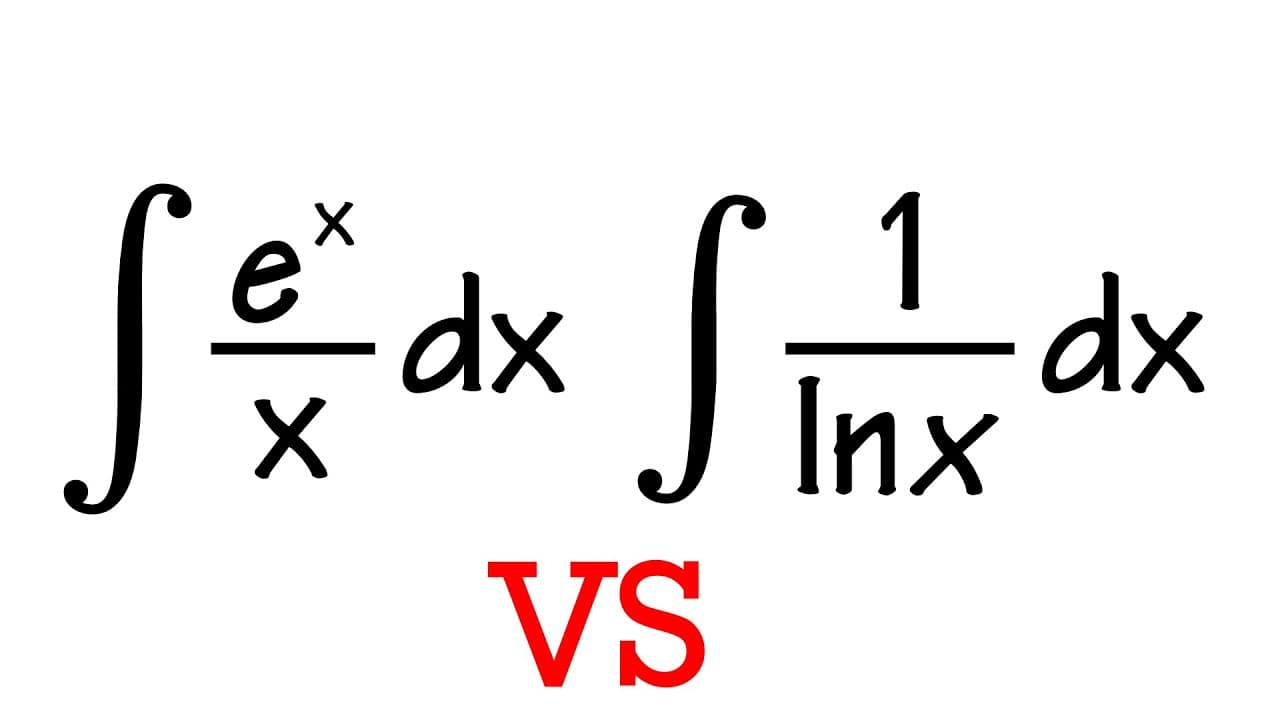
The exponential integral function Ei(x) helps solve the integral of e^x/x, while the logarithmic integral function Li(x) solves the integral of 1/ln(x). These functions have specific input restrictions: Ei(x) requires x ≠ 0, and Li(x) requires x > 0 and x ≠ 1.
Transcript
okay let's do some math Oh funny let's talk about two special functions that your property has in a work phone alpha and we are going to make more sense of that means video because keep in mind the more functions that we have the more intercourse you can do the more pleasures that we can have in our lives isn't it yes therefore let's take a look at... Read More
Key Insights
- 🎮 The video explains the exponential integral function, Ei(x), and logarithmic integral function, Li(x), which are used in calculus to solve certain integrals.
- 🍉 Ei(x) is defined in terms of an integral and can be differentiated to obtain e^x/x. Li(x) is also defined in terms of an integral and has restrictions on its input.
- ➖ There are connections between Ei(x) and Li(x), with Ei(x) being equal to Li(x) minus Li(2).
Install to Summarize YouTube Videos and Get Transcripts
Explore YouTube Video Summarizer or Get YouTube Transcript Extractor
Questions & Answers
Q: What is the purpose of using special functions like Ei(x) and Li(x) in calculus?
Special functions like Ei(x) and Li(x) are used to solve integrals that do not have elementary solutions. These functions provide a way to obtain approximate values for these integrals.
Q: Can the exponential integral function, Ei(x), be differentiated?
Yes, Ei(x) can be differentiated. If you differentiate Ei(x), you will obtain e^x/x. This differentiation property makes Ei(x) a useful tool in solving certain differential equations.
Q: Is there a relationship between the exponential integral function, Ei(x), and the logarithmic integral function, Li(x)?
Yes, there is a connection between Ei(x) and Li(x). The video explains that Ei(x) is equal to Li(x) minus Li(2), where Li(x) is the integral of 1/ln(x). This relationship can be derived by considering the limits and domains of these functions.
Q: Are there any restrictions on the inputs of the logarithmic integral function, Li(x)?
Yes, Li(x) has restrictions on its inputs. It is only defined for x > 0, and if x=1, the integral does not converge and results in negative infinity. This means that Li(x) is not applicable for x=1.
Summary & Key Takeaways
-
The video discusses the exponential integral function, denoted as Ei(x), which is defined in terms of an integral and helps solve the integral of e^x/x.
-
It also covers the logarithmic integral function, denoted as Li(x), which is defined in terms of an integral and helps solve the integral of 1/ln(x).
-
Both functions have restrictions on their inputs, with Ei(x) requiring x ≠ 0 and Li(x) requiring x > 0 and x ≠ 1.
Read in Other Languages (beta)
Share This Summary 📚
Summarize YouTube Videos and Get Video Transcripts with 1-Click
Try YouTube Summary with ChatGPT & Claude or YouTube Transcript Generator
Explore More Summaries from blackpenredpen 📚
Summarize YouTube Videos and Get Video Transcripts with 1-Click
Try YouTube Summary with ChatGPT & Claude or YouTube Transcript Generator