L23.4 Symmetric and Antisymmetric states of N particles
TL;DR
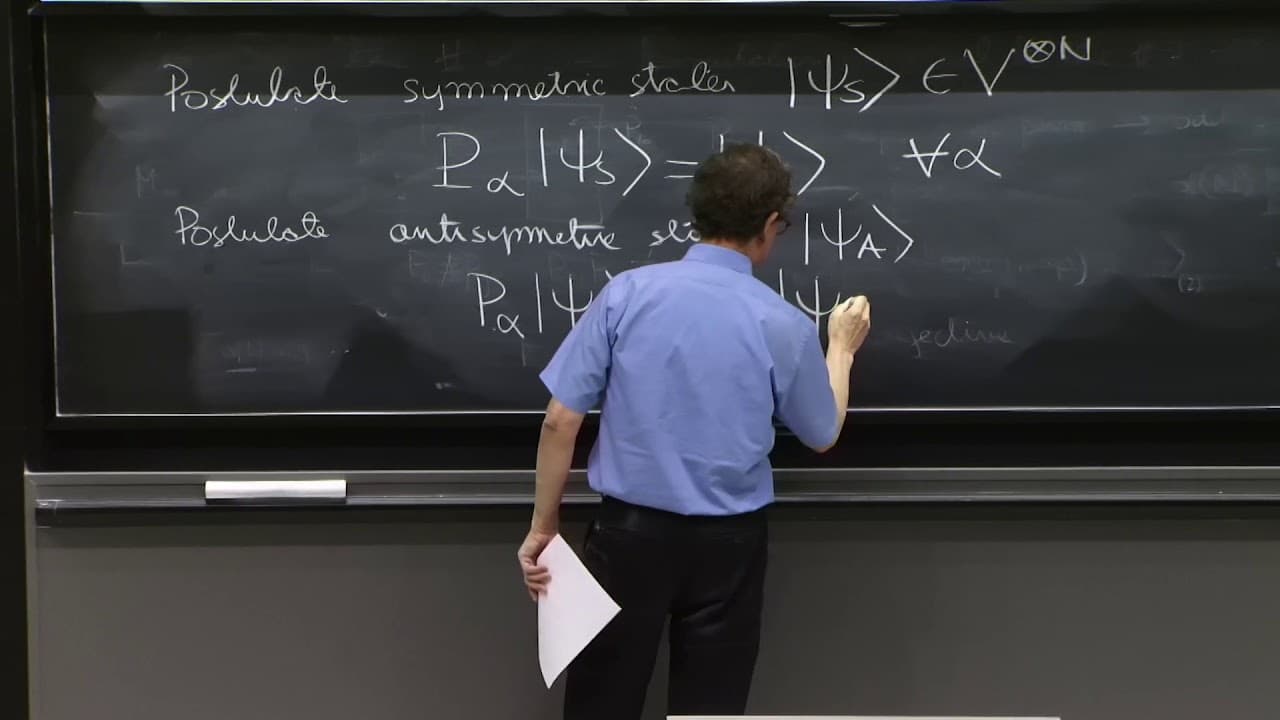
Quantum mechanics introduces symmetric and anti-symmetric states that are eigenstates of permutation operators and help solve the problem of exchange degeneracy.
Transcript
PROFESSOR: With this, we can phase the construction of the operators that are going to help us build totally symmetric states and totally anti-symmetric states, and understand why we solve the problem of degeneracy, exchange degeneracy. So let us look into that. So this is called complete symmetrizers and anti-symmetrizers, complete symmetrizers an... Read More
Key Insights
- 🦾 Permutation operators in quantum mechanics do not commute, making simultaneous diagonalization impossible.
- 🇦🇬 Special states, such as symmetric and anti-symmetric states, can be found that are eigenstates of all permutation operators.
- 🤘 Symmetric states are invariant under permutation operators, while anti-symmetric states change sign.
- 🤙 Symmetric states form a subspace called symN(V), and anti-symmetric states form a subspace called antiN(V).
- 👾 Projectors can be used to reach these subspaces, but they do not form a basis in the full Hilbert space.
- 🤘 The sign factor, epsilon, ensures consistent sign changes for anti-symmetric states.
Install to Summarize YouTube Videos and Get Transcripts
Explore YouTube Video Summarizer or Get YouTube Transcript Extractor
Questions & Answers
Q: What is the significance of permutation operators in quantum mechanics?
Permutation operators in quantum mechanics represent the exchange of particles. They do not commute and cannot be simultaneously diagonalized.
Q: Can symmetric states in quantum mechanics form a basis in the full Hilbert space?
No, symmetric states cannot form a basis in the full Hilbert space because permutation operators do not commute. However, they can be reached by using projectors into a subspace of symmetric states.
Q: How are anti-symmetric states different from symmetric states?
Anti-symmetric states change sign under permutation operators. They are defined with a sign factor, epsilon, associated with each permutation. This solves the problem of inconsistent sign changes for multiple transpositions.
Q: What are the names given to the subspaces of symmetric and anti-symmetric states?
The subspace of symmetric states is called symN(V), representing symmetric states of N particles in space V. The subspace of anti-symmetric states is called antiN(V).
Summary & Key Takeaways
-
Permutation operators in quantum mechanics do not commute and cannot be simultaneously diagonalized.
-
However, it is possible to find special states that are eigenstates of all permutation operators.
-
Symmetric states are invariant under permutation operators and have eigenvalue 1, while anti-symmetric states change sign under permutation operators.
Read in Other Languages (beta)
Share This Summary 📚
Summarize YouTube Videos and Get Video Transcripts with 1-Click
Try YouTube Summary with ChatGPT & Claude or YouTube Transcript Generator
Explore More Summaries from MIT OpenCourseWare 📚


Summarize YouTube Videos and Get Video Transcripts with 1-Click
Try YouTube Summary with ChatGPT & Claude or YouTube Transcript Generator