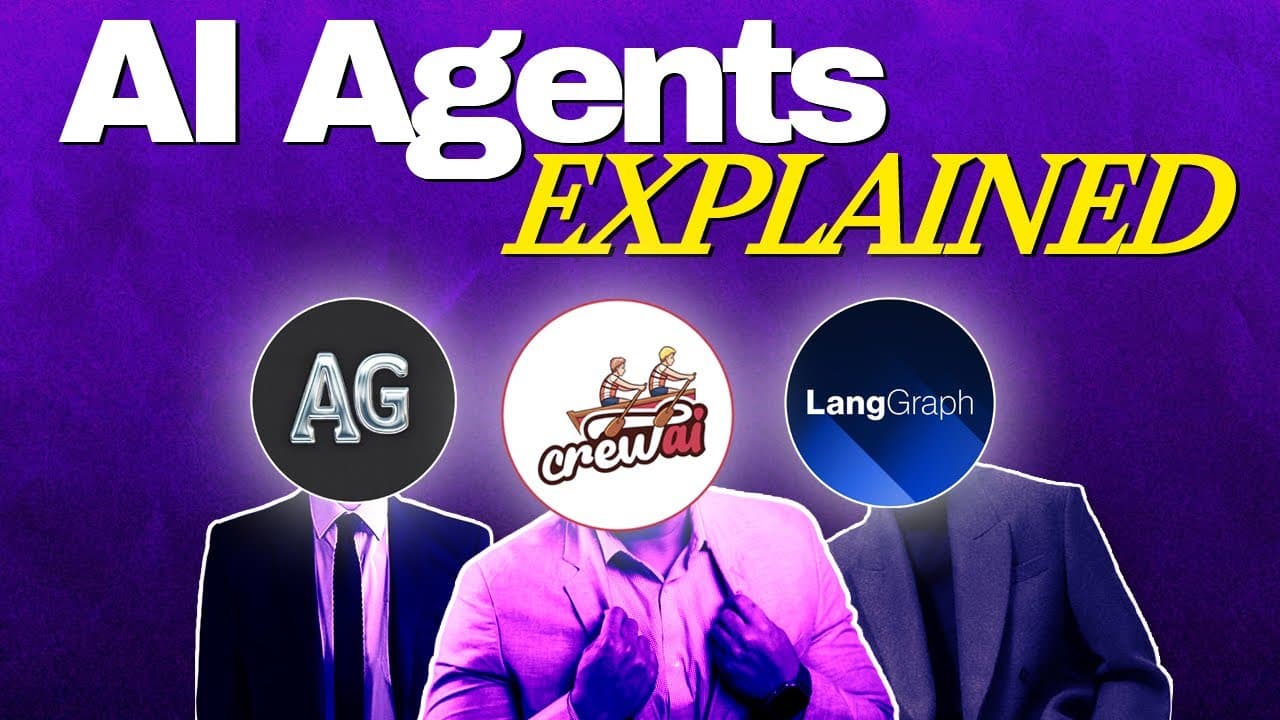
AI Agents EXPLAINED: Unbiased Review of Langraph, AutoGen, and Crew AI Frameworks
TL;DR
Dive into Langraph, AutoGen, and Crew AI frameworks for AI agents.
Transcript
if you like me you probably heard the term a agent being used to describe just about everything this days customer agents Gaia generative AI agent I don't think we've kind of nailed the the right way to interact with these agent applications it seems like every company is claiming to have their own unique AA agent that's goi... Read More
Key Insights
- AI agents are being marketed as revolutionary tools, but understanding their differences is crucial for proper integration.
- Multi-agent collaboration is essential for complex tasks, offering superior performance compared to single-agent systems.
- AutoGen, the oldest framework, supports multi-agent systems but has challenges with fine-tuning and user experience.
- Langraph uses directed acyclic graphs, offering cleaner code and better organization, ideal for collaborative agent systems.
- Crew AI offers a balanced approach with hierarchical agent structures, compatible with Langchain and useful for debugging.
- Choosing the right framework depends on specific needs, such as maturity, ease of use, and unique features.
- Multi-agent systems can break down complex tasks, making them easier to manage and debug.
- Real-world applications of these frameworks include customer service, code assistance, and content creation, among others.
Install to Summarize YouTube Videos and Get Transcripts
Explore YouTube Video Summarizer or Get YouTube Transcript Extractor
Questions & Answers
Q: What are the key differences between Langraph, AutoGen, and Crew AI?
Langraph uses directed acyclic graphs for a cleaner code structure, making it ideal for collaborative agent systems. AutoGen, the oldest framework, supports multi-agent systems but faces challenges with fine-tuning and user experience. Crew AI offers a balanced approach with hierarchical agent structures and compatibility with Langchain for debugging.
Q: Why is multi-agent collaboration important in AI agent frameworks?
Multi-agent collaboration is crucial for handling complex tasks by breaking them down into manageable subtasks. This approach offers superior performance compared to single-agent systems, allowing for better task execution and easier debugging. It enables different agents to focus on specific roles, enhancing overall efficiency and effectiveness.
Q: What are the real-world applications of AI agent frameworks?
AI agent frameworks can be applied in various real-world scenarios, including customer service, code assistance, and content creation. They enable businesses to automate and improve operations, enhance customer interactions, and streamline complex processes, ultimately leading to increased efficiency and innovation across industries.
Q: What challenges does AutoGen face despite its maturity?
Despite its maturity, AutoGen faces challenges with fine-tuning outcomes and user experience. It can be difficult to navigate, with a user interface that is not very intuitive. Additionally, it struggles with infinite loops and requires careful management of iterations to prevent excessive resource consumption.
Q: How does Langraph improve code organization compared to AutoGen?
Langraph improves code organization by using directed acyclic graphs, which provide a clear mental model for users. This approach results in cleaner, better-organized code, making it easier to navigate and maintain. It allows for more efficient collaboration among multiple agents, enhancing the overall development process.
Q: What makes Crew AI a versatile choice for AI engineers?
Crew AI is versatile due to its hierarchical agent structures and compatibility with Langchain, which aids in debugging and optimizing agents. It supports both local and global language models, making it suitable for various integration scenarios. This adaptability makes it a preferred choice for AI engineers and entrepreneurs.
Q: How do multi-agent systems enhance task management and debugging?
Multi-agent systems enhance task management by breaking down complex tasks into smaller, manageable subtasks, allowing different agents to focus on specific roles. This approach simplifies debugging, as issues can be isolated within specific agents or subtasks, leading to more efficient problem-solving and system maintenance.
Q: What factors should be considered when choosing an AI agent framework?
When choosing an AI agent framework, consider factors such as maturity, ease of use, customization options, and unique features. Assess the specific needs and priorities of your project, including the complexity of tasks, integration requirements, and desired outcomes. Evaluating these elements will help determine the most suitable framework for your needs.
Summary & Key Takeaways
-
The video explores three major AI agent frameworks: Langraph, AutoGen, and Crew AI, highlighting their strengths and weaknesses. It emphasizes the importance of multi-agent collaboration for complex tasks and provides insights into the customization and integration features of each framework.
-
AutoGen is noted for its maturity and support for multi-agent systems, but it faces challenges with fine-tuning and user experience. Langraph offers a cleaner, more organized code structure and is praised for its collaborative agent systems, while Crew AI balances maturity with hierarchical structures.
-
The video concludes by stressing the importance of choosing the right framework based on specific needs and priorities, such as maturity, ease of use, and unique features. It encourages viewers to consider real-world applications and potential use cases for these agentic frameworks.
Read in Other Languages (beta)
Share This Summary 📚
Summarize YouTube Videos and Get Video Transcripts with 1-Click
Try YouTube Summary with ChatGPT & Claude or YouTube Transcript Generator
Explore More Summaries from AI SIMP 📚



Summarize YouTube Videos and Get Video Transcripts with 1-Click
Try YouTube Summary with ChatGPT & Claude or YouTube Transcript Generator