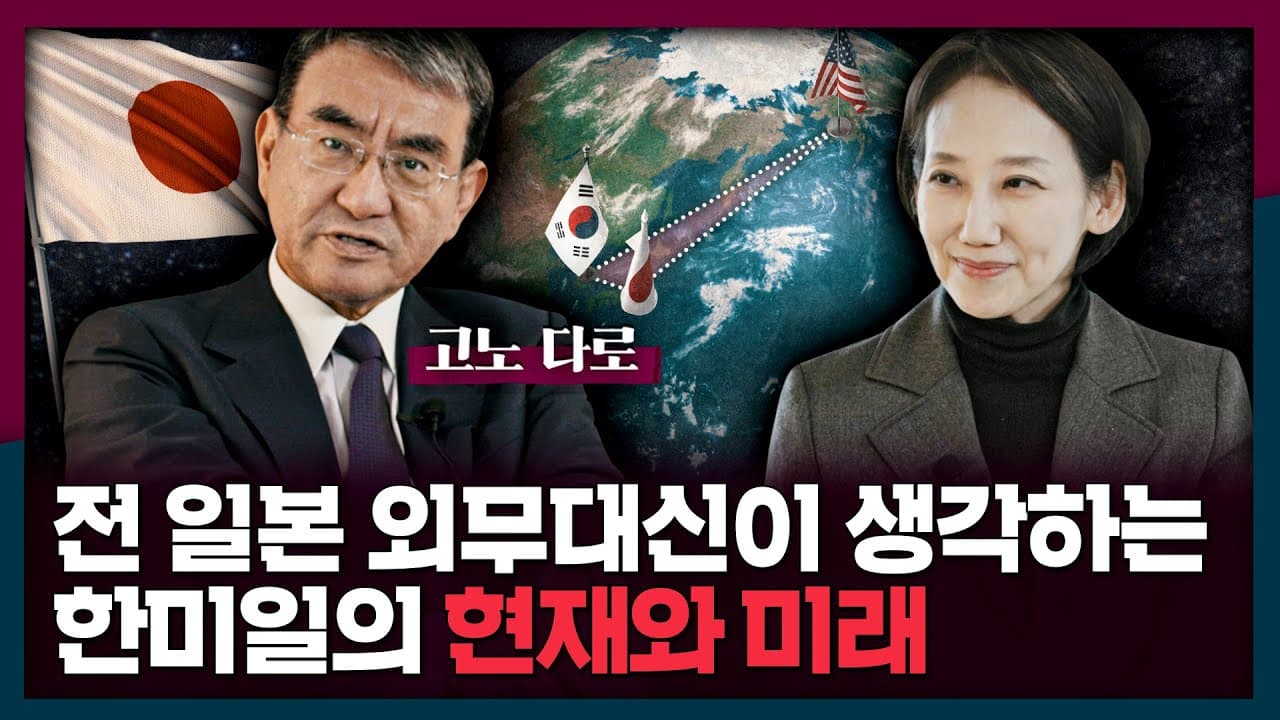
[ENG] Mr. Taro Kono on Korea–U.S.–Japan: What’s Next?
TL;DR
Discusses trilateral cooperation amid leadership changes and regional challenges.
Transcript
the last but very important question when do you think that you will become a well I let you interview me when that happens so oh you promised well first of all thank you so much for sharing your time for this interview thank you for invitation let's get to the point a few weeks ago president Trump and prime minister IA had your first summi... Read More
Key Insights
- The trilateral relationship between Korea, Japan, and the U.S. is state-based, not reliant on individual leaders, ensuring stability despite leadership changes.
- The Camp David agreement is seen as a significant step in strengthening trilateral cooperation, with a focus on shared values like democracy and human rights.
- Japan is cautious about China's growing military influence and its potential threat to regional stability, especially concerning Taiwan.
- North Korea's missile tests pose a significant threat to Japan, leading to strong reactions and a need for continued diplomatic pressure.
- Japan's primary diplomatic challenge is preventing China's military aggression, while also managing North Korea's unpredictable actions.
- Japan values its alliance with the U.S. but faces unpredictability with Trump's return, impacting strategies on tariffs and security.
- Japan opposes Korea's inclusion in the G7, suggesting a new framework for like-minded countries to discuss broader issues.
- Cultural exchanges and tourism have improved Korea-Japan relations, with potential for deeper economic and security cooperation.
Install to Summarize YouTube Videos and Get Transcripts
Explore YouTube Video Summarizer or Get YouTube Transcript Extractor
Questions & Answers
Q: How does the Camp David agreement impact trilateral relations?
The Camp David agreement is seen as a major step in strengthening trilateral cooperation between Korea, Japan, and the U.S. It emphasizes state-based relationships over personal ties, ensuring stability despite leadership changes. The agreement focuses on shared values like democracy, rule of law, and human rights, providing a foundation for ongoing collaboration.
Q: What are Japan's concerns regarding China's military actions?
Japan is wary of China's growing military influence and its potential threat to regional stability, particularly concerning Taiwan. The hope that China's integration into the global economy would lead to peaceful cooperation has not materialized. Japan emphasizes the need to defend its territorial integrity and collaborate with allies to counter China's aggressive actions.
Q: How does Japan view North Korea's missile tests?
North Korea's missile tests are a significant threat to Japan, leading to strong reactions and a need for continued diplomatic pressure. Japan is concerned about the unpredictability of North Korea's actions and the potential for escalation. The lack of diplomatic relations and unresolved issues, such as Japanese abductees, complicate efforts to address the threat.
Q: What is Japan's primary diplomatic challenge?
Japan's primary diplomatic challenge is preventing China's military aggression in the region. This involves coordinating with allies, particularly the U.S., to develop strategies that address the threat from China and manage North Korea's unpredictable actions. Japan aims to maintain regional stability while navigating complex geopolitical dynamics.
Q: How does Japan perceive Trump's return to the White House?
Japan values its alliance with the U.S. but faces unpredictability with Trump's return to the White House. This unpredictability affects strategies on tariffs and security, as Japan seeks to coordinate with the U.S. to address threats from China and Russia. Japan is cautious about potential changes in U.S. foreign policy under Trump's leadership.
Q: What is Japan's position on Korea joining the G7?
Japan opposes Korea's inclusion in the G7, citing the need to consider other countries like Australia and New Zealand. Instead, Japan suggests creating a new framework for like-minded countries to discuss broader issues, including security and political matters, beyond just economic concerns. This approach would allow for more comprehensive collaboration.
Q: How have cultural exchanges impacted Korea-Japan relations?
Cultural exchanges and tourism have significantly improved Korea-Japan relations, with a notable increase in favorable sentiments, particularly among the younger generation. The popularity of K-pop and Korean culture in Japan has strengthened bilateral ties, creating opportunities for deeper economic and security cooperation between the two countries.
Q: What potential does Japan see in Korea-Japan cooperation?
Japan sees significant potential in Korea-Japan cooperation, particularly in economic and security areas. The countries have discussed a Free Trade Agreement, which could facilitate free travel and professional exchanges. Strengthening bilateral relations would provide a foundation for regional stability and enhance trilateral cooperation with the U.S., benefiting all parties involved.
Summary & Key Takeaways
-
The interview with Taro Kono highlights the evolving trilateral relationship between Korea, Japan, and the U.S., emphasizing the importance of state-based cooperation over personal ties. Despite leadership changes, the Camp David agreement remains a cornerstone of their collaboration, focusing on shared democratic values and regional stability.
-
Japan is concerned about China's military expansion, particularly regarding Taiwan, and emphasizes the need for a unified front among like-minded countries. North Korea's missile tests are a real threat, prompting Japan to advocate for continued diplomatic pressure and collaboration with the U.S. to manage regional security challenges.
-
Improved cultural exchanges and tourism have strengthened Korea-Japan relations, with potential for further economic and security cooperation. However, Japan remains cautious about Korea's inclusion in the G7, suggesting the creation of a new framework for discussing broader political and security issues with like-minded nations.
Read in Other Languages (beta)
Share This Summary 📚
Summarize YouTube Videos and Get Video Transcripts with 1-Click
Try YouTube Summary with ChatGPT & Claude or YouTube Transcript Generator
Explore More Summaries from 김지윤의 지식Play 📚
![[ENG] 애플의 실수? 중국에 발 묶인 글로벌 기업의 딜레마 | 애플, 중국, 애플인차이나 thumbnail](/_next/image?url=https%3A%2F%2Fi.ytimg.com%2Fvi%2FvYmzkgCa5w0%2Fhqdefault.jpg&w=750&q=75)
![[ENG_SUB] [뉴스 브리핑] 전쟁이 싫다던 트럼프가 이란을 타격한 이유는? | 국제뉴스, 중동 thumbnail](/_next/image?url=https%3A%2F%2Fi.ytimg.com%2Fvi%2FWEgVowxz4QM%2Fhqdefault.jpg&w=750&q=75)
![[ENG_SUB] 대기업 회장님이 생각하는 한국 경제의 미래? | SK, 최태원 thumbnail](/_next/image?url=https%3A%2F%2Fi.ytimg.com%2Fvi%2FGH6CG5w3SJ0%2Fhqdefault.jpg&w=750&q=75)
![[ENG_SUB] 먼로 독트린이 뭐길래 트럼프가 다시 꺼냈을까? | 미국, 먼로주의, 지정학 thumbnail](/_next/image?url=https%3A%2F%2Fi.ytimg.com%2Fvi%2Ftl5NFrAMqAo%2Fhqdefault.jpg&w=750&q=75)
Summarize YouTube Videos and Get Video Transcripts with 1-Click
Try YouTube Summary with ChatGPT & Claude or YouTube Transcript Generator