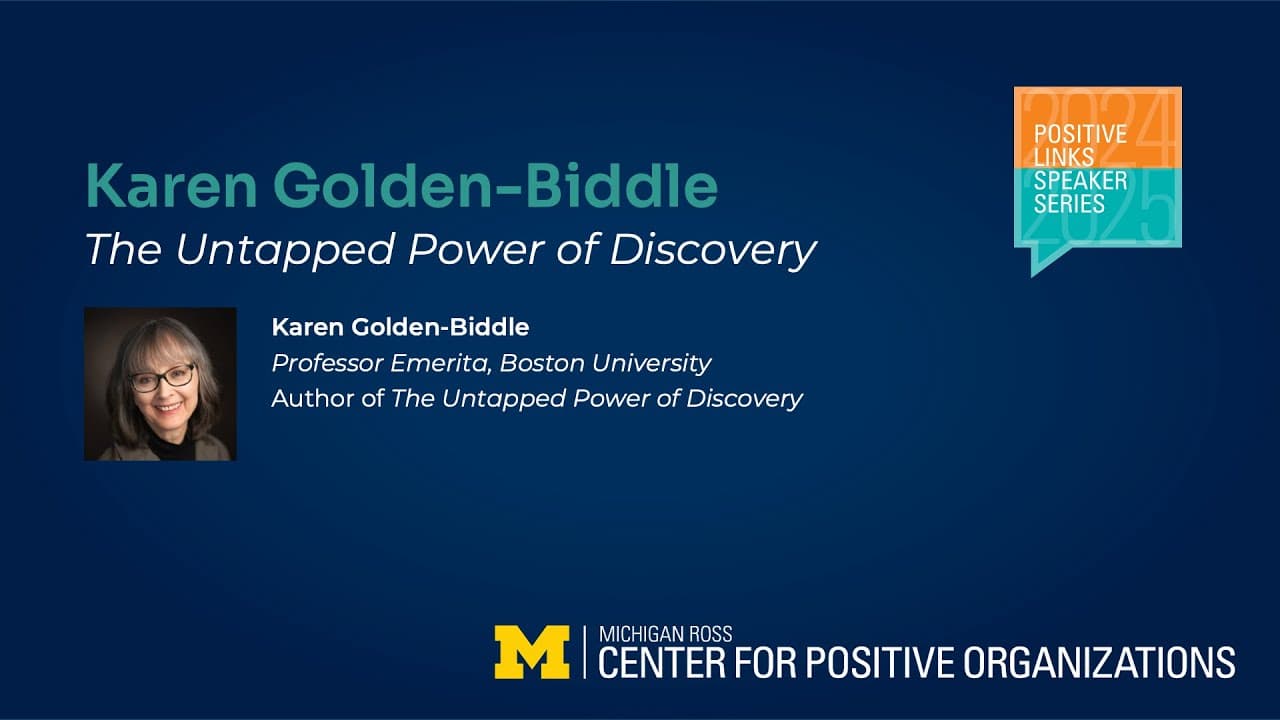
The Untapped Power of Discovery: How to Create Change that Inspires a Better Future
TL;DR
Discovery is a process that catalyzes change by embracing surprise and doubt.
Transcript
hello and welcome I'm delighted to be with you today for this positive link speaker series session the untapped power of Discovery how to create change that inspires a better future presented by the center for positive organizations at the Michigan Ross School of Business I'm Monica warline the faculty director of the center for pos... Read More
Key Insights
- Discovery is not just an end result but a continuous process that unfolds through change initiatives, sparking new insights and possibilities.
- Surprise acts as an ignition for discovery, challenging settled beliefs and opening up new avenues for exploration and innovation.
- Doubt, when genuine, fuels discovery by questioning existing beliefs and practices, allowing for the creation of new solutions.
- Launching new ways involves immersing oneself in the specific context of the situation, experimenting with new possibilities grounded in real-world experiences.
- Organizations often prioritize operational processes over discovery, which can stifle innovation and the emergence of new solutions.
- Discovery requires belief flexibility, allowing individuals and organizations to challenge and change beliefs to adapt to new circumstances.
- The process of discovery involves a balance between operational stability and inventive exploration to achieve effective change.
- Personal growth and organizational change are interconnected, with discovery processes facilitating development at both individual and collective levels.
Install to Summarize YouTube Videos and Get Transcripts
Explore YouTube Video Summarizer or Get YouTube Transcript Extractor
Questions & Answers
Q: How does discovery relate to innovation in organizations?
Discovery is a continuous process that weaves through innovation, catalyzing insights and new perspectives. It is not limited to experts or scientists; anyone can develop the capacity for discovery by embracing surprise and doubt, leading to inventive solutions and successful change initiatives.
Q: What went wrong with the Play Pump project in Africa?
The Play Pump project failed because it treated the technology as a perfect, finished solution, neglecting the ongoing process of discovery. By not embracing surprise and doubt, the project continued without addressing significant maintenance issues, ultimately leading to its downfall.
Q: How did Intuit discover a new market need for QuickBooks?
Intuit discovered a new market need for QuickBooks by initially dismissing surprising survey results that showed customers using Quicken at work. Eventually, they explored this surprise further, leading to the insight that customers were using Quicken for small business accounting, prompting the development of QuickBooks.
Q: What role does doubt play in the discovery process?
Doubt serves as the creative fuel for discovery, challenging existing beliefs and prompting exploration of new possibilities. Genuine doubt, as opposed to self-doubt, allows for the questioning of methods, ideas, and beliefs, enabling the creation of innovative solutions and adaptation to change.
Q: How can organizations balance operational processes with discovery?
Organizations can balance operational processes with discovery by integrating both into their practices. While operational processes ensure stability and efficiency, discovery processes encourage exploration and innovation, allowing organizations to adapt and thrive in changing environments.
Q: What is belief flexibility, and why is it important?
Belief flexibility refers to the willingness to challenge and change existing beliefs in response to new experiences and insights. It is crucial for discovery, as rigid beliefs can hinder the exploration of new possibilities and prevent organizations from adapting to changing circumstances.
Q: How does discovery contribute to personal growth?
Discovery contributes to personal growth by encouraging individuals to embrace surprise and doubt, leading to new insights and perspectives. This process fosters continuous learning and adaptation, enabling personal development alongside organizational change.
Q: How can leaders foster a culture of discovery in their organizations?
Leaders can foster a culture of discovery by encouraging openness to surprise and doubt, promoting belief flexibility, and integrating discovery processes into everyday practices. By supporting exploration and innovation, leaders can create an environment where new ideas and solutions can emerge and thrive.
Summary & Key Takeaways
-
Karen Golden-Biddle discusses the process of discovery as a means to create change, emphasizing the importance of embracing surprise and doubt to challenge existing beliefs and spark new possibilities.
-
The session highlights real-world examples, such as Intuit's discovery of a new market need, illustrating how surprise and doubt can lead to significant innovation and growth.
-
Golden-Biddle advocates for integrating discovery into everyday organizational practices, balancing operational processes with inventive exploration to foster continuous change and development.
Read in Other Languages (beta)
Share This Summary 📚
Summarize YouTube Videos and Get Video Transcripts with 1-Click
Try YouTube Summary with ChatGPT & Claude or YouTube Transcript Generator