Lecture 3: Morphology, Part 2
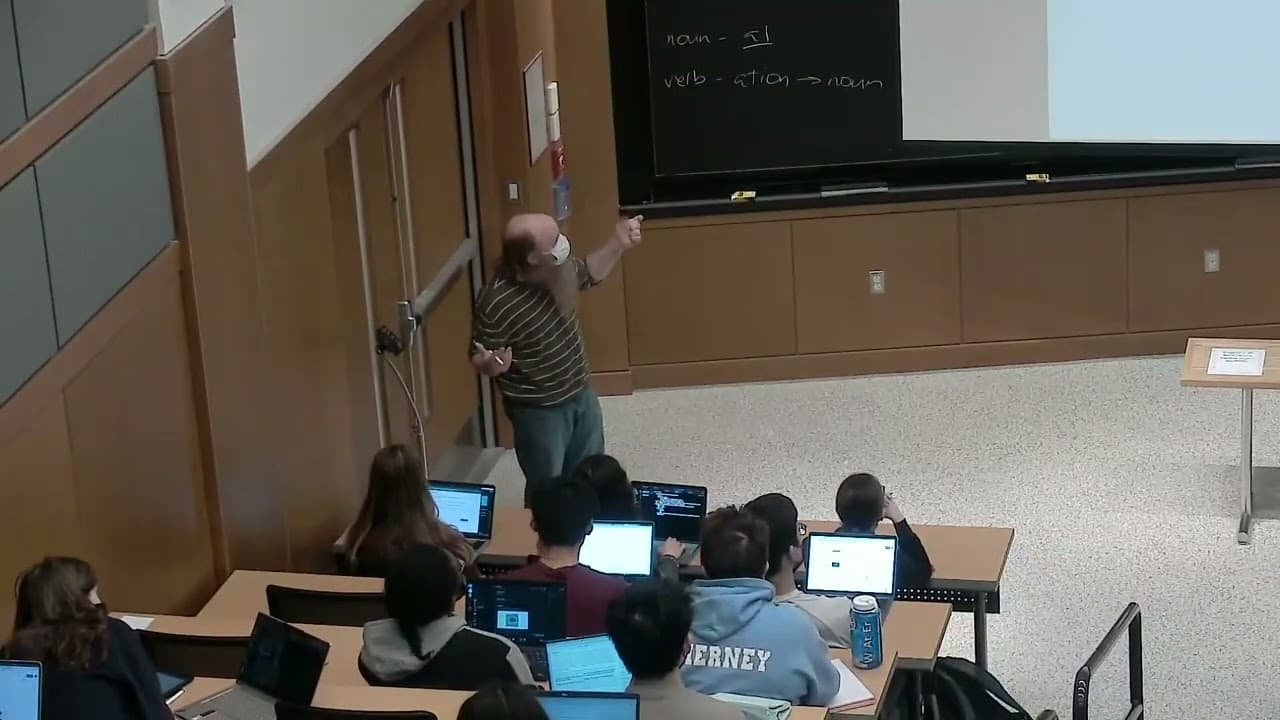
TL;DR
Explores how morphemes shape language structure and meaning.
Transcript
[CREAKING, CLICKING] NORVIN RICHARDS: All right, so welcome to day two of morphology. Last time, I was trying to get you to believe that it's worth-- for trying to think about what you have in your mind, the representations you have in your mind of what you can do with your native language-- if we're trying to think about that, that it's useful to ... Read More
Key Insights
- Morphemes are fundamental units in language, consisting of sound and meaning that can be free or bound.
- Bound morphemes, like prefixes and suffixes, require attachment to other morphemes to convey meaning.
- The morpheme '-al' attaches to nouns but not verbs, demonstrating the specificity of morpheme application.
- English language history affects morpheme usage, as seen with Latin-derived '-ity' and Germanic '-th'.
- Allomorphs are variations of morphemes that appear in different morphological contexts.
- The concept of merge is used to combine morphemes, allowing recursive application in word formation.
- Sound changes, such as final devoicing in Polish, illustrate how phonological rules affect morpheme pronunciation.
- The ambiguity in words like 'unlockable' arises from different possible morpheme combinations.
Install to Summarize YouTube Videos and Get Transcripts
Explore YouTube Video Summarizer or Get YouTube Transcript Extractor
Questions & Answers
Q: What are morphemes in language?
Morphemes are the basic elements of language, consisting of units that combine sound and meaning. They can be free, standing alone as words, or bound, needing attachment to other morphemes. Each morpheme is tagged with information about its pronunciation, meaning, and whether it is free or bound.
Q: How do bound morphemes function in language?
Bound morphemes, such as prefixes and suffixes, cannot stand alone and must attach to other morphemes to convey meaning. They can change the category or meaning of the base morpheme they attach to, as seen in examples like '-al' attaching to nouns or '-ation' turning verbs into nouns.
Q: What role does language history play in morpheme usage?
Language history significantly influences morpheme usage, as seen in English. For example, '-ity' is derived from Latin and attaches to Latinate adjectives, while '-th' is Germanic and attaches to Germanic adjectives. This historical borrowing results in distinct classes of adjectives and suffixes.
Q: What are allomorphs?
Allomorphs are different forms of a morpheme that appear under different morphological circumstances. They often arise due to phonological rules or historical language changes. For instance, the plural morpheme in English can be pronounced as 's' or 'z', depending on the preceding sound.
Q: How does the concept of merge apply to morphemes?
Merge is a linguistic process that combines two morphemes to create a new word. It is recursive, meaning it can reapply to its own output, allowing complex word formation. For example, 'unlockable' can be formed by merging 'un-' with 'lock' and then '-able', or vice versa, resulting in different meanings.
Q: What is final devoicing in Polish?
Final devoicing is a phonological rule in Polish where voiced consonants like 'g' become voiceless 'k' at the end of words. This rule affects the pronunciation of morphemes but not their underlying form, as seen in the pluralization of words like 'wug' to 'wuki'.
Q: Why is the word 'unlockable' ambiguous?
The word 'unlockable' is ambiguous because it can be formed by merging morphemes in different orders. It can mean 'not able to be locked' if '-able' is added after 'un-', or 'able to be unlocked' if 'un-' is added after '-able', demonstrating how morpheme order affects meaning.
Q: What challenges arise in defining morpheme meanings?
Defining morpheme meanings can be challenging, especially with reversible verbs. For example, 'un-' typically reverses the action of a verb, but not all verbs are naturally reversible, like 'unsink'. This requires careful consideration of the morpheme's effect on verb meaning and context.
Summary & Key Takeaways
-
Morphemes are the building blocks of language, consisting of sounds and meanings that can be free or bound. Bound morphemes, such as prefixes and suffixes, require attachment to other morphemes to convey meaning.
-
The specificity of morpheme application is highlighted by examples like '-al', which attaches to nouns but not verbs. English language history influences morpheme usage, as seen in Latin-derived '-ity' and Germanic '-th'.
-
Allomorphs are variations of morphemes that appear in different morphological contexts. The concept of merge allows for recursive application, combining morphemes to form words, while phonological rules, such as final devoicing in Polish, affect pronunciation.
Read in Other Languages (beta)
Share This Summary 📚
Summarize YouTube Videos and Get Video Transcripts with 1-Click
Try YouTube Summary with ChatGPT & Claude or YouTube Transcript Generator
Explore More Summaries from MIT OpenCourseWare 📚



Summarize YouTube Videos and Get Video Transcripts with 1-Click
Try YouTube Summary with ChatGPT & Claude or YouTube Transcript Generator