CW radar | Numerical problems | Radar Systems | Lec-30
TL;DR
The video discusses two common problems related to Continuous Wave (CW) radar calculations.
Transcript
hi everyone in this video I am discussing two important problems that are repeatedly asked in the previous question in this video I have made it for CW radar in the next coming video I will do it for fmcwriter also okay so these two problems are especially asked on previous in previous question papers on CW radar I'll let you know what is the purpo... Read More
Key Insights
- 🎯 Continuous Wave radar is essential for calculating the velocities of moving targets by analyzing the Doppler frequency shift.
- ❓ Accurate calculations require an understanding of both the relationship between Doppler frequency and relative velocity and the various formulas involved in this process.
- 🤒 Unit consistency is critical; converting measurements from kilometers per hour to meters per second (or vice versa) ensures valid outcomes in velocity-related computations.
- 🛩️ Doppler frequency shifts are generally small, often measured in hertz, highlighting the need for precise calculations and understanding of radar technology.
- 👮 Real-world applications of radar include law enforcement, where it is used to monitor vehicle speeds, improving road safety.
- 🧑🎓 Practical problems related to CW radar frequently appear in exam contexts, making mastery of these concepts vital for students.
- 🐎 Each calculated velocity result must be interpreted in relation to the relevant speed limits to determine if any penalties should be applied.
Install to Summarize YouTube Videos and Get Transcripts
Explore YouTube Video Summarizer or Get YouTube Transcript Extractor
Questions & Answers
Q: What is the primary function of Continuous Wave radar?
The primary function of Continuous Wave radar is to measure the Doppler frequency shift that occurs when a target is moving. This shift allows the radar to calculate the relative velocity of the target. Understanding the relationship between Doppler frequency and relative velocity is crucial for accurate assessments and applications in various fields, such as law enforcement and aviation.
Q: How does a police officer determine if a driver is speeding using radar?
A police officer determines if a driver is speeding by calculating the vehicle's relative speed using a radar system. When the radar detects a Doppler frequency shift, it allows the officer to compare the calculated speed against the posted speed limit. If the vehicle's speed exceeds the limit, appropriate actions, such as issuing a fine, can be taken based on this calculated data.
Q: What are the key formulas used in calculating relative velocity using CW radar?
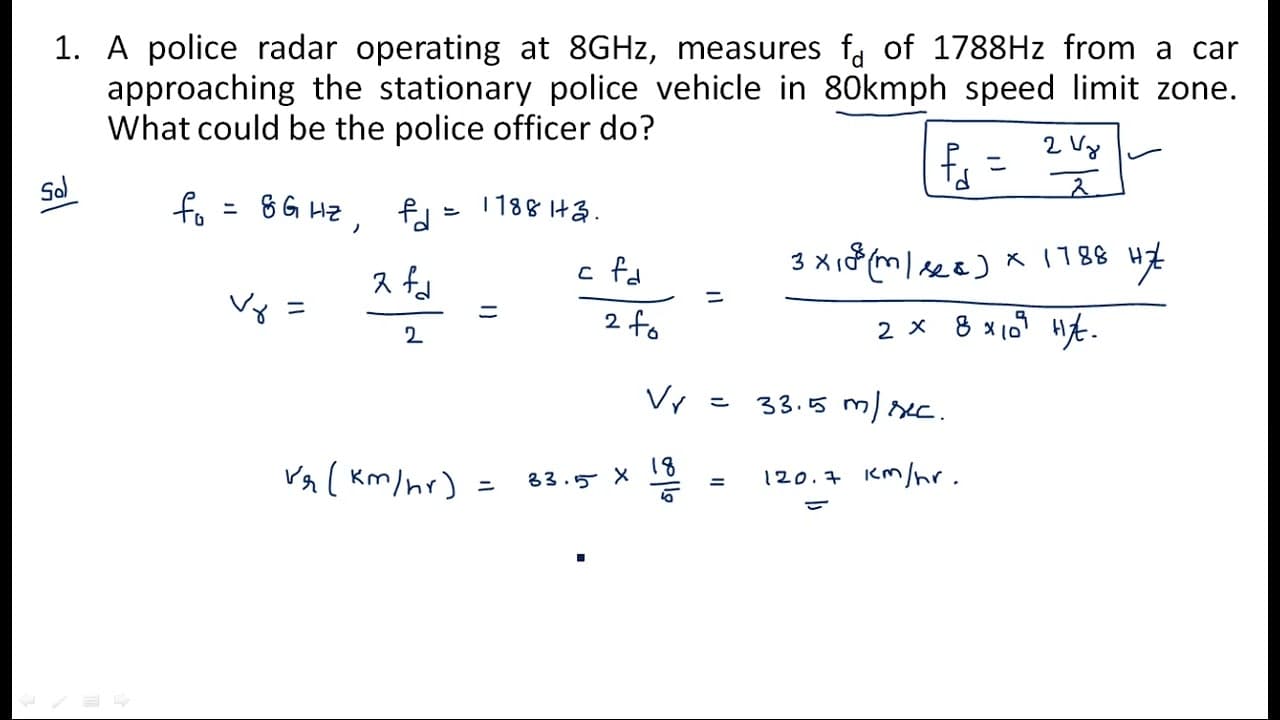
The key formulas in calculating relative velocity include FD = 2VR/λ and VR = (c × FD)/(2 × F₀). In these equations, FD represents the Doppler frequency shift, VR is the relative velocity, λ is the wavelength, c is the speed of light, and F₀ is the operating frequency of the radar. Correct application of these formulas requires careful attention to units for accurate results.
Q: Why is it important to convert between kilometers per hour and meters per second in radar calculations?
It is crucial to convert between kilometers per hour and meters per second in radar calculations to ensure unit consistency, which is imperative for achieving accurate results. When different units are used in formulas, errors can occur, leading to incorrect calculations of velocities or frequencies, potentially affecting the legitimacy of speed enforcement actions taken by authorities.
Summary & Key Takeaways
-
The video explains the fundamental purpose of Continuous Wave radar, particularly its ability to calculate Doppler frequency shifts from moving targets, allowing for velocity measurements.
-
It provides a practical example involving a police radar operating at 8 GHz to calculate the relative speed of a vehicle in a speed limit zone, demonstrating the importance of unit conversions in calculations.
-
The second example illustrates calculating Doppler frequency for stationary targets, emphasizing the need to ensure velocity units are consistent to avoid errors in results.
Read in Other Languages (beta)
Share This Summary 📚
Summarize YouTube Videos and Get Video Transcripts with 1-Click
Try YouTube Summary with ChatGPT & Claude or YouTube Transcript Generator