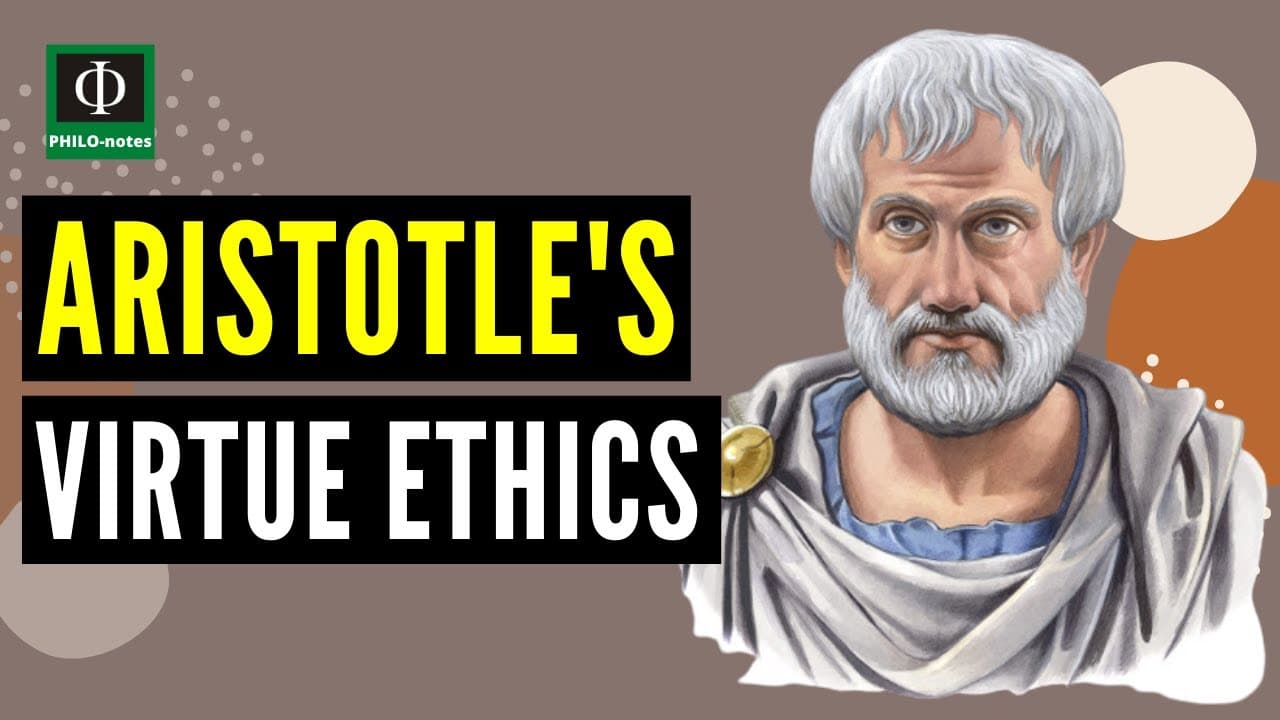
Aristotle's Virtue Ethics (See link below for more video lectures in Ethics)
TL;DR
Aristotle's virtue ethics focuses on the pursuit of happiness through the development of virtuous character.
Transcript
iris totals virtue ethics iris totals virtue ethics can be gleaned from his seminal word titled nicomachean ethics this book is undoubtedly the first systematic study of ethics in western civilization in this book aristotle offers principles of conduct that would guide humans in attaining the good life it is worthwhile to begin our discussion of ar... Read More
Key Insights
- 🇪🇭 Aristotle's "Nicomachean Ethics" is the first systematic study of ethics in Western civilization.
- 🫵 He contrasts his virtue ethics with Plato's view that moral evaluations presuppose a good life independent of experience.
- 🥅 Aristotle believes that the ultimate goal of humans is happiness or eudaimonia, which can be attained through the development of virtuous character.
- *️⃣ Virtue is the mean between excess and deficiency and is key to achieving true happiness.
- 🌵 The formation of virtuous character requires habituation and consistent practice of virtuous acts.
- ⤵️ Virtuous behavior is what distinguishes morally good and right actions from those driven by pleasure or vices.
- ❓ Practical virtues must be displayed in action for humans to truly attain happiness.
Install to Summarize YouTube Videos and Get Transcripts
Explore YouTube Video Summarizer or Get YouTube Transcript Extractor
Questions & Answers
Q: What is the main difference between Plato and Aristotle's approach to ethics?
Plato believed that moral evaluations presuppose a good life independent of experience, personality, and circumstances, while Aristotle argued that moral principles can be discovered in daily activities through empirical study.
Q: What is the ultimate goal in Aristotle's virtue ethics?
The ultimate goal in Aristotle's virtue ethics is attaining eudaimonia, which is happiness or the good life. He believes that happiness is the ultimate human good.
Q: How does virtue relate to happiness in Aristotle's ethical theory?
Virtuous acts are the means to achieve true happiness according to Aristotle. Only through virtuous behavior can one reach their ultimate goal of eudaimonia.
Q: How does Aristotle define virtue?
Virtue is defined as a behavior showing high moral standards or the general quality of goodness in a person. It is the mean between the extremes of excess and deficiency.
Key Insights:
- Aristotle's "Nicomachean Ethics" is the first systematic study of ethics in Western civilization.
- He contrasts his virtue ethics with Plato's view that moral evaluations presuppose a good life independent of experience.
- Aristotle believes that the ultimate goal of humans is happiness or eudaimonia, which can be attained through the development of virtuous character.
- Virtue is the mean between excess and deficiency and is key to achieving true happiness.
- The formation of virtuous character requires habituation and consistent practice of virtuous acts.
- Virtuous behavior is what distinguishes morally good and right actions from those driven by pleasure or vices.
- Practical virtues must be displayed in action for humans to truly attain happiness.
- Aristotle's virtue ethics emphasizes the significance of developing an excellent character as a precondition for attaining happiness.
Summary & Key Takeaways
-
Aristotle's "Nicomachean Ethics" is the first systematic study of ethics in Western civilization, offering principles of conduct to guide humans in attaining the good life.
-
Unlike Plato, Aristotle believes that moral principles are found in daily activities and can be discovered through empirical study.
-
Aristotle's virtue ethics is centered around the concepts of eudaimonia (happiness) and virtue, emphasizing the development of virtuous character as the key to attaining true happiness.
-
Virtue is the mean between two vices: excess and deficiency.
Read in Other Languages (beta)
Share This Summary 📚
Summarize YouTube Videos and Get Video Transcripts with 1-Click
Try YouTube Summary with ChatGPT & Claude or YouTube Transcript Generator
Explore More Summaries from PHILO-notes 📚

Summarize YouTube Videos and Get Video Transcripts with 1-Click
Try YouTube Summary with ChatGPT & Claude or YouTube Transcript Generator