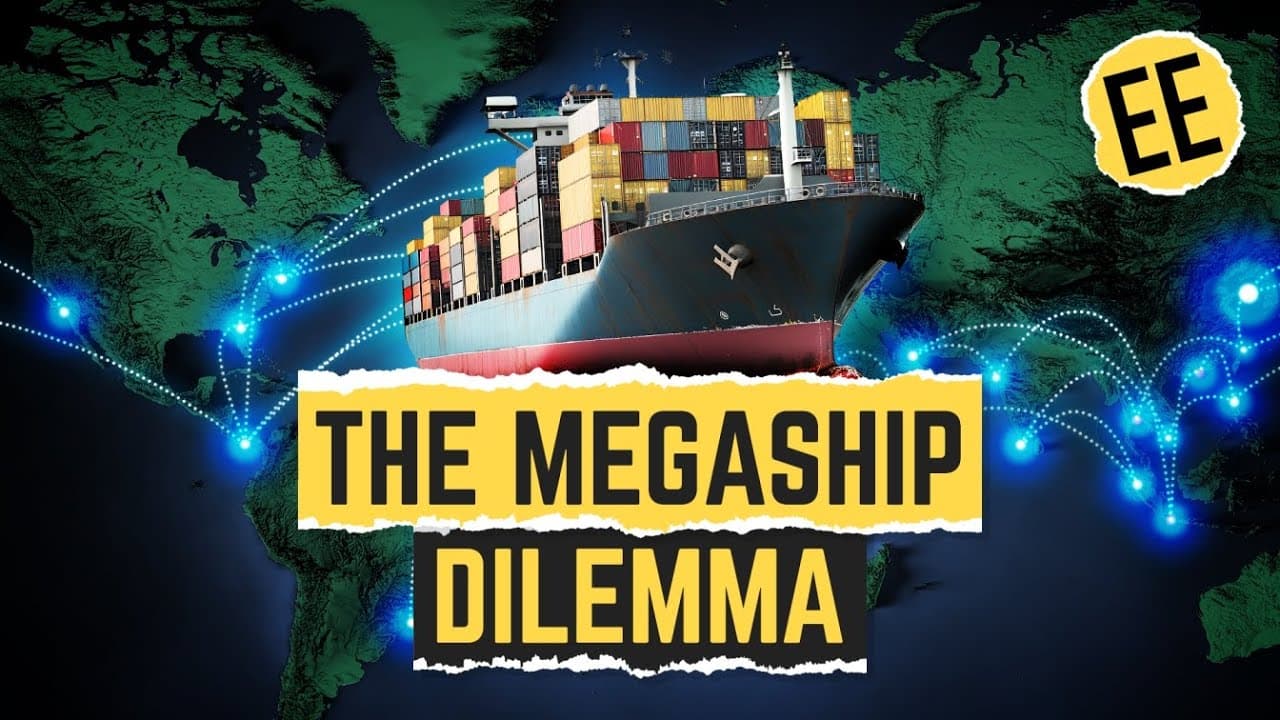
Why Ships Got So Insanely Big
TL;DR
Global shipping has expanded due to economic and technological advancements.
Transcript
3 years ago, this was the state of the global merchant marine fleet. Record numbers of perfectly serviceable vessels were intentionally scrapped because the cost of keeping them in the water meant that for modern shipping companies operating on razor thin margins, they were worth more as the tax write down and scrap metal than they were sitting aro... Read More
Key Insights
- The global merchant marine fleet has evolved significantly, with larger ships replacing smaller ones, driven by economic efficiency and technological advancements.
- Container ships have revolutionized global supply chains, making it cheaper to transport goods worldwide, thus facilitating globalization.
- The shipping industry is at a crossroads, facing challenges from geopolitical tensions, trade wars, and the need for more efficient supply chains.
- Historically, global shipping was expensive and dangerous, but technological advances have drastically reduced costs, enabling widespread international trade.
- The square-cube law has allowed larger ships to carry more cargo with relatively fewer resources, making them more efficient.
- Shipbuilding has concentrated in countries like Japan, South Korea, and China, which have become global leaders due to their industrial capacity and cost advantages.
- The pandemic exposed vulnerabilities in global supply chains, prompting discussions on nearshoring and friendshoring to create more stable trade dynamics.
- While globalization has created winners and losers, the future may see even bigger disparities as shipping continues to evolve.
Install to Summarize YouTube Videos and Get Transcripts
Explore YouTube Video Summarizer or Get YouTube Transcript Extractor
Questions & Answers
Q: Why have ships become significantly larger in recent years?
Ships have become larger due to the square-cube law, which allows them to carry more cargo with relatively fewer resources. This efficiency reduces shipping costs, enabling more intense global trade. The demand for larger ships has also been driven by the need to accommodate growing global economic activity and trade volumes.
Q: How have container ships impacted global supply chains?
Container ships have revolutionized global supply chains by drastically reducing transportation costs. This has allowed goods to crisscross the world multiple times during production and distribution, facilitating globalization. The efficiency of container ships has made it economically viable to source and sell products internationally, supporting complex supply chains.
Q: What challenges does the global shipping industry currently face?
The global shipping industry faces challenges from geopolitical tensions, trade wars, and the need for more efficient and resilient supply chains. The pandemic highlighted vulnerabilities in global trade, prompting discussions on nearshoring and friendshoring to create more stable and reliable trade dynamics. Additionally, environmental concerns and evolving economic policies add to the complexity.
Q: How did technological advancements change global shipping?
Technological advancements transformed global shipping from an expensive and dangerous process to an efficient and cost-effective industry. Innovations in shipbuilding, such as the transition from sailing ships to steam ships and modern steel vessels, have significantly reduced transportation costs, enabling widespread international trade and supporting global economic growth.
Q: Why is shipbuilding concentrated in countries like Japan, South Korea, and China?
Shipbuilding is concentrated in Japan, South Korea, and China due to their industrial capacity, lower labor costs, and ability to produce competitive ships. These countries invested heavily in shipbuilding infrastructure and have built a reputation for quality and efficiency, making it difficult for other economies to compete in the global market.
Q: What is the impact of the square-cube law on shipbuilding?
The square-cube law states that as a ship's dimensions increase, its volume grows exponentially compared to its surface area. This allows larger ships to carry more cargo with relatively fewer resources, making them more efficient. Consequently, shipping companies have favored building larger vessels to reduce costs and increase competitiveness.
Q: How did the pandemic affect global supply chains?
The pandemic exposed vulnerabilities in global supply chains, causing disruptions and highlighting the risks of over-reliance on long, complex networks. Shipping costs soared, prompting businesses and policymakers to reconsider supply chain strategies. This led to discussions on nearshoring and friendshoring as potential solutions to create more resilient and stable trade dynamics.
Q: What are the potential benefits of nearshoring and friendshoring?
Nearshoring and friendshoring involve shifting supply chains closer to home or to politically aligned regions. These strategies can reduce transportation costs, minimize geopolitical risks, and create more stable trade dynamics. They also offer opportunities for underdeveloped economies to compete regionally, potentially boosting local industries and economic growth.
Summary & Key Takeaways
-
Global shipping has transformed from a costly, inefficient process to a cornerstone of modern globalization, driven by technological advancements and economic policies.
-
Container ships have enabled complex global supply chains by significantly reducing transportation costs, but the industry faces challenges from geopolitical tensions and economic shifts.
-
The concentration of shipbuilding in Asia and the rise of larger ships have reshaped the industry, but also risk creating disparities among economies in global trade.
Read in Other Languages (beta)
Share This Summary 📚
Summarize YouTube Videos and Get Video Transcripts with 1-Click
Try YouTube Summary with ChatGPT & Claude or YouTube Transcript Generator
Explore More Summaries from Economics Explained 📚






Summarize YouTube Videos and Get Video Transcripts with 1-Click
Try YouTube Summary with ChatGPT & Claude or YouTube Transcript Generator