Wheatstone's and Kelvin's bridge | Problems | Electrical Instruments ( EIM ) | Lec - 45
TL;DR
Deep dive into Wheatstone and Kelvin bridge calculations with example problems.
Transcript
i am going to explain uh two example problems on wheatstone's bridge and one problem on the kelvin bridge problems are very very important when bridges concept is considered because everything is in analytical part so if you know the formula what is the unknown value of this rx in terms of the known values like r1 r2 r3 then we can calculate the un... Read More
Key Insights
- 🌉 Understanding the Wheatstone bridge's balance condition is crucial for solving resistor problems efficiently.
- ❓ The inclusion of internal resistor values is vital for accurate current calculations in unbalanced scenarios.
- 🌉 The formula Rx = (R2 * R3) / R1 is fundamental for calculating unknown resistances in balanced bridge conditions.
- 🌉 Thevenin’s theorem simplifies complex circuit analysis, particularly in unbalanced bridge configurations.
- 🌉 Each component's arrangement can significantly affect the balance and calculations in Wheatstone bridges.
- 🌉 The understanding of the Kelvin bridge extends the application of bridge principles to measure low resistances accurately.
- 🈸 Practicing example problems enhances grasping these concepts for examinations or practical applications.
Install to Summarize YouTube Videos and Get Transcripts
Explore YouTube Video Summarizer or Get YouTube Transcript Extractor
Questions & Answers
Q: What is the main formula used to calculate the unknown resistance in a balanced Wheatstone bridge?
In a balanced Wheatstone bridge, the main formula to calculate the unknown resistance (Rx) is given by Rx = (R2 * R3) / R1. This formula arises from the principle of balance, where the ratios of the resistances must be equal, allowing for straightforward calculations when the bridge is in equilibrium.
Q: How do you identify whether a Wheatstone bridge is in balanced or unbalanced condition?
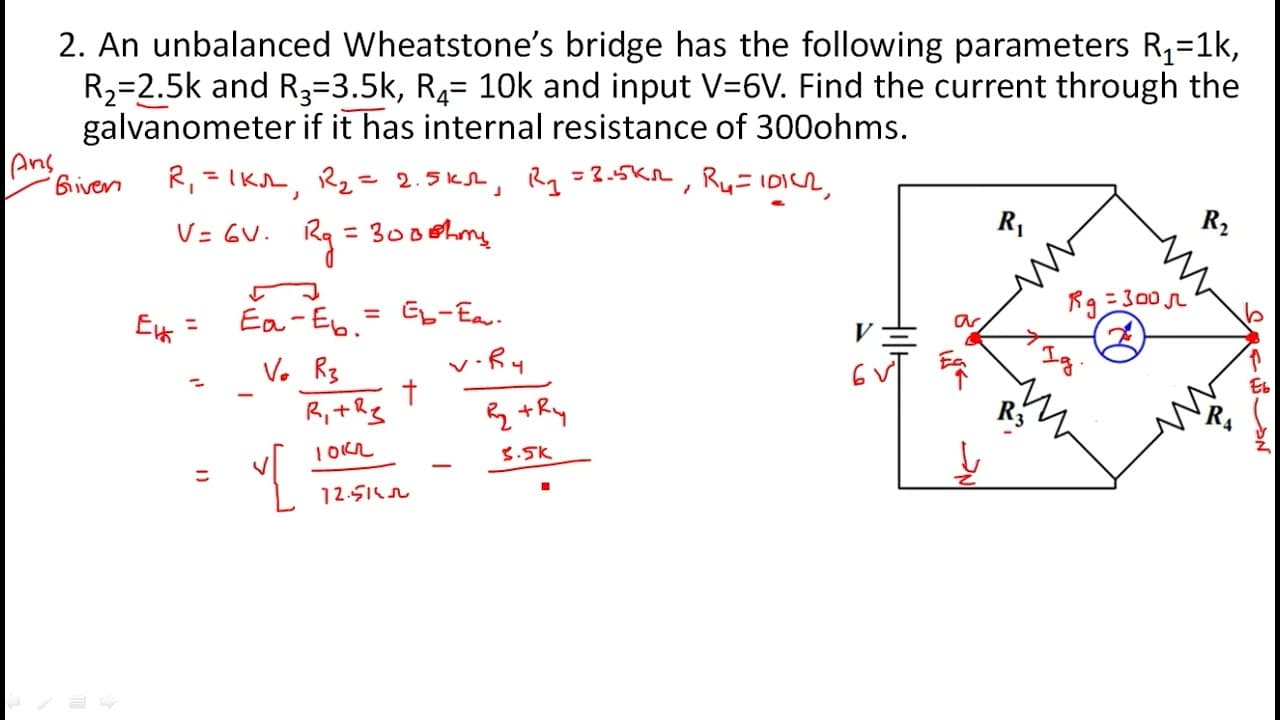
A Wheastone bridge is considered balanced when the ratio of the resistances satisfies the equation R1/R2 = R3/Rx, leading to zero current through the galvanometer. Conversely, if there is a measurable current flowing through the galvanometer due to unequal voltage across the bridge's arms, the bridge is in an unbalanced state.
Q: What method is used to calculate Thevenin's equivalent voltage and resistance in an unbalanced Wheatstone bridge?
To calculate Thevenin's equivalent voltage in an unbalanced Wheatstone bridge, you identify the voltages across the resistors involved and determine the difference in potential using voltage division formulas. For calculating Thevenin’s resistance, the voltage source is short-circuited, finding the equivalents through parallel and series combinations of the resistances that create the effective resistance seen from the load side.
Q: What role does internal resistance play in measuring current through a galvanometer in these bridge problems?
Internal resistance affects the current measurement as it adds to the total resistance encountered by the circuit. In the current calculation through the galvanometer, it is essential to include internal resistance (Rg) in the total resistance seen by the Thevenin equivalent circuit, impacting the current value calculated.
Summary & Key Takeaways
-
The discussion focuses on solving problems related to Wheatstone's bridge. Important concepts such as balancing conditions and calculations for unknown resistances are explained comprehensively.
-
A balanced Wheatstone bridge problem is solved using known resistances to determine an unknown resistance value, demonstrating the bridge formula in action.
-
An unbalanced Wheatstone bridge problem is addressed, outlining how to calculate current through the galvanometer by using Thevenin's theorem and providing step-by-step calculations for clarity.
Read in Other Languages (beta)
Share This Summary 📚
Summarize YouTube Videos and Get Video Transcripts with 1-Click
Try YouTube Summary with ChatGPT & Claude or YouTube Transcript Generator