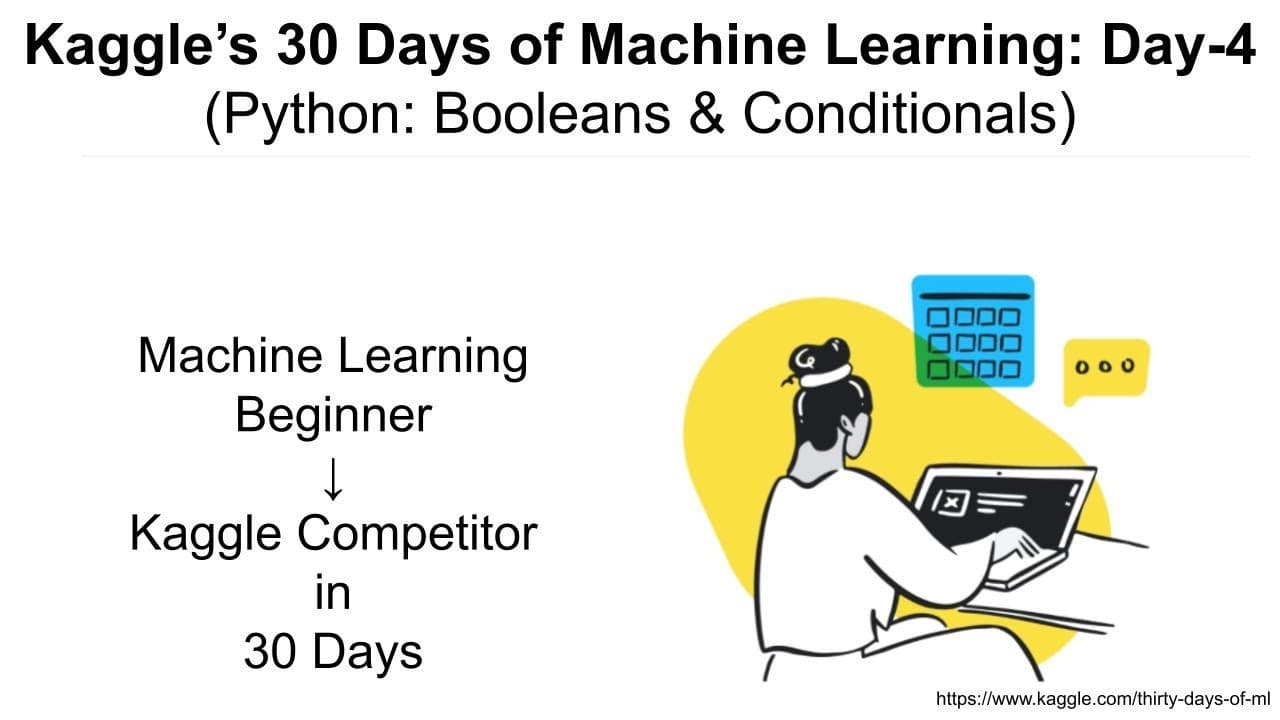
Kaggle's 30 Days Of ML (Day-4): Python Booleans and Conditionals
TL;DR
This content explores the concept of booleans and conditionals in Python, explaining their importance in machine learning and providing examples and exercises to practice their implementation.
Transcript
hello everyone and welcome to day four of kaggle's 30 days of ml in day one and two and three we learned some basic stuff and uh day three was functions and day four is about booleans booleans and conditionals in python which is also very something something very interesting you will be using it every day when you're working with machine learning s... Read More
Key Insights
- 🖐️ Booleans are fundamental in programming and play a significant role in decision-making processes.
- 👻 Comparison operators in Python allow for comparing two values and returning a boolean result.
- 👨💻 Conditionals, such as if, else, and elif, are essential for executing different blocks of code based on specific conditions.
- ❓ Python provides boolean operators like and, or, and not for combining and manipulating boolean values.
- 😨 Care should be taken when comparing different types of values, as the comparisons may yield unexpected results.
- 😑 Understanding the order of precedence in Python is crucial for correctly evaluating boolean expressions.
- 🅰️ The bool() function can be used to convert values to boolean type.
- ⚾ Python implicitly treats non-boolean values as their corresponding boolean values in if conditions and other boolean-based operations.
- 😑 Bugs in boolean expressions can result in incorrect outputs and should be carefully debugged.
Install to Summarize YouTube Videos and Get Transcripts
Explore YouTube Video Summarizer or Get YouTube Transcript Extractor
Questions & Answers
Q: What are booleans in Python?
Booleans in Python are a type of variable that can have two values: True or False. They are often used in decision-making processes and conditionals.
Q: How can booleans be used in comparison operations?
Booleans can be used to compare two values using operators such as equals (==), less than (<), greater than (>), less than or equal to (<=), greater than or equal to (>=), and not equal to (!=).
Q: What are some common boolean operators?
Some common boolean operators in Python include and, or, and not. These operators allow for combining multiple boolean values and evaluating logical conditions.
Q: How can conditional statements be used in Python?
Conditional statements, such as if, else, and elif, allow for executing different blocks of code based on certain conditions. They are helpful for controlling the flow of a program.
Summary & Key Takeaways
-
Booleans are a type of variable in Python that can have two values: True or False.
-
Python provides several boolean operators, including comparison operators such as equals, less than, greater than, and not equal to.
-
Conditionals, such as if, else, and elif statements, allow for executing different code blocks based on certain conditions.
Read in Other Languages (beta)
Share This Summary 📚
Summarize YouTube Videos and Get Video Transcripts with 1-Click
Try YouTube Summary with ChatGPT & Claude or YouTube Transcript Generator
Explore More Summaries from Abhishek Thakur 📚



Summarize YouTube Videos and Get Video Transcripts with 1-Click
Try YouTube Summary with ChatGPT & Claude or YouTube Transcript Generator