Optimum Currency Areas and the Euro
TL;DR
The Eurozone struggles with diverse economies and non-uniform shocks.
Transcript
let's now apply the theory of optimum currency areas which we discussed in a previous video let's apply it to the euro recall that the benefits of a common currency or a lower more stable inflation rate lower interest rates and increased trade notice that these benefits applied most in Europe to the smaller periphery economies to Portugal to Irelan... Read More
Key Insights
- The Eurozone's common currency benefits smaller economies like Portugal and Greece with lower inflation and interest rates, but these benefits don't extend to larger economies like Germany.
- Germany's participation in the Euro was politically motivated, not economically, leading to future complications due to its dominance in monetary policy.
- The Eurozone's inability to respond to national shocks is a major cost, as economies like Greece and Germany face different economic conditions and require different monetary policies.
- The European Central Bank was designed to prioritize Germany's monetary policy, limiting its responsiveness to peripheral economies' shocks.
- Labor mobility within the Eurozone is low due to cultural and language barriers, hindering economic adjustments compared to the United States.
- Fiscal equalization is more controversial in the EU, with national identities taking precedence over a collective European identity, complicating economic support across countries.
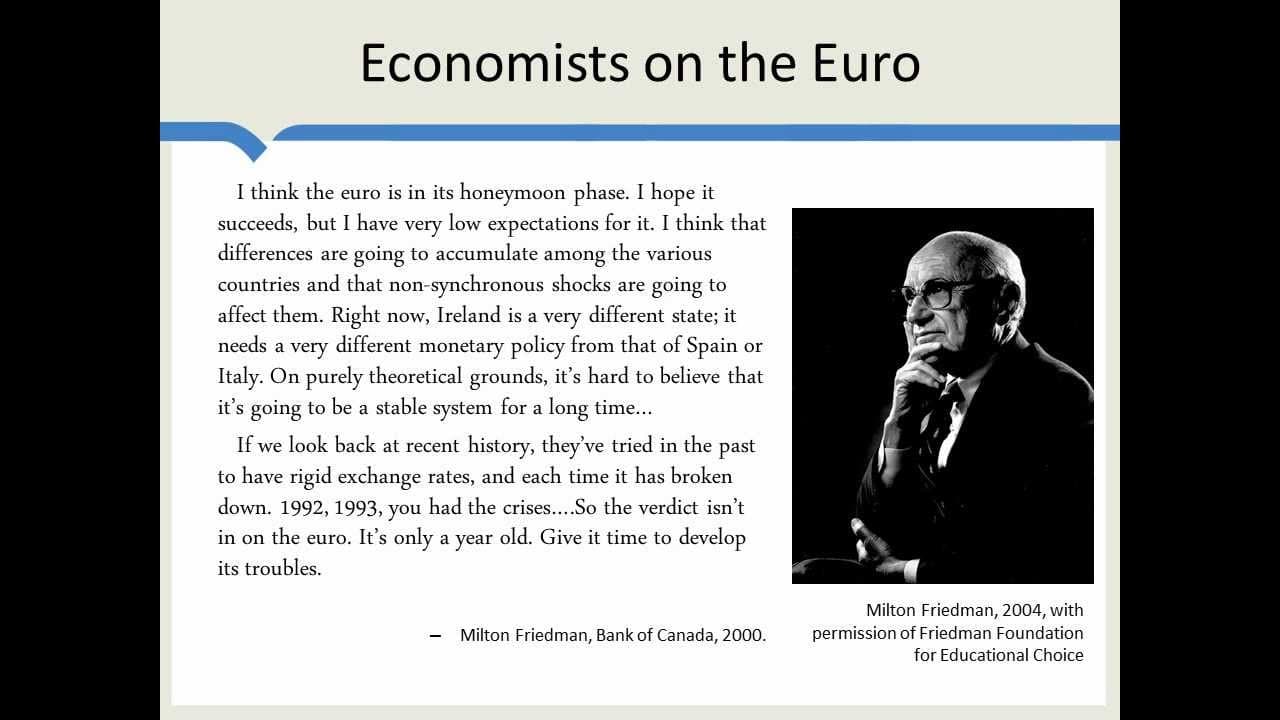
- Economists like Milton Friedman and Paul Krugman predicted the Euro's challenges, citing the Eurozone's lack of optimal currency area characteristics.
- The theory of optimum currency areas, introduced by Robert Mundell, suggests that the Eurozone's diverse economies make it unsuitable for a common currency.
Install to Summarize YouTube Videos and Get Transcripts
Explore YouTube Video Summarizer or Get YouTube Transcript Extractor
Questions & Answers
Q: Why did Germany join the Eurozone if it didn't benefit economically?
Germany joined the Eurozone primarily for political reasons rather than economic benefits. As a large economy with stable inflation and low interest rates, Germany did not need the economic advantages that the common currency offered. Its participation was more about political integration and influence within the European Union, despite the future complications that arose from its dominance in monetary policy.
Q: What are the main costs of a common currency in the Eurozone?
The main costs of a common currency in the Eurozone include the loss of independent monetary policy and a reduced ability to respond to national economic shocks. Countries like Greece and Germany have different economic conditions and require tailored monetary policies, which the Eurozone's uniform approach cannot provide. This lack of flexibility leads to economic instability and challenges in addressing non-uniform shocks across member states.
Q: How does labor mobility affect the Eurozone's economic stability?
Labor mobility is crucial for economic stability within a currency union as it allows for adjustments to economic shocks. In the Eurozone, labor mobility is limited due to cultural and language barriers, preventing workers from moving freely to areas with better economic opportunities. This contrasts with the United States, where high labor mobility facilitates economic adjustments across states, helping to stabilize the economy during regional downturns.
Q: Why is fiscal equalization controversial in the Eurozone?
Fiscal equalization is controversial in the Eurozone because of strong national identities and the lack of a unified European identity. Citizens of member states often prioritize national interests, making it difficult to justify spending on economic support for other countries within the union. This contrasts with the United States, where there is a stronger sense of national unity and less controversy over providing fiscal support across states during economic downturns.
Q: What did economists predict about the Euro's stability?
Economists like Milton Friedman and Paul Krugman predicted challenges for the Euro's stability, arguing that the Eurozone lacked the characteristics of an optimal currency area. They foresaw that the diverse economic conditions and non-synchronous shocks among member states would lead to instability. These predictions were based on the theory of optimum currency areas, which suggests that a common currency is only viable when economies are sufficiently similar in their economic structures and responses to shocks.
Q: What is the theory of optimum currency areas?
The theory of optimum currency areas, introduced by economist Robert Mundell, outlines the conditions under which multiple regions or countries can share a common currency successfully. These conditions include similar economic structures, synchronized economic cycles, high labor mobility, and fiscal integration. The Eurozone struggles with these criteria, as its member states have diverse economies and limited labor mobility, making it a suboptimal currency area.
Q: How does the European Central Bank's design affect its response to economic shocks?
The European Central Bank (ECB) was designed to prioritize the monetary policy needs of Germany, which had the most stable monetary policy among member states. This design choice limits the ECB's ability to respond effectively to economic shocks in peripheral economies like Greece and Spain. As a result, the ECB's response to economic crises has been slower and less effective, exacerbating economic instability in those regions.
Q: What role did political motivations play in the Euro's adoption?
Political motivations played a significant role in the Euro's adoption, as countries like Germany joined the Eurozone to strengthen political integration within the European Union. The common currency was seen as a step towards greater unity and influence in global affairs, despite the economic challenges it posed. This political drive sometimes overshadowed the economic realities and the lack of optimal currency area characteristics among the member states.
Summary & Key Takeaways
-
The Eurozone's adoption of a common currency benefits smaller economies but not larger ones like Germany, which joined for political reasons. This has implications for monetary policy dominance and economic stability.
-
The Eurozone faces challenges due to its inability to respond effectively to national shocks. Economies like Greece and Germany have different needs, making a one-size-fits-all monetary policy problematic.
-
Labor mobility and fiscal equalization are critical for economic adjustment within a currency union. The Eurozone struggles with these due to cultural barriers and strong national identities, unlike the United States.
Read in Other Languages (beta)
Share This Summary 📚
Summarize YouTube Videos and Get Video Transcripts with 1-Click
Try YouTube Summary with ChatGPT & Claude or YouTube Transcript Generator
Explore More Summaries from Marginal Revolution University 📚


Summarize YouTube Videos and Get Video Transcripts with 1-Click
Try YouTube Summary with ChatGPT & Claude or YouTube Transcript Generator