How Many Terms Are There In The Arithmetic Sequence
TL;DR
Solve for the number of terms in an arithmetic sequence by using the nth term formula.
Transcript
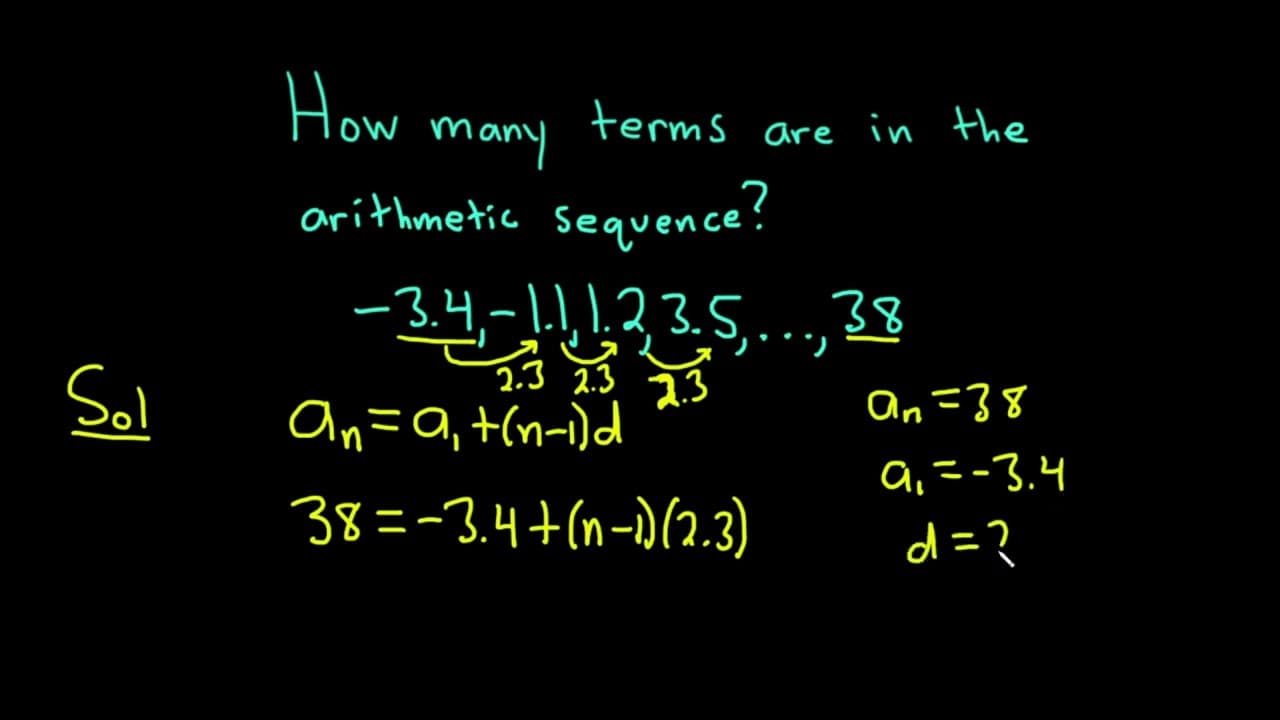
hello in this video we're going to do a problem involving arithmetic sequences the question says how many terms are in the arithmetic sequence when we have negative 3.4 negative 1.1 .2 3.5 the dots indicate that there's numbers missing and then 38. let's work through it solution we're going to use a formula to solve for the number of terms the form... Read More
Key Insights
- 🍉 Arithmetic sequences have a consistent difference between terms.
- 🍉 The nth term formula helps find specific terms in a sequence.
- ❓ Identifying the common difference is crucial for solving arithmetic sequence problems.
- 🍉 Calculating the number of terms in a sequence involves using known values and solving for the missing term.
- 🈸 Practical applications of arithmetic sequence solutions can be found in finance and statistics.
- ❓ Precision in calculations is essential to ensure accurate results in arithmetic sequence problems.
- #️⃣ Checking for whole numbers in calculations confirms the correctness of the determined number of terms.
Install to Summarize YouTube Videos and Get Transcripts
Explore YouTube Video Summarizer or Get YouTube Transcript Extractor
Questions & Answers
Q: How do you find the number of terms in an arithmetic sequence with missing numbers?
To find the number of terms, use the nth term formula and plug in known values like the first term, common difference, and last term to solve for n.
Q: Why is it essential to identify the common difference in arithmetic sequences?
The common difference helps determine the pattern of terms added or subtracted in the sequence, making it crucial to find and use in formula calculations.
Q: What happens if the calculated number of terms in an arithmetic sequence is a decimal?
If the calculated number of terms is a decimal, it means there might be an error in the calculations, as the number of terms in a sequence should be a whole number.
Q: How can arithmetic sequence problems like this be applied in real-world scenarios?
Understanding arithmetic sequences helps in various fields like finance, where calculating compound interest involves similar mathematical patterns.
Summary & Key Takeaways
-
Given an arithmetic sequence with missing numbers, find the number of terms.
-
Use the nth term formula: a sub n = a sub 1 + (n - 1) * D.
-
Plug in the given values and solve for n to determine there are 19 terms in the sequence.
Read in Other Languages (beta)
Share This Summary 📚
Summarize YouTube Videos and Get Video Transcripts with 1-Click
Try YouTube Summary with ChatGPT & Claude or YouTube Transcript Generator
Explore More Summaries from The Math Sorcerer 📚


Summarize YouTube Videos and Get Video Transcripts with 1-Click
Try YouTube Summary with ChatGPT & Claude or YouTube Transcript Generator