Alternator | Phasor diagram | Synchronous Machines | Lec-16
TL;DR
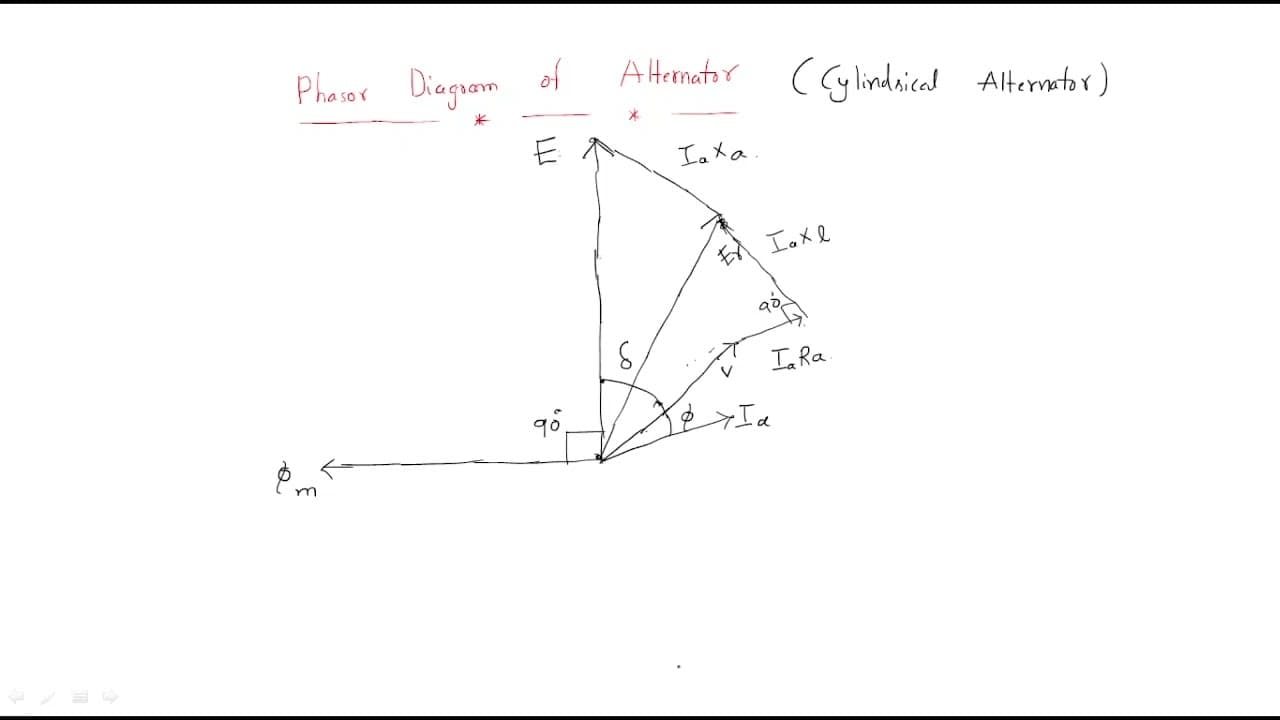
This content explains the phasor diagram of cylindrical alternators and associated voltage concepts.
Transcript
hello everyone in the last session we discussed about the voltage drops across the alternator in that the open circuit voltage e equaled open circuit voltage equal that will be combination of terminal voltage Plus okay next we will draw the phase the diagram of the alternator so this is very important topic this is very important topic so in order ... Read More
Key Insights
- ⚡ The phasor diagram of a cylindrical alternator is crucial for visualizing voltage and phase relationships.
- ⚡ Open circuit voltage is generated after a 90-degree electrical phase shift, dependent on terminal voltage and drops in the circuit.
- ⚡ The combination of terminal voltage, armature resistance drops, and leakage reactance ultimately results in calculating the voltages in an alternator.
- 🔺 Load angle and power factor angle are significant for analyzing the operation of alternators under different load conditions.
- 💦 The synchronous impedance drop plays a pivotal role in understanding the losses within the alternator and affects overall system efficiency.
- 🆘 The relationship between armature current and load conditions can help identify the performance characteristics of the alternator.
- 💦 Essential formulas involve the combination of different voltage drops to gain insight into the alternator's efficiency under load.
Install to Summarize YouTube Videos and Get Transcripts
Explore YouTube Video Summarizer or Get YouTube Transcript Extractor
Questions & Answers
Q: What are the two types of alternators mentioned?
The content discusses two main types of alternators: cylindrical and salient pole alternators. Cylindrical alternators are typically used for high-speed applications, while salient pole alternators are used for lower speed and larger output. Each type has distinct designs that affect performance and application.
Q: How is the power factor angle related to the alternator's current and voltage?
The power factor angle refers to the phase difference between the terminal voltage and the armature current in an alternator. A lagging power factor indicates that the current lags behind the voltage due to inductive loads, while a leading power factor indicates that the current leads the voltage, affecting system performance and stability.
Q: Can you explain the significance of the load angle?
The load angle represents the angle between the open circuit voltage and the terminal voltage in an alternator. It is critical because it influences the alternator's output, affects the stability of the system, and adjusts according to the load conditions. Understanding this angle aids in designing and managing electrical systems.
Q: What is the role of the air gap voltage (ER) in an alternator?
The air gap voltage (ER) in an alternator is the voltage across the air gap between the rotor and the stator. It is essential because it represents the induced voltage in the machine. Understanding the relation between the internal EMF (E) and air gap voltage helps in analyzing the performance and efficiency of the alternator.
Summary & Key Takeaways
-
The discussion begins with an overview of cylindrical alternators, emphasizing the importance of drawing the phasor diagram to understand voltage relationships in these machines.
-
Key terms such as open circuit voltage, terminal voltage, load angle, and power factor angle are defined to clarify the connections between different voltage components within the alternator.
-
The session concludes with a detailed explanation of voltage drops and their relationships, including the concepts of synchronous impedance and the significance of the air gap voltage.
Read in Other Languages (beta)
Share This Summary 📚
Summarize YouTube Videos and Get Video Transcripts with 1-Click
Try YouTube Summary with ChatGPT & Claude or YouTube Transcript Generator