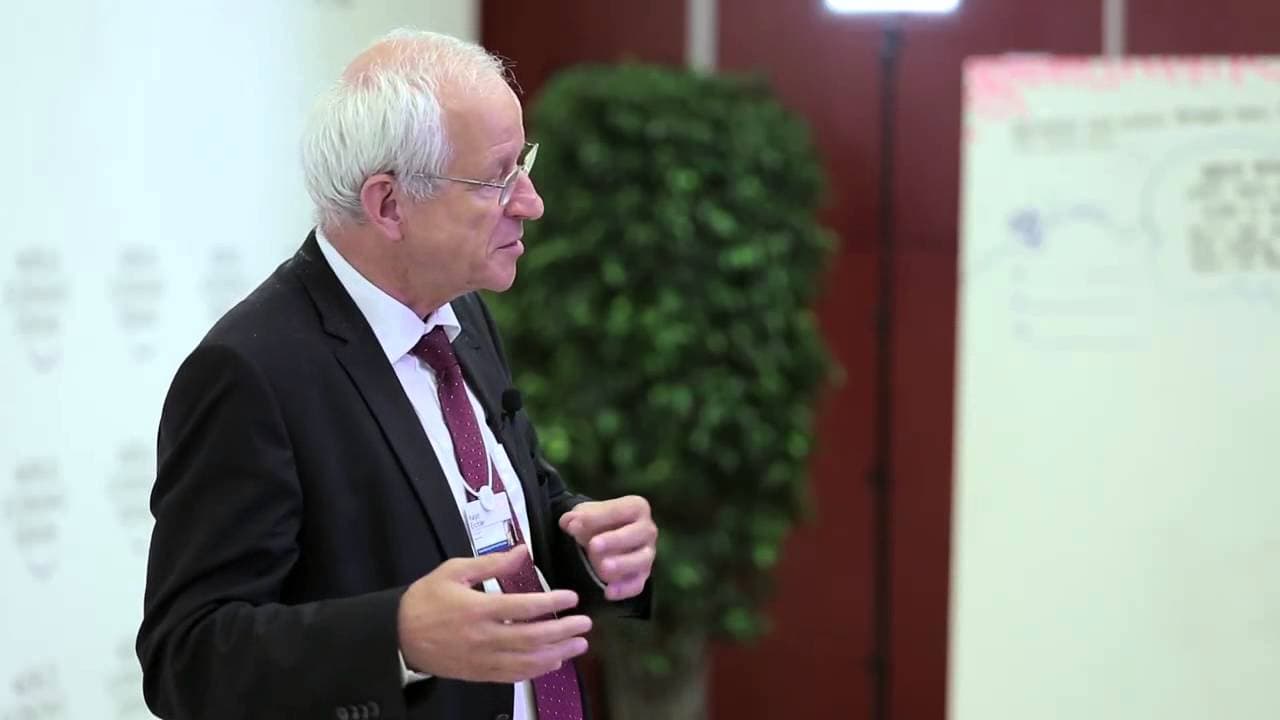
Ideas Labs | The ETH Zurich University | Ralph Eichler
TL;DR
University in Switzerland discusses the interlinked nature of risks and catastrophes, emphasizing the importance of resilience in facing complex challenges.
Transcript
welcome i would like to firstly introduce you our university in switzerland and science technology and architecture and then introduce you the the topic the integrative risk how the different risks and catastrophes are interlinked and depend on each other and that you cannot only think in silos but have to combine them we have a university of 18 00... Read More
Key Insights
- ✳️ Risks and catastrophes are interconnected, necessitating a holistic approach to mitigate them effectively.
- 😀 Resilience is crucial in facing challenges like natural disasters, technical failures, terrorism, and climate change.
- 👳 Integrating disciplines like mathematics, infrastructure, and urban planning is essential in managing complex risks.
- 😋 Understanding the dynamics of cities, energy flow, and food production is vital for building resilient systems.
- ⚖️ Balancing the costs of preventing risks versus paying for damages is a challenge for insurance companies.
- 🪜 Migration due to climate change impacts adds another layer of complexity to risk management.
- 🥼 The Asian connection at the university includes a risk lab in Singapore to address regional challenges collaboratively.
Install to Summarize YouTube Videos and Get Transcripts
Explore YouTube Video Summarizer or Get YouTube Transcript Extractor
Questions & Answers
Q: How does the university in Switzerland emphasize the interlinked nature of risks and catastrophes?
The university highlights the need to consider various risks collectively and address them in a holistic manner to ensure effective mitigation strategies. This approach involves integrating disciplines like mathematics, infrastructure, and urban planning.
Q: Why is resilience important in the face of complex challenges like natural disasters?
Resilience plays a key role in mitigating the impacts of natural disasters by focusing on how systems can bounce back from disruptions, minimize damages, and maintain functionality in the aftermath.
Q: How do factors like climate change and terrorism contribute to the complexity of risk management?
Climate change and terrorism add layers of uncertainty and unpredictability to risk management efforts, requiring a comprehensive approach that considers both immediate and long-term impacts on various systems and populations.
Q: What role does data play in understanding and tackling risks in the Asian region?
Data is crucial in analyzing and predicting risks in the Asian region, enabling proactive measures to enhance resilience and response capabilities. The partnership with a local university in Singapore and access to relevant data aim to improve risk assessment and management.
Summary & Key Takeaways
-
University in Switzerland highlights the interconnectedness of different risks and catastrophes, stressing the need to address them holistically.
-
Importance of combining various disciplines like mathematics, infrastructure, and urban planning to mitigate risks effectively.
-
Emphasis on resilience in facing challenges like natural disasters, technical failures, terrorism, and climate change.
Read in Other Languages (beta)
Share This Summary 📚
Summarize YouTube Videos and Get Video Transcripts with 1-Click
Try YouTube Summary with ChatGPT & Claude or YouTube Transcript Generator
Explore More Summaries from World Economic Forum 📚

Summarize YouTube Videos and Get Video Transcripts with 1-Click
Try YouTube Summary with ChatGPT & Claude or YouTube Transcript Generator