2.4.2.3 Binary Cross Entropy
TL;DR
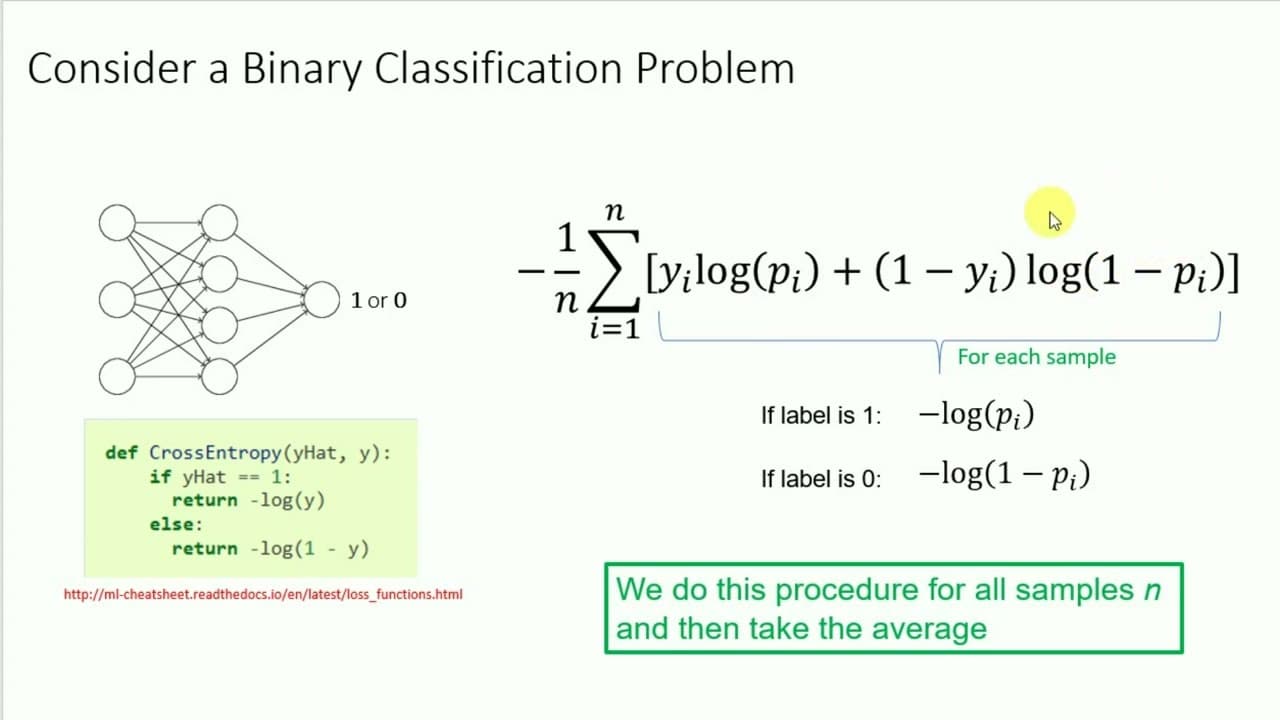
The binary cross entropy loss function is used for binary classification tasks and multi-label classification, helping to measure the difference between predicted and actual outcomes.
Transcript
hello and welcome back to this course in this lecture we're going to talk about the binary cross entropy loss function now before we talk about this we're going to have to understand the logarithmic function actually negative of the logarithmic function okay because the binary cross entropy is heavily related and depends on the negative of the log ... Read More
Key Insights
- ❎ The binary cross entropy loss function is based on negative logarithmic function.
- ✖️ It is commonly used in binary classification tasks and multi-label classification.
- 🌼 Labels of zero and one are handled differently in the loss function.
- ❎ The negative logarithm helps penalize incorrect predictions.
- 🌼 The binary cross entropy loss can be applied to multi-label classification by separately calculating the loss for each label.
Install to Summarize YouTube Videos and Get Transcripts
Explore YouTube Video Summarizer or Get YouTube Transcript Extractor
Questions & Answers
Q: What is the binary cross entropy loss function used for?
The binary cross entropy loss function is used in binary classification tasks, where the goal is to predict one of two classes. It is also used in multi-label classification tasks, where multiple labels can be assigned to a single input.
Q: How does the binary cross entropy loss function handle labels of zero and one?
If the label is one (indicating the positive class), the loss function only considers the logarithm of the predicted probability. If the label is zero (indicating the negative class), the loss function only considers the logarithm of the complement of the predicted probability.
Q: What is the significance of taking the negative logarithm in the binary cross entropy loss function?
Taking the negative logarithm helps penalize incorrect predictions that are far from the actual labels. It converts the loss value into a positive scalar that increases as the predicted probability deviates from the actual label.
Q: How is the binary cross entropy loss function applied in multi-label classification?
In multi-label classification, the binary cross entropy loss function is applied separately for each output neuron. It calculates the loss for each label by taking the negative logarithm of the predicted probability if the label is one, and the negative logarithm of the complement of the predicted probability if the label is zero.
Key Insights:
- The binary cross entropy loss function is based on negative logarithmic function.
- It is commonly used in binary classification tasks and multi-label classification.
- Labels of zero and one are handled differently in the loss function.
- The negative logarithm helps penalize incorrect predictions.
- The binary cross entropy loss can be applied to multi-label classification by separately calculating the loss for each label.
- The sigmoid activation function is often applied to the output layer to ensure predictions fall within the range of 0 to 1.
Summary & Key Takeaways
-
The binary cross entropy loss function is based on the negative logarithmic function, which exponentially decreases as the predicted value approaches one and exponentially increases as it approaches zero.
-
It is commonly used in binary classification tasks, where there are only two classes to predict (e.g., predicting whether a person has diabetes or not).
-
The equation for the binary cross entropy loss function involves taking the negative logarithm of the predicted probability for the class and multiplying it with the actual class label or its complement.
Read in Other Languages (beta)
Share This Summary 📚
Summarize YouTube Videos and Get Video Transcripts with 1-Click
Try YouTube Summary with ChatGPT & Claude or YouTube Transcript Generator
Explore More Summaries from Fuse AI 📚
Summarize YouTube Videos and Get Video Transcripts with 1-Click
Try YouTube Summary with ChatGPT & Claude or YouTube Transcript Generator