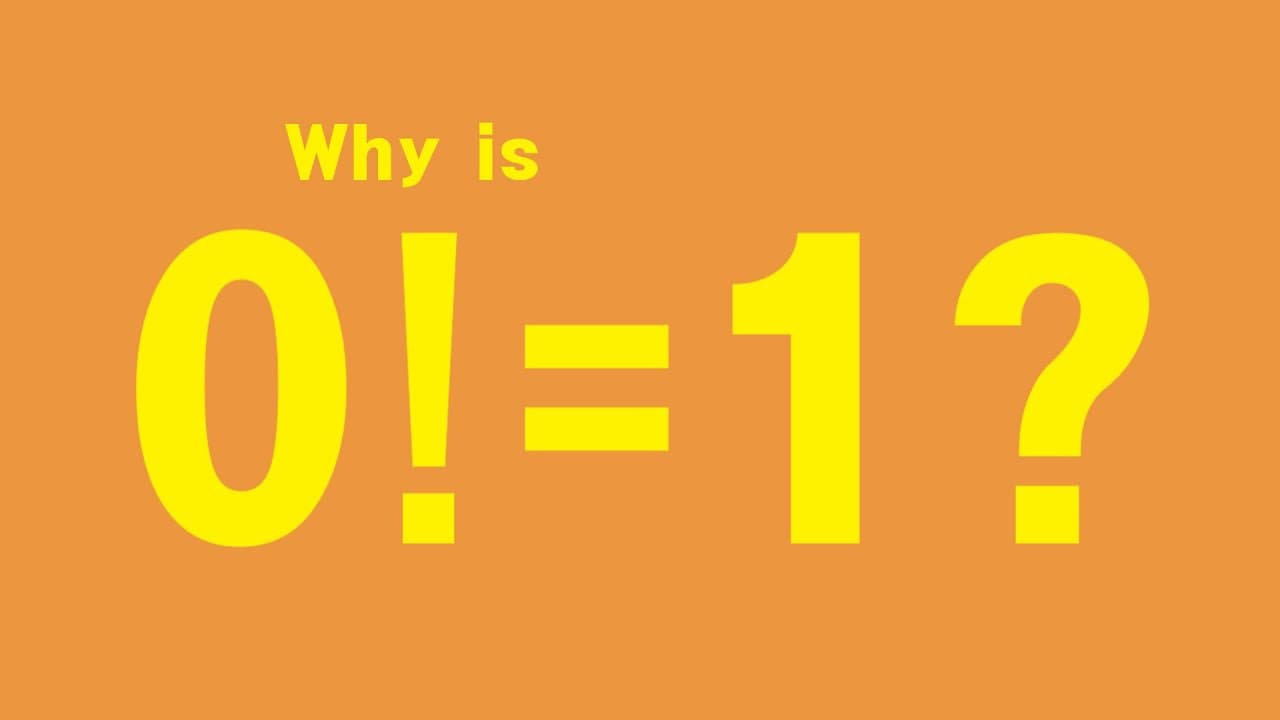
Why is 0! = 1? Zero Factorial
TL;DR
0 factorial is equal to 1 because it follows a consistent pattern and has practical applications in calculating permutations.
Transcript
good day welcome to the tech math Channel I'm Josh one of the main questions my students ask me when we're doing combinations and permutations and we're using factorials is this one right here why is 0 factorial equal to 1 which is a great question and I'm going to explain by going through a quick recap of what a factorial is so say for instance we... Read More
Key Insights
- #️⃣ Factorials involve multiplying a number by every number below it, descending by 1 each time.
- 🗂️ As factorials decrease, the difference between each factorial is obtained by dividing the number it is multiplied by.
- 🟰 The pattern continues until we reach 1 factorial, which is equal to 1.
- 💨 Factorials have practical applications in calculating permutations and determining the number of ways objects can be arranged.
Install to Summarize YouTube Videos and Get Transcripts
Explore YouTube Video Summarizer or Get YouTube Transcript Extractor
Questions & Answers
Q: What is a factorial, and how is it calculated?
A factorial is the product of an integer and all the positive integers below it. It is calculated by multiplying the number by every number below it, descending by 1 each time.
Q: Why is 0 factorial equal to 1?
0 factorial is equal to 1 because it follows the same pattern as other factorials. Just as 4 factorial is obtained by dividing 5 factorial by 5, 0 factorial is obtained by dividing 1 factorial by 1.
Q: Are there practical applications for factorials?
Yes, factorials have practical applications in calculating permutations. They help determine the number of ways objects can be arranged, as shown by the examples of arranging colored objects in the video.
Q: How does the pattern of dividing factorials apply to zero factorial?
The pattern of dividing factorials applies to zero factorial by dividing 1 factorial by 1, which results in 1. This maintains consistency in the pattern and explains why 0 factorial is equal to 1.
Summary & Key Takeaways
-
Factorials involve multiplying a number by every number below it, descending by 1 each time. For example, 5 factorial is 5 * 4 * 3 * 2 * 1 = 120.
-
As factorials decrease, the difference between each factorial is obtained by dividing the number by which it is multiplied. This pattern continues until we reach 1 factorial, which is equal to 1.
-
Factorials have practical applications in calculating permutations, i.e., the number of different ways objects can be arranged.
Read in Other Languages (beta)
Share This Summary 📚
Summarize YouTube Videos and Get Video Transcripts with 1-Click
Try YouTube Summary with ChatGPT & Claude or YouTube Transcript Generator
Explore More Summaries from tecmath 📚

Summarize YouTube Videos and Get Video Transcripts with 1-Click
Try YouTube Summary with ChatGPT & Claude or YouTube Transcript Generator