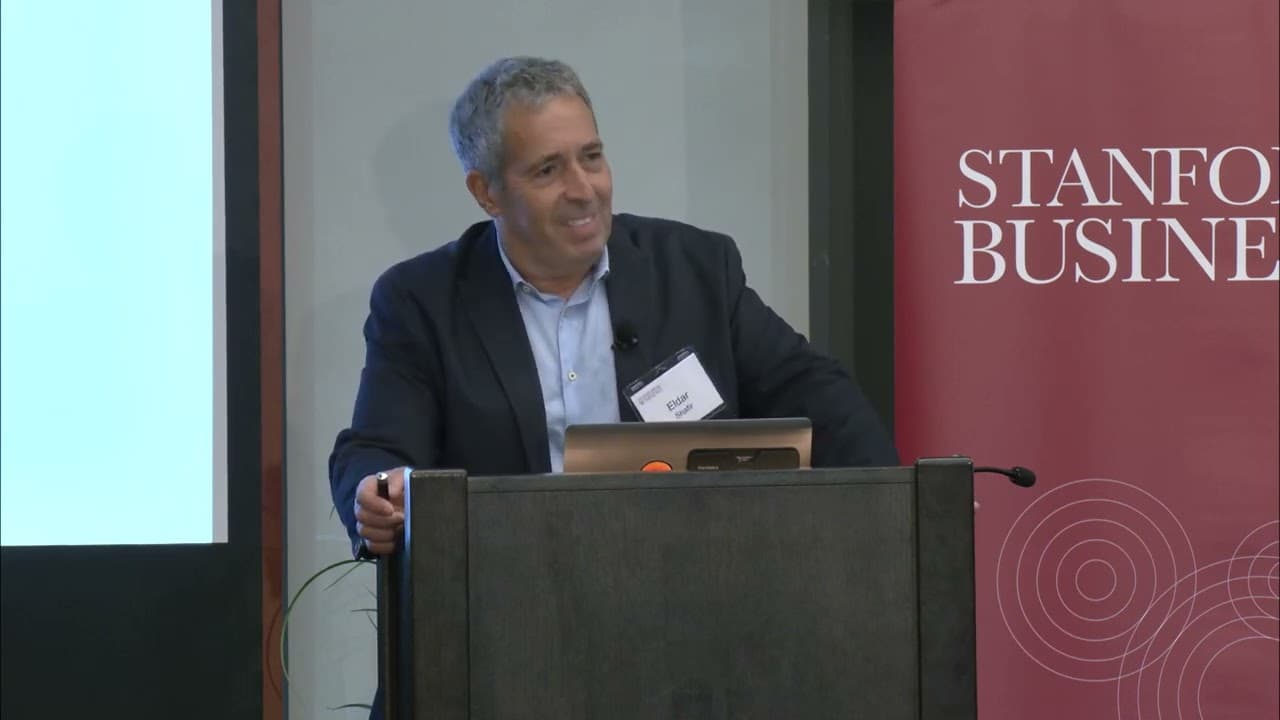
Professor Eldar Shafir: “Context, Cognition, and Flippant Preferences”
TL;DR
Flippant preferences, shaped by context, can influence decision-making and lead to choices that are not always in line with individual preferences.
Transcript
[MUSIC] I'm Deb Gruenfeld, I'm a faculty member here at the Business School, and David's colleague in organizational behavior. And it's my honor this afternoon to introduce our next speaker, Eldar Shafir, who is the class of 1987 Professor of Behavioral Science and Public Policy. The Professor of Psychology and Public Affairs, and the inaugural dir... Read More
Key Insights
- ❓ Flippant preferences are preferences that individuals have which are unintended, unconsidered, reactive, and often not their true preferences.
- 🖐️ Context plays a significant role in decision-making, influencing perceptions, processing, and the awareness of preferences.
- 💠 Exposure to certain stimuli can shape and influence preferences, even if individuals are not consciously aware of the impact.
Install to Summarize YouTube Videos and Get Transcripts
Explore YouTube Video Summarizer or Get YouTube Transcript Extractor
Questions & Answers
Q: What are flippant preferences?
Flippant preferences are preferences that individuals have which are unintended, unconsidered, and often reactive. They may not align with their true preferences or be fully aware of them.
Q: How does context affect decision-making?
Context influences decision-making by shaping perceptions, processing information, and influencing individuals' awareness of their preferences. It can lead to flippant preferences and impact choices in unexpected ways.
Q: Can exposure to certain stimuli affect preferences?
Yes, exposure to stimuli, such as repeated exposure to certain images or ideas, can influence preferences. For example, individuals may start to like something more after being exposed to it multiple times, even if they were initially indifferent.
Q: What are some examples of flippant preferences?
Examples of flippant preferences include making different decisions based on the weather, reacting differently to candidates in job interviews based on mood, and forming opinions and attitudes based on repeated exposure to certain messages or ideas.
Q: How does the power of the situation influence decision-making?
The power of the situation refers to the influence that external factors, such as social and environmental contexts, can have on decision-making. People may behave differently in specific situations, often without conscious awareness or control over their preferences.
Q: How do cognitive biases impact decision-making?
Cognitive biases, such as the availability heuristic or confirmation bias, can affect how individuals process and interpret information, leading to biased decision-making. These biases can contribute to the formation of flippant preferences and influence choices.
Summary & Key Takeaways
-
Flippant preferences are preferences that are unintended, unconsidered, and often not the real preferences of individuals.
-
Context plays a significant role in decision-making, as it affects perception, processing, and the awareness of preferences.
-
Factors like exposure, social situations, and cognitive biases can lead to flippant preferences and influence decisions in unexpected ways.
Read in Other Languages (beta)
Share This Summary 📚
Summarize YouTube Videos and Get Video Transcripts with 1-Click
Try YouTube Summary with ChatGPT & Claude or YouTube Transcript Generator
Explore More Summaries from Stanford Graduate School of Business 📚




Summarize YouTube Videos and Get Video Transcripts with 1-Click
Try YouTube Summary with ChatGPT & Claude or YouTube Transcript Generator