24.3 Worked Example - Block Sliding Down Circular Slope
TL;DR
This analysis explains how to determine the compression of a spring based on energy concepts in a motion example.
Transcript
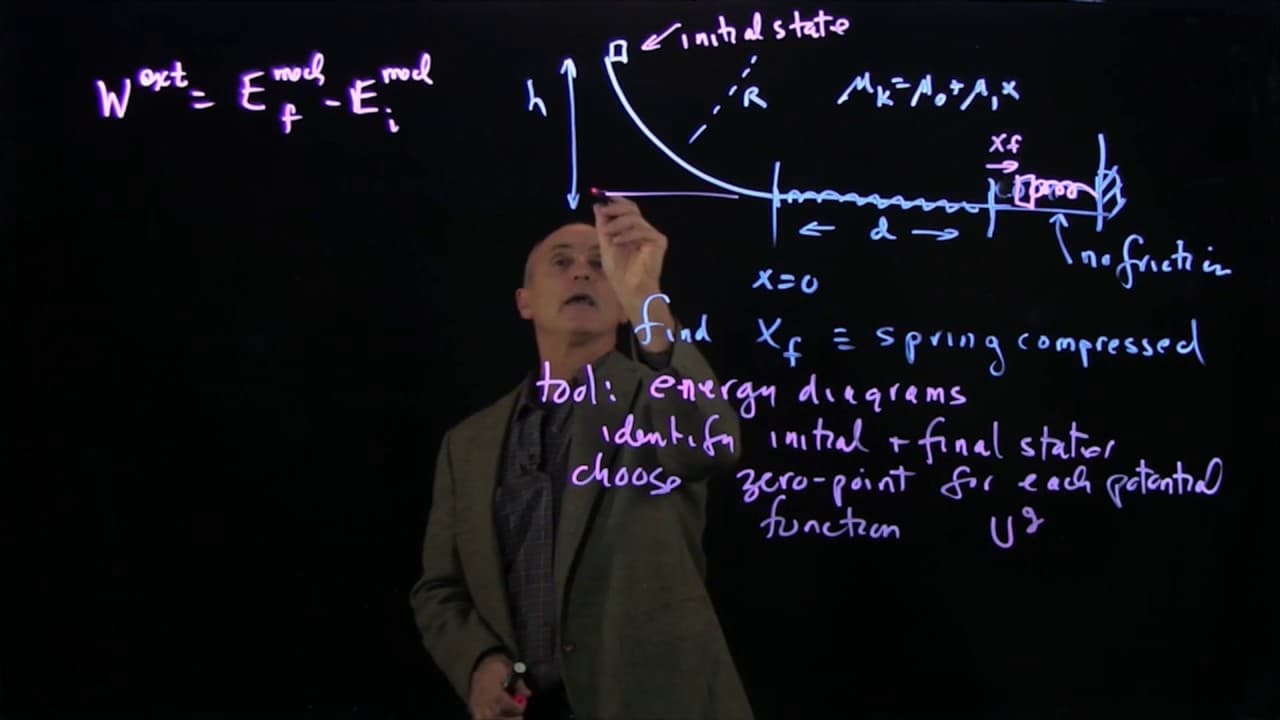
Let's consider an example of motion, in which we want to use our energy concepts. So suppose we have a ramp which is circular, radius r. And we have an object here. And now, here's a surface a certain distance, d, that has friction, where the coefficients of friction is non-uniform. So we'll write it mu-0 And we'll write it as mu-1x. We'll take x e... Read More
Key Insights
- 😥 Energy diagrams and reference points are essential tools for analyzing motion and energy changes in a system.
- 💦 The external work is equal to the change in mechanical energy in the system.
- 🗺️ The friction force can be calculated by integrating the coefficient of friction over the distance traveled.
Install to Summarize YouTube Videos and Get Transcripts
Explore YouTube Video Summarizer or Get YouTube Transcript Extractor
Questions & Answers
Q: What tools are used to analyze the motion and energy in the example?
The tools used in the analysis are energy diagrams, which help identify initial and final states, and reference points for potential energy functions.
Q: How is the compression of the spring determined?
The compression of the spring is determined by solving a mathematical equation that considers the initial gravitational potential energy, external work, and the friction force integrated over the distance.
Q: Why is the friction force described as non-uniform?
The friction force is described as non-uniform because the coefficient of friction varies along the distance traveled by the object.
Q: What is the purpose of choosing reference points for potential energy functions?
Choosing reference points allows us to measure the potential energy related to gravity and the spring, with zero points established at specific positions to simplify the calculation of energy changes.
Summary & Key Takeaways
-
A circular ramp with a friction surface and a spring is used as an example for analyzing motion and energy concepts.
-
The analysis involves using energy diagrams to identify initial and final states, as well as selecting reference points for potential energy functions.
-
The external work is equal to the change in mechanical energy, which includes gravitational potential energy and the potential energy of the compressed spring.
Read in Other Languages (beta)
Share This Summary 📚
Summarize YouTube Videos and Get Video Transcripts with 1-Click
Try YouTube Summary with ChatGPT & Claude or YouTube Transcript Generator
Explore More Summaries from MIT OpenCourseWare 📚



Summarize YouTube Videos and Get Video Transcripts with 1-Click
Try YouTube Summary with ChatGPT & Claude or YouTube Transcript Generator